How to Audit Your Domain Portfolio for Better Investment Decisions
At some point, most investors stop knowing exactly what they're holding. Renewal season is when that becomes expensive.
Every renewal is a decision to reinvest, and your overall domain value helps determine where that capital should stay. Some domains earn that decision without debate. Others have already been listed and priced. The names that deserve your attention are the ones in between: domains you bought with conviction, renewed out of habit, and haven't reassessed since. That's where most carrying costs hide.
The easiest way to evaluate those decisions is to value the portfolio as a whole instead of reviewing one domain at a time. This article shows you how to value an entire portfolio, interpret the results, and turn them into four practical decisions: list, hold, investigate, or drop.
What Does a Neglected Portfolio Actually Cost You?
Neglect leads to capital misallocation. Each renewal extends yesterday's investment decisions, whether they still reflect today's market or not.
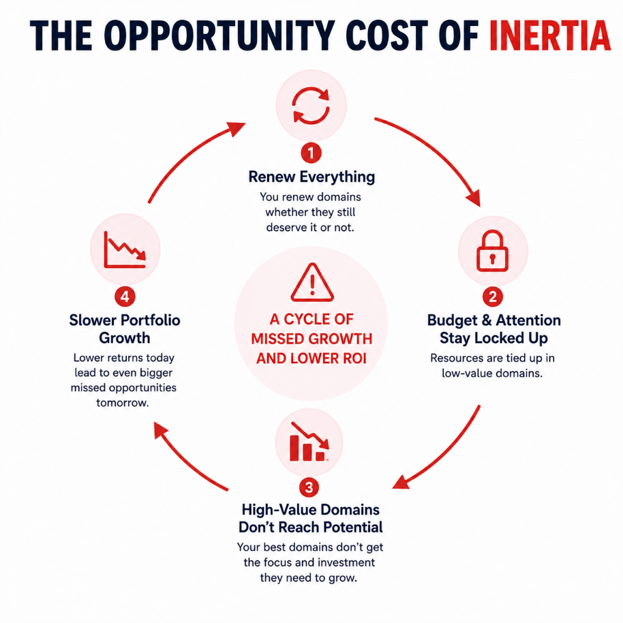
That becomes expensive as a portfolio grows. For a 100-domain portfolio, you’d end up spending $1,000 to $2,000 a year renewing names that no longer justify the cost, while giving stronger domains the same routine treatment instead of closer attention.
That's why a regular portfolio review is necessary – you can reset your decisions before another renewal cycle begins. In many portfolios I’ve analyzed, a major portion of active renewals sit below the domain's estimated market value.
This means the domains are quietly costing more to hold than they're likely to return.
What Data Makes a Domain Name Estimate Reliable?
The most useful valuation answers the same question you're trying to answer. For a portfolio review, that question is simple: does this domain still deserve capital?
Answering that requires market evidence. Comparable sales tell you what buyers have actually paid for similar domains. That makes them far more useful for renewal decisions than isolated opinions or arbitrary scoring systems.
That's the thinking behind Bishopi's Domain Value Analysis.
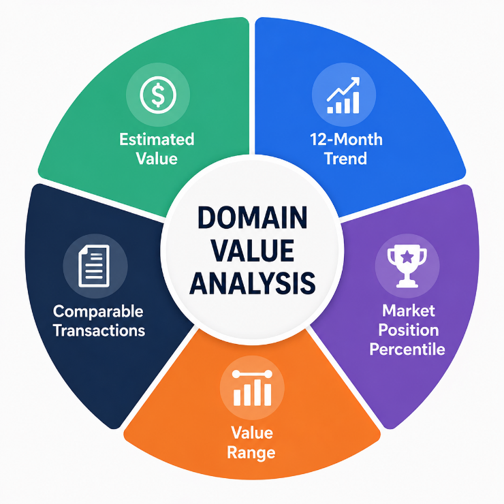
Every domain name estimate is built from more than 3 million verified domain sales across marketplaces including GoDaddy, Sedo, and Afternic. Unlike score-based tools that return a number without explanation, every estimate traces back to specific transactions you can review directly — so you can judge the confidence level yourself.
The model compares domains with similar keywords, length, TLD, and historical sales patterns to produce an estimate grounded in actual market activity. Most free valuation tools either rely on thin proprietary scoring or pull from a fraction of the market.
The difference here is the comp pool — 3 million verified transactions is large enough that most keyword categories return meaningful comps rather than directional guesses.
Data Point | What It Is | How to Use It |
Estimated value | Market-rate estimate based on comparable sales | Use it as your starting point for pricing and portfolio decisions. |
Value range | The spread of comparable sales supporting the estimate | Narrow ranges generally indicate stronger pricing confidence. |
Market position percentile | Where the domain ranks against similar names | Higher-percentile domains often deserve active listing or renewal priority. |
12-month sales trend | Whether comparable sale prices are rising, stable, or falling | Read alongside the valuation to understand market direction. |
Comparable transactions | The sales records behind the estimate | More comparable sales generally increase confidence in the estimate. |
The analysis is intentionally focused on market value. It doesn't include traffic, backlinks, or SEO metrics because those answer a different question. If you're deciding whether to buy, hold, list, or drop a domain, comparable sales provide the evidence that matters most.
The market position percentile is particularly useful when reviewing a portfolio rather than an individual domain. It shows how a domain compares with others in its category.
A domain in the top 20% deserves closer attention than one in the bottom 20%, especially when supported by a strong estimated value and a rising sales trend. When you're reviewing dozens of renewals, the percentile helps you identify which names deserve active selling and which are candidates for removal.
How Should You Run Your Domain Portfolio Review?
Once you know what the data shows, the next question is how to actually run it across a full portfolio without it becoming a week-long project. The workflow is three steps.
Step 1: Compile your domain list
Export every domain you're actively renewing into a single list. Include parked domains, listed domains, and names you haven't looked at in years. A portfolio review only works when every renewal decision is evaluated together.
Step 2: Run valuations in Bishopi
Run the list through Bishopi's Domain Value Analysis. Each domain returns an estimated value, value range, market position percentile, 12-month sales trend, and comparable transactions using the same market methodology.
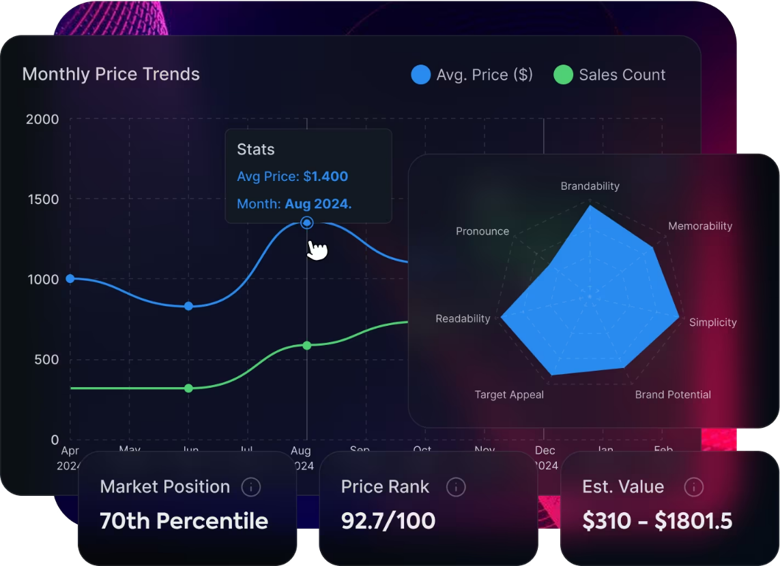
If your portfolio is larger than you'd comfortably review in the browser, the Bishopi Domain Tools APIs support the same workflow in bulk.
Step 3: Export and sort
Export the results and sort them by estimated value, highest to lowest. Then add one more column with the annual renewal cost for each domain — .com runs roughly $10–12/year, .io roughly $30–40/year.
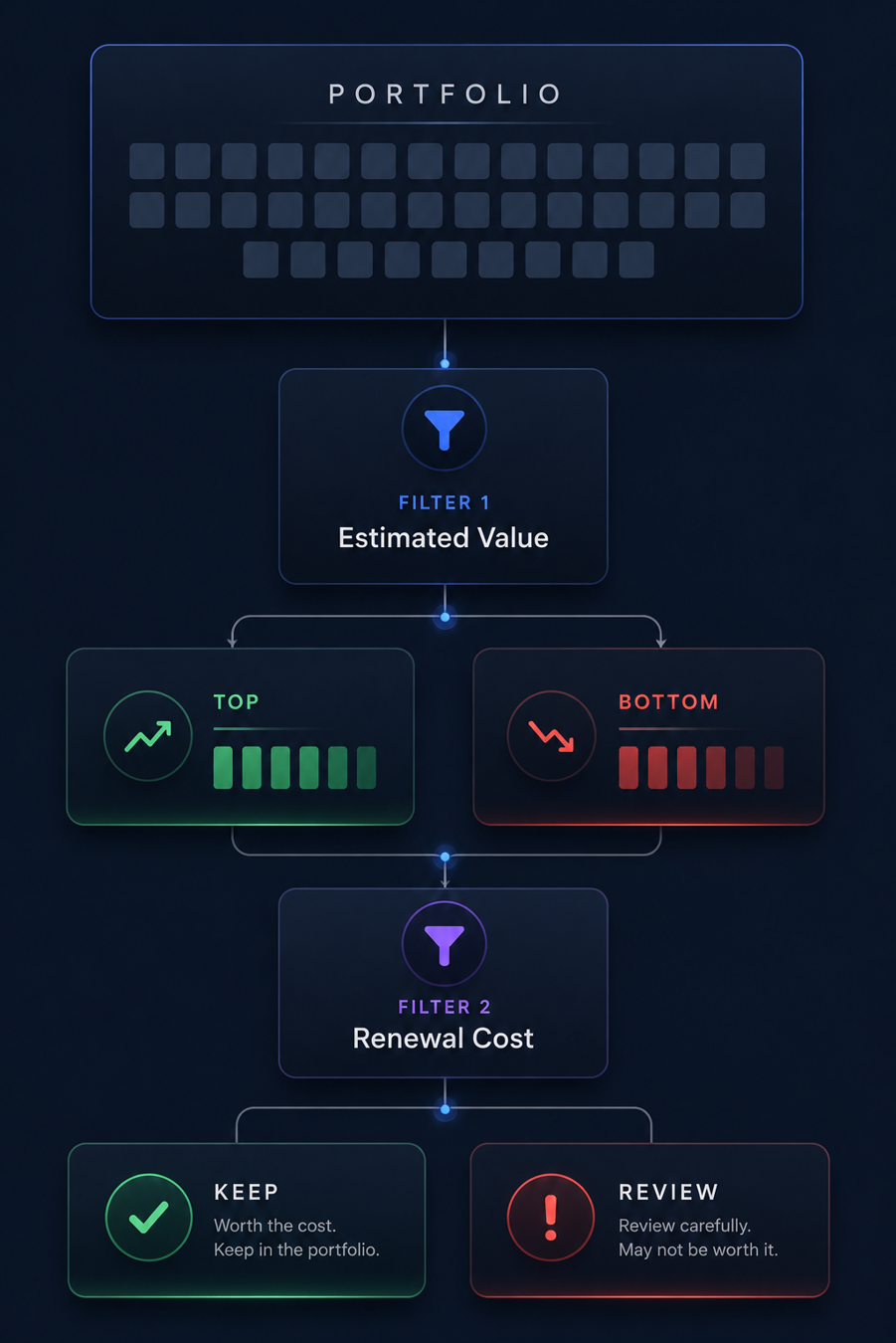
That double sort usually changes the conversation.
Sorting by estimated value usually confirms what you already know about your best domains. The real value of the exercise lies in everything below them. That's where you'll uncover overlooked opportunities alongside domains you've been renewing out of habit. Most portfolios gain the most from decisions made in that middle tier.
How Do You Sort Domain Value Into Categories?
Most mature portfolios follow the same pattern. Your strongest domains are usually obvious, and the weakest rarely require much debate. The investment decisions that deserve your attention sit in the middle, where domains continue renewing without a fresh look at whether they still justify the capital.
That's where a simple decision framework becomes useful.
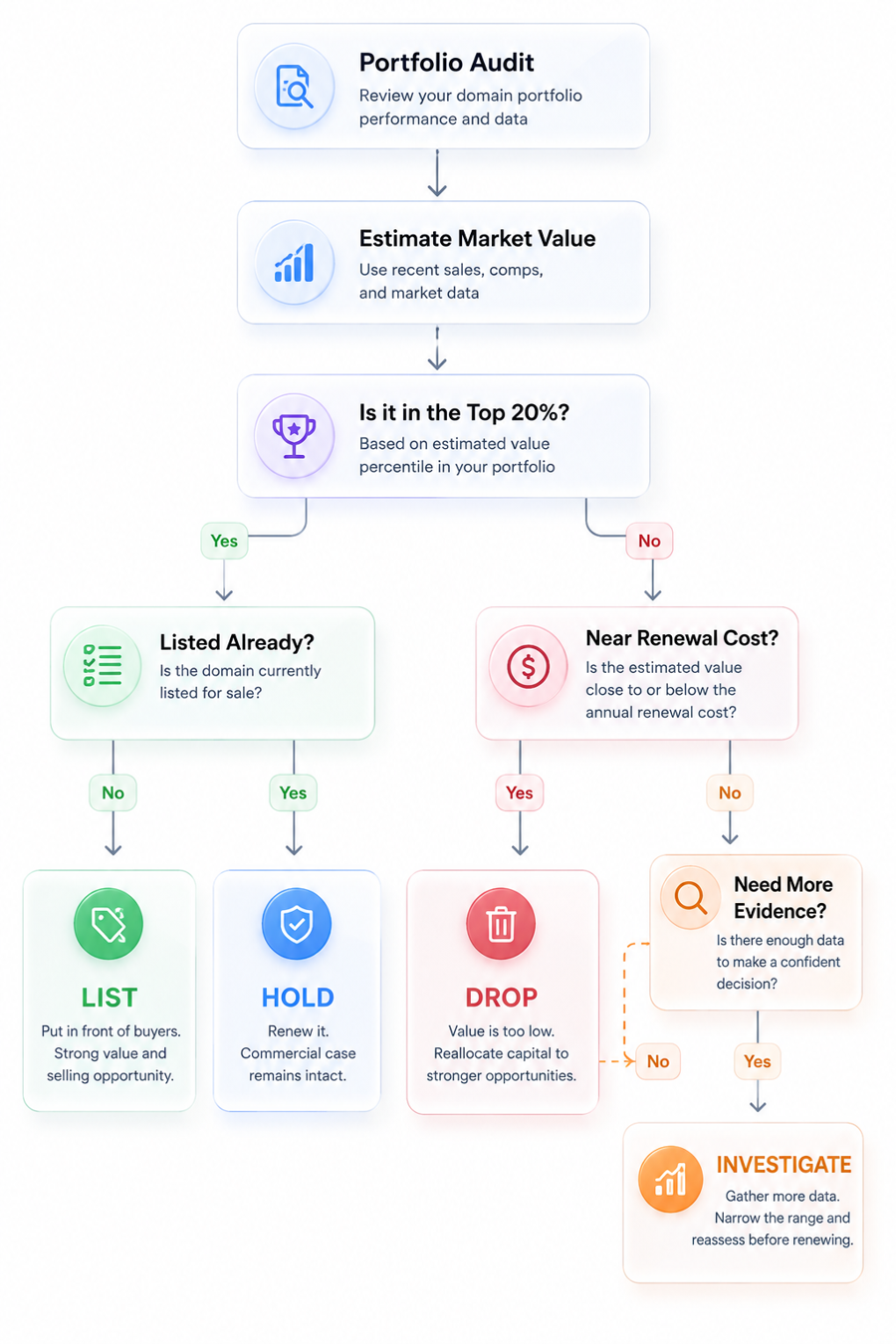
Start by sorting the portfolio by estimated value and market position percentile. Domains clustered in the top 20% usually become your listing priorities, while those near the bottom 20% deserve a closer look before another renewal.
From there, every domain naturally falls into one of four categories.
List: The market supports the investment. Put the domain in front of buyers.
Hold: The commercial case remains intact. Renew it and review it again at your next portfolio audit.
Investigate: The market has left unanswered questions. Gather more evidence before making the call.
Drop: The domain has reached the end of its investment case. Reallocate the capital to stronger opportunities.
Use these categories as a decision framework rather than fixed rules. Your renewal costs, holding period, and investment strategy should always shape the final call.
Domain | Est. Value | Value Range | Trend | Suggested Action |
seotools.com | $12,400 | $10,500–$14,200 | ↑ Rising | List for sale — top 20% of portfolio |
rankcheck.io | $3,200 | $2,700–$3,800 | → Stable | Hold — renewal worth it at current value |
keywordspy.net | $890 | $700–$1,100 | → Stable | Hold or list at a competitive price |
serpdata.co | $560 | $420–$700 | ↓ Falling | Investigate before the next renewal |
linkanalyse.de | $310 | $200–$420 | ↓ Falling | Drop unless there's a strategic reason to hold |
seo-audit.net | $180 | $100–$260 | ↓ Falling | Drop — value below renewal cost |
1) List: Put your strongest domains in front of buyers
Pay particular attention to domains that rank in the top 20% of your portfolio by estimated value but aren't currently listed. A high market position percentile combined with a rising sales trend is often a signal that the market is stronger than your current selling strategy. Those are the domains worth prioritising for active outreach or marketplace listings.
2) Hold: Review the market, not just the renewal date
Some domains continue earning another year of capital because demand remains healthy and the commercial case still holds. Those decisions rarely need much debate today.
But also keep in mind that stable doesn't mean permanent. Review these domains during your next portfolio audit because a stable market today can become a rising or falling one over the next renewal cycle.
3) Investigate: Fill the gaps the market leaves behind
Wide value ranges and a small pool of comparable sales leave room for interpretation. The valuation narrows the possibilities; your research finishes the job.
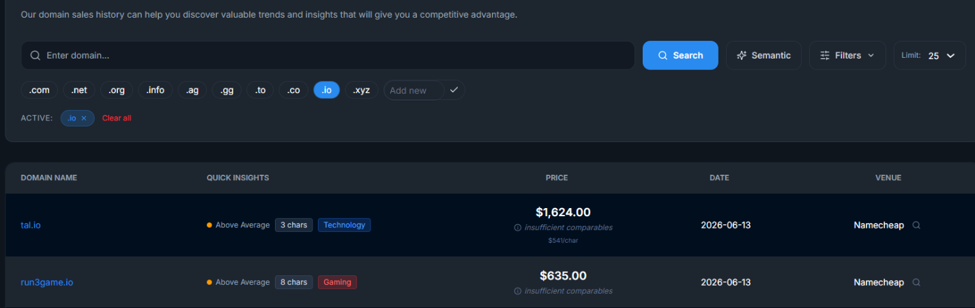
Review comparable sales in Bishopi's Domain Sales History tool and consider whether there's a realistic end user who would pay a premium for the name.
4) Drop: Reallocate capital with intention
Every renewal commits another year of capital and some domains have already delivered everything they're likely to deliver.
It doesn’t matter if you’re attached to a name you've held for three years. What you need to focus on is whether the current market supports another twelve months of carrying cost.
Domains whose estimated value sits close to or below the annual renewal cost deserve the closest scrutiny, especially when comparable sales are trending downward. At that point the exit math doesn't work: you're holding a depreciating asset at a loss, with no realistic buyer at a price that recovers the investment.
That said, not every domain in this category is an immediate drop. A clear strategic buyer, an active outreach pipeline, or a category with known seasonality can all justify one more renewal cycle. What's not justified is the automatic renewal – the one that happens because you forgot to review.
Understanding Your Domain Portfolio: How Do You Turn the Data Into Action?
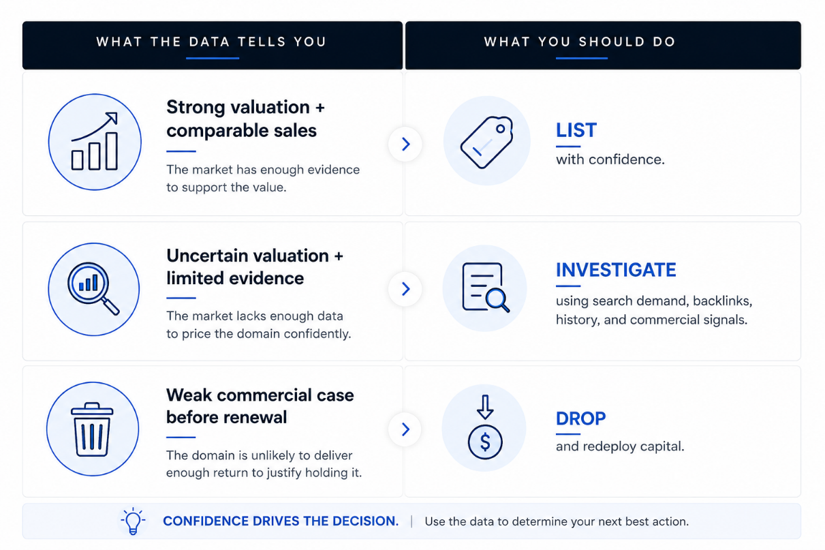
Categories are only useful if they produce action before the next renewal cycle closes the window. Here's what to do with each one.
Step 1: List with Market Context
Start with the valuation, then review recent comparable sales in Bishopi's Domain Sales History tool. The valuation provides your starting point, while comparable transactions help you judge whether your asking price is realistic.
Once you've set a price, choose the marketplace that best fits the domain. Generic .com domains often perform well on Afternic, international names may be better suited to Sedo, and mid-market domains can also be listed on Dan.com.
Step 2: Investigate with Better Evidence
A wide valuation range or a lack of comparable sales is usually a signal that the market doesn't have enough evidence to price the domain confidently. That's when you need to look beyond the estimate.
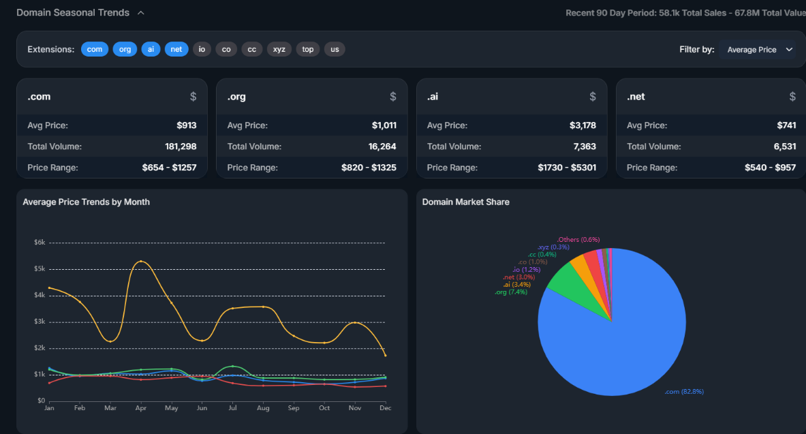
Use Bishopi's market data to understand what the valuation can't tell you. Review market trends, seasonal trends and other commercial signals to assess whether the name has genuine long-term value or simply lacks recent sales data.
Then apply your own judgment. Ask whether a business would realistically pay a premium for the domain and whether its commercial potential is supported by the underlying data.
Automated valuations are an excellent starting point, but the best acquisition decisions come from combining market evidence with investor experience.
For deep individual analysis on domains flagged for investigation, read our Sales History API article.
Step 3: Drop Deliberately
Review every drop candidate around 60 days before renewal. That's usually enough time for one final market check without drifting into another automatic renewal. If the commercial case hasn't improved, release the capital and put it to work elsewhere.
Remember that every valuation is a market benchmark, not a guaranteed sale price. A domain is ultimately worth what the right buyer is willing to pay at a given time.
The final sale price depends on factors no automated model can fully measure, including buyer intent, negotiation, timing, and marketplace exposure. The strongest sales happen because a buyer sees strategic value in owning the domain, not simply because the domain has resale value.
How Often Should You Run a Portfolio Review?
One review tells you what the portfolio looks like today. The next one tells you whether your decisions are improving.
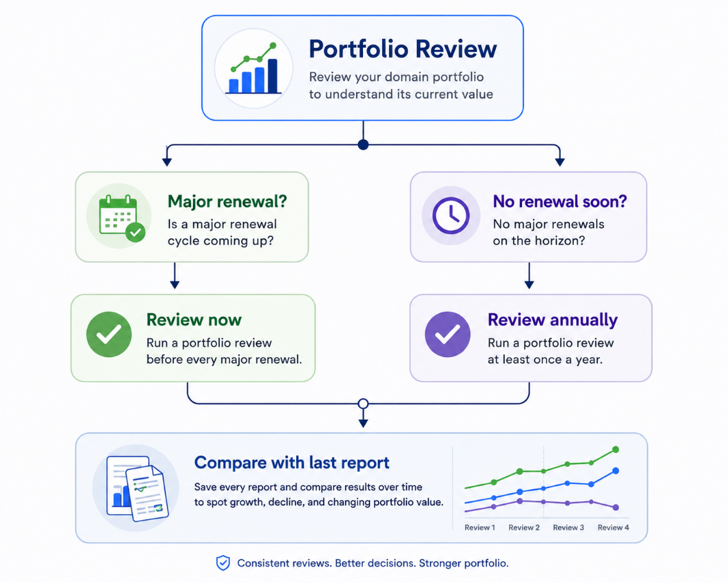
That's why portfolio reviews work best as a recurring habit rather than a one-time exercise. Run the same review before every major renewal cycle, or at least once a year.
And don’t forget to save each report. Over time, the comparison becomes as valuable as the valuation itself because it shows how both the market and your portfolio are changing.
Start With Your Full Portfolio
Your portfolio reflects every acquisition and every renewal decision you've made so far. Most investors are surprised by what a portfolio-level review surfaces -- names they'd forgotten about that have quietly appreciated, and renewals they've been funding on autopilot for years.
Running the numbers once, across the whole list, changes both problems at the same time.
Ready to review your portfolio? Run it through Bishopi's Domain Value Analysis — no account needed for individual lookups, and most portfolios get a full read in under five minutes. If you're managing larger portfolios, the Bishopi Domain APIs support the same workflow in bulk.
Frequently Asked Questions
1. How accurate are Bishopi's portfolio valuations?
Bishopi's Domain Value Analysis estimates market value using more than 3 million verified domain sales. The estimates are market benchmarks based on comparable sales, not guaranteed sale prices.
2. How often should I run a portfolio review?
At least once a year, or before every major renewal cycle. If you're actively acquiring domains, quarterly reviews provide a better view of changing market demand. Save each export so you can compare valuations year over year — the trend across two reviews tells you more than any single snapshot.
3. What domains should I drop from my portfolio?
Start with domains whose estimated value is close to their renewal cost and whose market outlook has weakened. A useful final check is simple: would you buy the domain again today?
4. Is Bishopi's Domain Value Analysis free?
Yes. The tool includes free usage limits, with paid plans and API access available for larger portfolios.
5. Can I value hundreds of domains at once?
Yes. You can start with Bishopi's Domain Value Analysis for standard portfolio reviews – no technical setup needed. If your portfolio grows beyond what you'd comfortably review in the browser, the Bishopi Domain APIs let you run the same valuations in bulk.
Originally published at: bishopi.io
Stay up to date
Get updated with all the news, update and upcoming features.