10 Real SEO API Use Cases: What Developers Are Building Today
Most SEO API documentation tells you what data APIs return, not what people are actually building with that data.
If you are evaluating an API for SEO software projects, building internal SEO infrastructure, or adding search data into an existing SaaS product, the challenge is not finding data. It’s turning that data into something useful, whether it’s a dashboard, an automation workflow, a reporting layer, or a product feature.
This article covers 10 things developers are actually building using SEO APIs. These are not hypothetical ideas but established software categories where APIs provide the underlying search data layer. The endpoints referenced in each use case are available via Bishopi's SEO API.
What Does a Modern SEO API Provide?
A modern SEO API provides structured access to search engine data that developers use to build applications, dashboards, automation pipelines, and internal tools.
The API replaces manual exports and browser-based workflows with machine-readable data. Instead of an analyst checking rankings every morning, a backend service can request ranking data, store historical changes, and trigger alerts automatically.
A heads up: An SEO data API is a programmatic interface that returns structured search engine optimization data directly to your applications.
Instead of manually scraping results or logging into dashboards, you query the API in code and receive structured JSON responses that scale from single requests to millions of queries daily.
Developers use this data to build SEO software, rank trackers, automated audit tools, reporting systems, analytics dashboards, and automation workflows.
Here is the data endpoint categories modern search engine optimization APIs return:
Endpoint Category | Core Data Fields Returned | Primary Use Cases |
Keyword data | Search volume, keyword difficulty (KD), related keywords, SERP features triggered, search intent | Content planning, gap analysis, and keyword research tools |
Rank tracking | Keyword position, device type (desktop/mobile), geographic location, historical position delta, rank change | Rank tracking dashboards, position monitoring, and rank recovery alerts |
SERP data | Full SERP results, URLs ranking, titles, and snippets, SERP feature flags (featured snippet, AI Overview, PAA, knowledge panel, local pack), cited URLs | SERP feature monitoring, visibility tracking, and competitive analysis |
Backlinks | Source domain, anchor text, domain authority, follow/nofollow status, spam score, first crawl date, link delta (new/lost) | Backlink audits, toxic link detection, link monitoring, and competitive link research |
On-page SEO | Title tag, meta description, H1, canonical tag, robots directives, page speed signals, structured data presence, and schema type | Site audit tools, technical SEO crawlers, quality scoring, indexability analysis |
Domain overview | Estimated monthly organic traffic, domain authority (DA), total backlink count, top keywords by traffic, and brand mentions | Lead generation/prospecting, domain scoring, competitive sizing, CRM enrichment |
Local SERP | Location-parameterized search results, Google Business Profile presence, local pack listings, NAP consistency data | Local SEO monitoring, multi-location tracking, and local pack positioning |
AI Overview data | AI Overview presence flag, cited URLs within AI Overview, AI Overview position on page, AI Mode response availability | AI visibility tracking, citation monitoring, and modern CTR forecasting |
Modern APIs for SEO differ from older providers in three critical ways:
Data freshness: Modern SEO APIs update rank and SERP data daily, with data available within 24 hours of collection, unlike legacy providers that refresh monthly or quarterly. At monthly refresh rates, you can't build tools that react to real-time changes.
API-first architecture: These APIs return data as JSON, with consistent response schemas and optional filtering/sorting parameters, not parsed HTML pages or spreadsheets.
Feature coverage for AI overviews and zero-click searches: Recent research shows that AI Overviews are reshaping organic search behavior. A 2026 Seer Interactive study found that cited pages achieved substantially higher CTRs than uncited pages. Legacy SEO tools that don't include AI Overview presence flags, and citation data are insufficient for a modern SEO strategy. Modern APIs now prioritize this data as a core offering.
Bulk operations and batch requests: With modern APIs, you can submit 100+ domains or 500+ keywords in a single request, not one-at-a-time queries. This makes them ideal for rank tracking at scale, bulk audits, and prospecting workflows.
Data is AI/LLM ready: Data is structured for consumption by LLMs and AI systems, not just traditional dashboards. Response includes feature flags, entity extraction, and clean JSON schemas.
Modern SEO APIs can expose large datasets, but you need to select the right signals for each workflow. Having visibility into endpoint coverage and available fields makes it easier to plan integrations and avoid collecting unnecessary data. You can explore Bishopi API endpoints and data fields to see how these data categories are structured.
What SEO Tools Are Developers Building with APIs Right Now?
Modern developers are not using SEO APIs just to display keyword numbers. They are building complete SEO products around search data, including:
1. Rank Tracking Dashboards
Rank tracking dashboards are applications that pull keyword position data via an API on a schedule, store the position history, and display it in a UI your team owns, whether that's a web dashboard, Looker Studio report, Google Sheets script, Slack notification bot, or internal visualization.
Instead of manually checking rankings, developers are building rank trackers that monitor thousands of keywords, store historical movements, and surface changes automatically.
Why build it?
Traditional rank tracking platforms typically scale pricing based on the number of tracked keywords, domains, users, and data requirements. For example, Semrush's Pro plan starts at $139.95/month and includes tracking for up to 500 keywords. Ahrefs’ Lite plan starts at $129/month and includes 750 tracked keywords.
For agencies managing hundreds of keywords across dozens of client domains, costs can quickly increase from hundreds to several thousand dollars per month, especially when advanced reporting, API access, and higher tracking limits are required.
Building an in-house rank tracker can eliminate that cost at scale and, more importantly, give you ownership of your ranking data. You can integrate it into your own client reporting, feed it into proprietary alert systems like Slack, correlate it with your own event data, or combine it with proprietary workflows that commercial tools don't support.
Bishopi API data required
To build a custom rank tracker, you’ll need:
Keyword rank endpoint (position, URL, SERP features present, device, location)
Historical rank data
Rank change delta
Rank tracking is one of the most established SEO API use cases because every SEO team needs visibility into how keywords move over time.
Pull historical rank positions for a keyword set at scale via the Bishopi rank tracker API, store positions in a database, whether it’s PostgreSQL, Firebase, or a simple JSON file, and render a line chart showing position over time.
The API provides position, rank change deltas, and SERP feature data. You can scale keyword research with the same code.
2. Automated Site Audit Tools
An on-demand or automated site audit tool crawls a domain, returns technical SEO issues, and generates a report or alert without requiring a user to manually inspect pages. Unlike commercial tools, you're not buying the audit vendor's database. You're using an API to run the analysis on demand and surfacing results in your own system.
You can build these systems into dashboards, SaaS products, website builders, and agency platforms. A typical audit workflow checks hundreds or thousands of URLs and displays a domain’s technical health score plus a list of actionable fixes.
Why build it?
White-label SEO audits are table stakes for agencies and technical teams. Many SaaS platforms, including website builders, CMS, and hosting control panels, embed site health checks as a feature. Rather than licensing a commercial auditing platform, you can run audits on demand via API and embed the results directly in your product UX.
Bishopi API data required
On-page SEO data endpoint
Page speed data
Structured data presence
HTTP status codes
Crawl metadata
For a true crawl-based audit, you also need the ability to submit a domain and get back all onsite URLs (a site crawl endpoint), not just per-URL analysis of URLs you already know about.
Screaming Frog, Sitebulb, DeepCrawl, and similar tools are a proven category because SEO teams need automated ways to monitor site health across large websites. But many developers build lighter versions, such as Lighthouse-based audits, endpoint-based audits that feed into their own dashboards without the overhead of a commercial crawler.
To get started, submit a domain via the Bishopi SEO API, get back on-page SEO data on each page, store results in a database, and generate a report showing the top 10 issues by impact.
3. SERP Feature Monitors
A SERP feature monitor tracks not just whether you rank for a keyword, but whether that query triggers additional search features beyond the standard blue links. Developers build these systems to detect SERP elements like this:
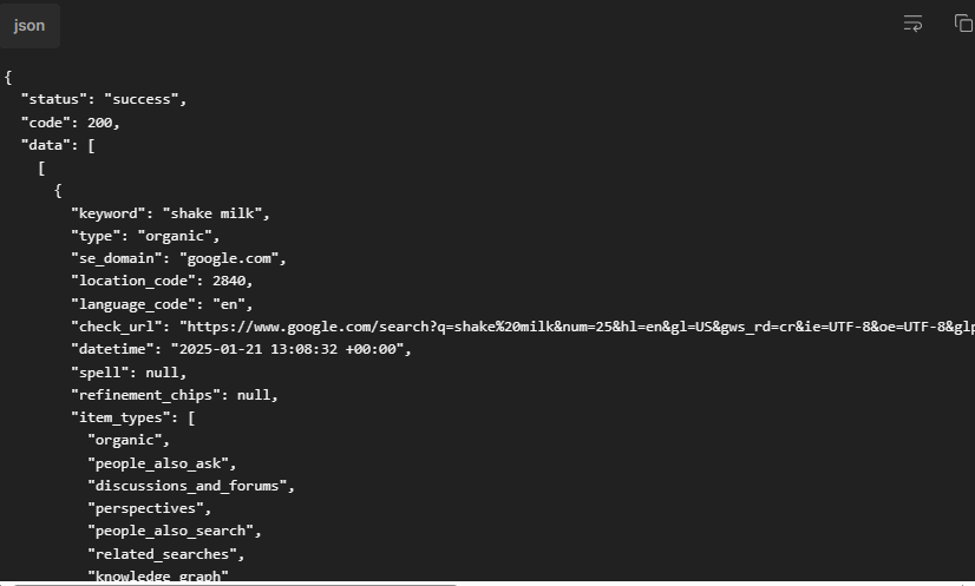
Source: Bishopi SERP API response
The difference matters because ranking position alone does not tell the full story. A website ranking in position three may receive less visibility than a page appearing inside a Featured Snippet or being cited inside an AI-generated result.
Why build it?
Search results are becoming more dynamic. A keyword position is only one visibility signal, and developers building modern SEO platforms need richer SERP intelligence.
Many existing rank trackers focus primarily on positions. Developers create custom SERP monitoring layers when they need additional signals:
Is an AI Overview appearing?
Which URLs are cited?
Does a competitor own the Featured Snippet?
Did a SERP layout change?
Are new search features reducing organic clicks?
Bishopi API data required
A SERP feature monitoring system typically requires:
SERP data endpoint: full SERP structure for each keyword
Feature presence flags: featured_snippet_present, ai_overview_present, knowledge_panel_present, paa_questions_count, local_pack_present, shopping_carousel_present
Cited URLs per feature: which domains are linked/cited in each feature
SERP element positions: where on the page features appear
Advanced rank trackers like Semrush's position tracking and newer players like Rank Ranger and BrightEdge have this built in. But solo developers building vertical solutions, such as feature monitoring for a specific industry, often build dedicated tools.
For a keyword set, fetch the SERP data endpoint from Bishopi SERP API, log which features are present, and alert when new features appear or disappear.
4. Backlink Monitoring and Toxic Link Detection
An automated backlink auditing tool runs on a schedule, pulls a domain's link profile via API, scores new links for quality/toxicity, and alerts when toxic or spammy links are acquired.
Developers build these tools to monitor new backlinks, lost links, competitor link growth, and potentially harmful referring domains.
Instead of manually reviewing backlink reports, automated systems continuously process link data and create alerts.
Why build it?
Backlinks remain a major part of search visibility analysis, but monitoring them manually can be difficult at scale.
An agency managing hundreds of client websites cannot realistically check every backlink profile every day. Developers build automated pipelines that detect meaningful changes and route them into dashboards, alerts, or reporting systems.
The same applies to internal SEO teams. They may want backlink events connected to Slack notifications, internal analytics, or customer reporting systems.
A good backlink API removes the need to maintain a crawler and link index internally.
Bishopi API data required
A backlink monitoring platform typically needs:
Backlinks endpoint
New/lost links delta
Link history
Automated backlink monitoring is a standard SEO workflow used by commercial SEO platforms such as Majestic, Linkody, and Monitorbacklinks for businesses that need ongoing visibility into their link profile. But agencies also build internal versions, usually as Slack bots or APIs that automatically flag new toxic links.
Pull new backlinks for your domains via the Bishopi backlinks API on a schedule, compare against yesterday's link profile, identify new acquisitions, score them by domain authority/spam signals, and alert if suspicious. Store link history in a database; over time, you can trend link acquisition by source quality.
The API returns domain authority, spam score flags, link quality, and toxic and spammy links:
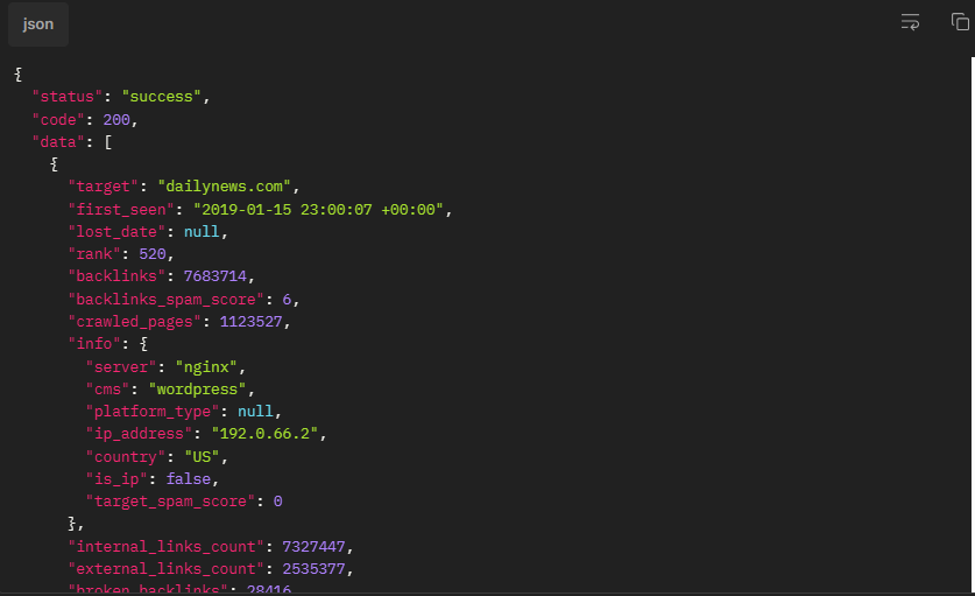
Source: See the Bishopi backlinks API documentation for the full response structure
This information helps score link quality and identify disavow candidates.
5. Keyword Research and Content Gap Tools
Keyword research systems turn search data into content opportunities. These tools accept a seed keyword, website, or competitor domain and return related keywords, ranking opportunities, search volume data, and content gaps.
Meanwhile, a content gap workflow identifies keywords that competitors rank for that a target website does not. The application then turns that information into editorial recommendations.
These systems are commonly integrated into content platforms, publishing workflows, and marketing dashboards.
Why build it?
Embedding keyword research into a content platform, CMS, or editorial planning tool creates significant product value. Rather than forcing users to context-switch to an external keyword research tool, you can surface keyword data directly in their workflow.
Bishopi API data required
Keyword research tools typically require:
Keyword data endpoint
Ranking URLs endpoint
Competitor keyword overlap
Search intent classification
SERP feature data
Content optimization platforms such as Clearscope, MarketMuse, Frase, Surfer, and Semrush's Keyword Gap have long used keyword intelligence and competitor analysis data as core infrastructure for planning and improving content. But solo developers and content agencies often build lighter versions that feed into internal content calendars.
Submit a competitor domain to Bishopi SERP API, get back their top ranking keywords, compare against your domain's keywords, and identify the gap.
6. White-Label SEO Reporting Platforms
White-label SEO reporting platforms collect SEO data from multiple API endpoints, transform it into client-facing reports, and deliver the results through branded dashboards, PDFs, or customer portals.
Developers build these systems because SEO reporting is rarely just one metric. A useful client report usually combines ranking changes, backlink growth, technical issues, SERP visibility, and traffic-related indicators into a single view.
Instead of logging into multiple SEO platforms, users receive a unified reporting experience built around their own workflow.
Why build it?
Agencies and SEO service providers need reporting systems that match how they operate.
A generic reporting product may not support a specific agency’s requirements, client permissions, branding, pricing model, or internal processes. Developers often create custom reporting layers that pull SEO data from APIs and transform it into exactly what clients need.
For SaaS companies, reporting is also a common product feature. A website platform, marketing tool, or analytics application may add SEO reporting without building its own search data infrastructure.
This is where API-based architecture becomes valuable. The application owns the interface and business logic, while the API provides the underlying SEO data.
Developers often store raw API responses and create their own reporting tables to calculate trends over time.
Bishopi API data required
A white-label reporting system usually combines several API endpoint categories:
Rank tracking data
Backlink data
On-page SEO data
SERP visibility data
AgencyAnalytics, DashThis, Supermetrics, and similar platforms are essentially white-label API aggregators, but independent developers build equivalents for specific niches or client types.
Build a report generator that pulls a client's rank data, backlinks, and audit results from Bishopi, compiles them into JSON, and uses a templating engine to render an HTML or PDF report. Start with a monthly PDF; extend to real-time dashboards and white-label portals.
Bishopi's API documentation includes code examples for multi-endpoint calls, which are essential for batching report data efficiently.
7. AI Overview and AI Mode Visibility Trackers
A tool that detects when a keyword triggers Google's AI Overview, identifies whether your domain is cited in that overview, and tracks how AI Mode responses reference your brand or topic over time.
Traditional SEO reporting focused on rankings and clicks. AI-driven search changes the tracking problem: a page might not rank number one, but could still appear as a cited source inside an AI-generated answer.
Developers are building tools that detect:
Whether a query triggers an AI Overview
Which websites are cited
Which URLs appear in AI responses
How visibility changes over time
Why build it?
AI Overviews and AI Mode now affect organic CTR for a significant share of queries, yet standard rank trackers don't capture citation status, but developers building modern SEO tooling need structured AI search data, not just traditional keyword positions.
This is also why the market for AI SEO software is expanding beyond content generation. Developers are building infrastructure that measures how brands appear in AI-driven search.
Bishopi API data required
AI visibility tracking requires:
AI Overview presence flag: whether a query triggers an AI Overview
Cited URLs in AI Overview: which domains are linked/cited in the AI response
AI Overview position: where on the page it appears
AI Mode response summaries: where available, the actual AI-generated response text or summary
Semrush includes a position tracking feature and the Semrush sensor to monitor AI Overviews. You can see if your website is featured as a source within the AI answer.
DataForSEO provides integration for developers through its SERP API and AI optimization API. Their system retrieves structured JSON data that identifies which websites are cited in AI responses and exactly where they rank.
Meanwhile, Bishopi combines basic SERP and rank tracking with domain indicators and monitors specific SERP features, allowing users to keep an eye on modern AI-driven search environments.
8. Lead Generation Tools Using SEO Data
SEO-powered lead generation tools use search data to identify potential customers based on website quality, visibility, and technical performance.
Developers build prospecting systems that analyze domains and score opportunities. Instead of manually reviewing websites, sales teams receive prioritized leads based on SEO signals.
A tool might identify companies with:
Poor technical SEO
Declining rankings
Weak backlink profiles
Missing optimization opportunities
The output becomes a sales intelligence layer for agencies or SEO service providers.
Why build It?
SEO agencies constantly need qualified prospects.
Manual prospect research does not scale. A developer can automate the process by collecting SEO signals, scoring domains, and sending promising opportunities into a CRM or outreach system.
The important part is that the tool is not just collecting company names. It is using SEO data as qualification logic.
Bishopi API data required
Lead scoring tools typically combine:
Domain authority endpoint
On-page audit endpoint (to flag weak technical SEO)
Rank data (to identify declining-traffic domains)
WHOIS data for ownership/contact info
SEO-driven lead generation is commonly found in sales intelligence and prospecting platforms that combine website analysis with lead qualification. Tools such as Semrush Lead Finder, Apollo.io, and custom agency-built prospecting systems use SEO and website quality signals alongside business data to identify potential clients. Many solo consultants and agencies also build lightweight versions tailored to their own outreach workflows.
9. Local SEO Monitoring Tools
Local SEO monitoring tools track how businesses appear in location-based search results.
Unlike standard SEO tracking, local search depends heavily on geography. A business may rank well in one city and disappear in another.
Developers build local monitoring systems for agencies, franchises, and multi-location businesses that need visibility across many areas.
These tools track:
Local rankings
Map pack visibility
Business profile appearance
Location-specific SERP changes
Why build it?
Local SEO involves a different set of signals and SERP features from standard SEO. Commercial tools for this are expensive at scale. That’s why agencies serving local businesses build lightweight alternatives that track the signals that matter locally.
Bishopi API data required
Local SEO tracking systems require:
Local SERP endpoint
Local pack data
GBP citations
NAP consistency data
Review signals
BrightLocal, Whitespark, Local SEO Pro, and similar tools serve this category. But developers build internal versions; scripts that pull local SERPs for their client locations, track pack presence, and alert on changes.
For a client with 20 locations, access local SERP data via the Bishopi API.
10. SEO Data Enrichment for CRMs and Sales Tools
An integration that enriches a CRM (HubSpot, Salesforce, Pipedrive) or sales intelligence platform with SEO metrics for prospect domains, including domain authority, estimated organic traffic, top keywords, and backlink count. This data surfaces in the sales rep's workflow to enable them to qualify prospects using SEO health as a signal.
Why build it
Sales teams at SEO agencies, hosting companies, web design firms, and digital marketing tools all use SEO health as a qualification signal. Embedding SEO data into the CRM avoids context-switching. Sales reps see SEO metrics directly on a prospect record.
Bishopi API data required
CRM enrichment workflows commonly use:
Domain overview endpoint
Authority metrics
Estimated traffic
Backlink count
Top keywords
Ranking data
Bulk domain lookup capabilities
HubSpot's App Marketplace and Salesforce AppExchange both have SEO data enrichment integrations built by third-party developers. These typically pull domain-level data (DA, traffic estimates) and surface it in a side panel or custom field.
For higher volume, build a custom integration using Bishopi's bulk domain endpoint, sync to your CRM database via API, and update your CRM records nightly.
Bishopi's domain name APIs return all the data you need, including DA, estimated traffic, backlink count, and top keywords.
How Do You Get Started with the Bishopi SEO API?
If you are evaluating an API for SEO software projects, the fastest way to validate an integration is not by reading feature lists. Make your first request and check whether the returned data matches your application requirements.
A typical Bishopi SEO API integration follows a simple developer workflow:
Visit the Bishopi Sign up page and create your account.
Generate an API key.
Authenticate your requests.
Test the required endpoint.
Build your application logic around the response data.
Once you have created your Bishopi account, follow these simple steps:
Get Your API Key
Generate an API key from your dashboard.
You will use the API key to authenticate requests from your application. In production, store the key securely on your backend rather than exposing it inside frontend code.
Your application then sends authenticated requests to the relevant SEO endpoints and receives structured responses that can be processed inside your own system.
Choose the API Endpoints You Need
The endpoint you use depends on what you are building.
For example:
Rank tracking products use ranking endpoints for keyword positions, locations, devices, and historical changes.
SEO audit tools use on-page SEO endpoints for metadata, headings, canonical tags, and technical signals.
SERP monitoring platforms use SERP endpoints for search results, SERP features, and AI visibility data.
Link monitoring tools use backlink endpoints for referring domains, anchors, and link changes.
This modular approach lets you build only the data layer your product requires.
Test Responses Before Building
Before writing your full application logic, test API responses and confirm the fields match your workflow.
Bishopi’s API documentation includes endpoint references, response schema examples, and code snippets so developers can understand request formats and integrate faster.
For production systems, also evaluate:
Rate limits
Response consistency
Data freshness
Request volume requirements
Move From Prototype to Production
Once your integration works, you can connect the API to scheduled jobs, dashboards, automation workflows, or customer-facing products.
Bishopi provides different pricing tiers depending on usage requirements. This is to allow you to start small and scale as your data needs increase.
For developers looking for a free SEO API option to test before committing, Bishopi offers a 7-day free trial across all plans so you can experiment with the available endpoints and validate your build.
Start building with the Bishopi SEO API. Get your free API key here.
FAQ
What Is an SEO API?
An SEO API is a programmatic interface to search engine data. Instead of manually checking search results or using a SaaS platform's UI, you query the API directly in code and get structured JSON responses. This enables you to build custom tools, automate workflows, and integrate SEO data into your own applications.
What can you build with an SEO API?
You can build rank trackers, audit tools, SERP feature monitors, backlink auditing tools, keyword research tools, white-label reporting platforms, AI Overview trackers, lead gen tools, local SEO monitors, and CRM enrichment integrations. You can also build content planning tools, competitive intelligence dashboards, SEO anomaly detection systems, and more.
What is the best API for SEO projects?
There is no best API for everyone. When evaluating APIs for SEO projects, consider factors such as:
Data completeness: Does the API cover all the endpoints you need?
Data quality: How accurate is the data?
Cost and limits: Does the pricing scale with your use case?
Bishopi API, for instance, offers comprehensive rank tracking, SERP feature data, backlink data, and on-page SEO metrics in a single API. It offers well-documented endpoints, the response schemas are consistent, and the free tier gives you real testing ability without cost.
If you're building a niche tool, you might choose a more specialized provider. But for general-purpose SEO tooling, Bishopi covers the full stack.
Is there a free SEO API?
Most production SEO APIs are paid services because collecting and maintaining search data requires significant infrastructure.
However, some API platforms offer a free tier for developers to test before committing.
Bishopi, for instance, provides a 7-day free trial where you can experiment with API features, evaluate response formats, and validate whether the platform fits your project requirements.
What data does the Bishopi SEO API provide?
The Bishopi SEO API provides structured SEO data, including ranking information, SERP results, backlink information, on-page SEO signals, domain metrics, and AI visibility-related data.
The exact endpoint depends on the workflow.
Examples including:
Rank tracking for tracking positions and changes
SERP data for tracking search result features
Backlinks data for tracking referring domains and link signals
Domain overview for tracking DA, estimated traffic, and more
How do SEO APIs handle data freshness and update frequency?
SEO API freshness depends on the provider’s indexing system, update schedule, and the type of data requested.
Some data changes frequently, including rankings and SERP layouts, while other data, such as backlink profiles and domain-level metrics, change more slowly.
When building applications, you should consider how often data needs refreshing and design storage around the update cycle.
What's the difference between a SERP API and an SEO API?
A SERP API focuses specifically on search engine results pages. It returns information such as ranking URLs, search result layouts, featured snippets, SERP features, and AI Overview presence. On the other hand, an SEO API is broader. It may include SERP data plus rankings, backlinks, keywords, domain metrics, and technical website information.
A SERP API is usually one component inside a wider SEO API platform.
Conclusion
SEO APIs give developers the building blocks to create smarter search products without maintaining complex data collection infrastructure.
The opportunity is no longer just tracking rankings; it is building applications that understand how websites perform across modern search experiences.
With one unified API covering rank data, SERP features, backlinks, on-page signals, domain intelligence, and AI Overview tracking, developers can create complete SEO solutions faster. Whether you are building an internal tool or a customer-facing platform, the right data layer makes innovation easier. Explore the Bishopi SEO APIs and start building.
Originally published at: bishopi.io
Stay up to date
Get updated with all the news, update and upcoming features.