Best Domain Marketplaces to Sell Domains in 2026 (Ranked by Real Sales)
The best domain marketplaces to sell domains in 2026 are GoDaddy for liquid .com under $2,000, Namecheap for .ai, and Sedo for premium .com above $5,000. Choice matters: the same .com averages $748 on GoDaddy versus $13,745 on Sedo — an 18x gap on the identical extension.
Where you list a domain determines what you'll earn. We analyzed 97,742 aftermarket sales tracked between October 29, 2025 and April 27, 2026 across 6 active seller-facing marketplaces. All figures below are drawn from Bishopi's own tracked public-sales dataset. This guide ranks every major marketplace, shows how to choose the right one for your domain, and surfaces the finding that rewrites the rules for anyone selling AI-themed domains: 98% of tracked public .ai sales clear on a single platform.
By the Bishopi research team — active domain investors who have tracked aftermarket sales data since 2021.
Domain Marketplace Comparison: The 5 Best Platforms in 2026
This comparison matrix ranks the five active seller-facing marketplaces across volume share, overall average sale price, .com average, commission, and best-fit use case — all from Bishopi's tracked public-sales dataset of 97,742 transactions (Oct 29, 2025 – Apr 27, 2026). Use it to match your domain to the platform that pays most for it.
Marketplace | Volume share | Overall avg | .com avg | 2026 commission | Best for |
|---|---|---|---|---|---|
GoDaddy | 64.59% | $778 | $748 | 15% w/ Afternic NS, 25% without | Liquid .com under $2,000 |
Namecheap | 21.01% | $611 | $485 | Not publicly published | .ai domains (98% of tracked .ai sales) |
DropCatch | 11.97% | $700 | $691 | Auction-based | Expired/aged .com auctions |
Afternic | 2.01% | $3,879 | $3,571 | 15% (20% via reseller network) | Brandable .com $2,000–$50,000 |
Sedo | 0.43% | $13,916 | $13,745 | 10% Buy Now / 15% Make Offer | Premium .com $5,000+, ccTLDs |
NameJet is omitted from comparison sections — it had only 1 publicly-reported sale in the analysis window. All figures reflect Bishopi's tracked public sales, not private or brokered deals.
Methodology
Every figure in this guide comes from Bishopi's own tracked public-sales dataset: 97,742 aftermarket transactions recorded across six active marketplaces over a trailing 180 days. These are publicly reported sales only — where a headline stat like "98% of .ai sales" appears, it means 98% of the .ai sales Bishopi tracked publicly, not literally every transaction on Earth.
Data window. October 29, 2025 — April 27, 2026 (trailing 180 days).
Source. Aggregated public sales records across 6 active aftermarket marketplaces: GoDaddy, Namecheap, DropCatch, Afternic, Sedo, and NameJet. Total: 97,742 tracked public transactions. Registrar markups and commissions vary and are documented on each platform's own fee pages, such as GoDaddy's aftermarket fees and Sedo's fee schedule. TLD availability and policy definitions follow ICANN standards.
Scope decision. NameJet is included in the dataset total (97,742 transactions) but excluded from comparison sections. NameJet had only 1 publicly-reported sale in the analysis window — insufficient for meaningful comparison. All figures in the marketplace breakdowns below cover the 5 active seller-facing platforms.
What's excluded. Private brokered sales that aren't publicly reported. Wholesale registrar transactions. Drop-only platforms like SnapNames and BuyDomains, which don't operate as standard seller marketplaces.
Refresh cadence. Quarterly. The methodology and figures update as new windows close.
The Marketplace Paradox: Volume vs. Price
The marketplace paradox is that the platforms handling the most sales pay the least per sale. GoDaddy and Namecheap together clear 86% of all tracked aftermarket transactions, yet Sedo — at under 0.5% of volume — averages an overall sale 18x larger than GoDaddy's. Volume and price live at opposite ends of the market.
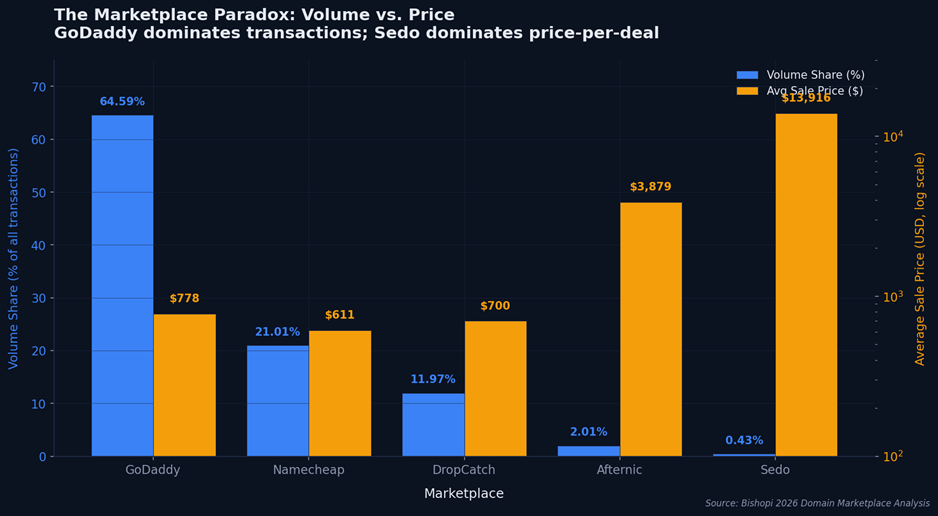
Volume share and average sale price across the 5 active marketplaces. The price axis is logarithmic — Sedo's overall average is 18x GoDaddy's despite handling roughly 150x fewer transactions.
Two multipliers matter here, and they measure different things. The 18x figure is the Sedo-vs-GoDaddy overall-average gap. The 28x figure is the min-to-max spread for the same .com extension across all five marketplaces — from the cheapest average to the most expensive. Here is the same .com priced five different ways:
Marketplace | .com average sale price |
|---|---|
Namecheap | $485 |
DropCatch | $691 |
GoDaddy | $748 |
Afternic | $3,571 |
Sedo | $13,745 |
That $485-to-$13,745 range is a 28x price spread for the identical extension. Marketplace fit isn't a marginal factor — it's the single biggest determinant of what your domain earns. List in the wrong place and the right buyers never see it; list in the right place and they compete for it.
How to Sell a Domain in 2026: The 3-Step Process
Before getting to the marketplace deep dives, here’s the practical framework that makes this all actionable. Three steps. Skip none of them.
Step 1 — Value your domain using comparable sales
Valuing a domain means pricing it off real comparable sales, not a gut estimate. Most sellers err in one of two directions: they list 10x too high and the domain sits for years, or they list at registration cost and a five-figure asset closes for $500. Comparable sales close that gap. Check any domain against real comparables with Bishopi's free Domain Value Analysis tool before you list.
Here's the workflow. Start with Bishopi's Sales History tool to pull 5–10 recent transactions of similar names — same length, same TLD, similar keyword category. Calculate the median, not the mean; the median resists outlier sales that skew the picture. Then run the same domain through the registrar-neutral Domain Value Analysis tool for a baseline appraisal, and reconcile the two numbers.
That reconciliation is where sellers get caught. Automated appraisers frequently disagree by thousands of dollars — a GoDaddy machine estimate and an EstiBot estimate on the same name can differ by 3x or more, because each weights TLD, keyword, and length differently. Worse, most appraisal tools quote a retail expectation while auctions and drop platforms return wholesale money. A name an appraiser values at $5,000 retail may clear $700 at wholesale — the exact gap between GoDaddy's $748 .com average and Sedo's $13,745 .com average in our dataset. A neutral tool checked against actual sold comps is the only reliable anchor.
Apply a TLD multiplier where appropriate. Bishopi's data shows .ai sells for roughly 2.4x the .com average on the same marketplace ($1,174 .ai vs $485 .com on Namecheap, for example). Premium ccTLDs like .de carry a similar multiplier on Sedo. New gTLDs like .xyz and .io trade closer to .com averages, with more variance.
Step 2 — Choose the right marketplace for your domain
This is where the data in this guide directly answers the question. Match TLD to marketplace specialty:
· .ai → Namecheap. The data is unambiguous (more on this below).
· Premium .com ($5,000+) → Sedo or Afternic.
· Standard .com → GoDaddy.
· Expired/aged .com → DropCatch.
· European ccTLDs (.de, .nl, .at, .ch) → Sedo.
Match price tier to marketplace average. Don’t list a $200 domain on Sedo (your listing gets ignored) or a $20,000 domain on GoDaddy alone (the price ceiling on GoDaddy’s main marketplace is real). For premium domains, multi-listing across two marketplaces is standard practice — typically Afternic for distribution + Sedo or GoDaddy for liquidity.
Step 3 — List with the right pricing strategy
Three mechanical decisions affect both speed-to-sale and final price:
Buy Now vs Make Offer. Sedo charges 10% commission on parked Buy Now sales versus 15% on Make Offer transactions. Buy Now closes faster but caps your upside. Make Offer creates negotiation room but adds 30-90 days to typical sale timelines.
Asking price. Set 20-30% above your target floor. If the median comparable is $3,000 and you’d be happy with $2,500, list at $3,500-$3,900. This gives you negotiation room without underpricing, and it lets you accept reasonable offers without feeling stretched.
Listing timing. Launch on Thursday if possible. Across the full 180-day window, Thursday was both the volume peak (35,622 total sales recorded on Thursdays) and the price peak ($1,089 average) for the week. Saturday was the weakest day — 29,843 total sales and a 27% lower average price than Thursday. The pattern held consistently across all six months.
The Marketplace Deep Dives
Each marketplace below is profiled with the same structure: real numbers from the data, sample sales, what it’s best for, and the catch. Read them like restaurant reviews — you’ll know which one fits your situation by the end.
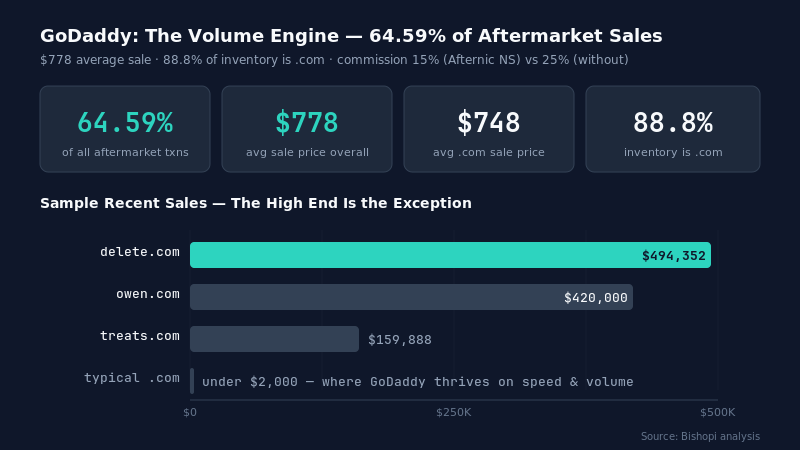
GoDaddy: The Volume Engine
The numbers. 64.59% of all aftermarket transactions in our dataset. $778 average sale price overall, $748 for .com (which is 88.8% of GoDaddy’s inventory). GoDaddy is the dominant marketplace by volume, and the dominance shows up in every metric.
Sample recent sales. delete.com — $494,352 · owen.com — $420,000 · treats.com — $159,888. The high-end exists, but it’s the exception.
Best for. Liquid inventory. Fast sales. .com domains priced under $2,000 where speed matters more than maximizing price.
The catch. GoDaddy’s average prices skew low because of the high volume of small sales. Premium domains can sell here, but they get diluted in the listing flow. Marketing visibility for an individual listing is limited unless you opt into Afternic’s distribution network (which most serious sellers should do).
2026 commission. 15% with Afternic nameservers / 25% without. Verify on GoDaddy’s pricing page — commission structures shift quarterly.
Namecheap: The .ai Marketplace
The standout finding from our data. Across 3,394 .ai domain sales tracked between October 2025 and April 2026, 97.88% cleared on Namecheap, where .ai domains represent 16.18% of total inventory — versus 3.6% market average across all marketplaces. The concentration isn’t just notable; it’s the most extreme marketplace specialty in the entire dataset. |
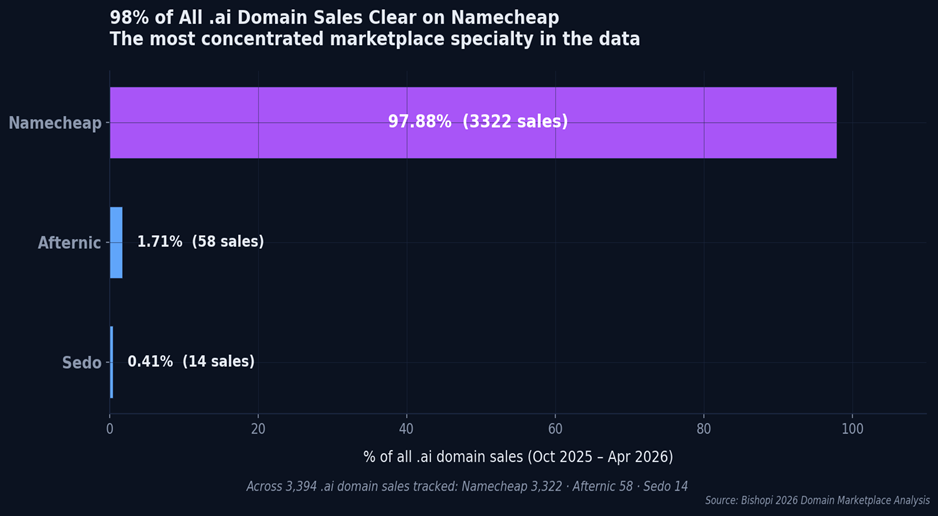
The most concentrated marketplace specialty in the data: 98% of all .ai domain sales clear on Namecheap.
The numbers. 21.01% of total volume — second-largest marketplace by transactions. $611 average sale, $485 for .com.
Sample recent sales. synthetic.ai — $110,000 · podcast.ai — $75,611 · depin.com — $58,000 · bitcoinfoundation.org — $78,500. Note how the top sales skew AI-themed, even when the TLD is .com.
Best for. AI-themed domains specifically. If you have .ai inventory in any tier, Namecheap is where the buyer pool lives.
The why. Namecheap’s user base over-indexes on developers and AI-startup founders — exactly the buyer demographic for .ai domains. A .ai domain on GoDaddy gets surfaced to a general audience; on Namecheap, it gets surfaced to people actively shopping for technical project names.
2026 commission. Namecheap’s commission structure on marketplace sales isn’t published as a single public rate. Check directly with the Namecheap marketplace team for current pricing on the specific listing format you’re considering.
DropCatch: The Expired Domain Auction
The numbers. 11.97% of total volume. $700 average sale, $691 for .com. 84.1% .com inventory — the second-purest .com marketplace after GoDaddy.
Sample recent sales. openpay.com — $310,000 · paylater.com — $90,095 · savoie-mont-blanc.com — $75,500. Most are aged or expired domains being recovered through auction.
Best for. Expired and aged .com domains. Buyers here specifically want existing domain authority — backlinks, traffic history, age signals — not new registrations.
The catch. Auction format. You’re competing against domain investors who run automated bidding on dropped names. This is not the marketplace for "list and forget" — it requires active monitoring of bidding patterns, and the outcome is decided in seconds when the name actually drops.
For monitoring domains about to drop across all major registrars, Bishopi’s Fresh Drops tool surfaces names entering the deletion pipeline in real time — the fastest way to identify DropCatch auction candidates before they’re listed.
2026 commission. ~15% auction fee.
For broader context on domain investing including drop-catching strategy, our guide on domain flipping data strategies covers the full investor playbook.
Afternic: The Mid-Market Premium Specialist
The numbers. 2.01% of volume — small share, but $3,879 average sale. Positioned squarely in the middle of the price tier. 69.7% .com inventory, with notable international diversity (.co.uk and .co.za each at 1.4% of inventory — unique among the marketplaces in our dataset).
Sample recent sales. metawatch.com — $289,995 · privatellm.com — $250,000 · serp.com — $210,000 · intuitive.ai — $125,000.
Best for. Brandable .com domains priced $2,000–$50,000. The mid-market sweet spot where neither GoDaddy’s volume engine nor Sedo’s premium positioning quite fits.
The why. Afternic is GoDaddy-owned, which gives it distribution across 100+ partner registrars without the price drag of GoDaddy’s main marketplace. Listings appear when buyers search at NameSilo, Network Solutions, Hover, and dozens of other registrars — not just at godaddy.com.
2026 commission. 15% with Afternic’s nameservers / 25% without. The nameserver setup is straightforward and worth doing for the lower commission tier.
Sedo: The Premium and International Specialist
The numbers. 0.43% of volume but $13,916 average sale — by far the highest-priced marketplace. 56.2% .com inventory, but with massive ccTLD diversity: 13.9% .de, 2.2% .eu, 1.9% .at, 1.2% .ch, 1.2% .it. Sedo is the only marketplace in the dataset where European ccTLDs get serious distribution.
Sample recent sales. bot.ai — $1,200,000 · midnight.com — $1,150,000 · c4.com — $265,000 · circa.com — $250,000. Sedo is where the seven-figure deals close.
Best for. Premium .com priced $5,000+. International ccTLD sales (Sedo has roughly 5x the European reach of any competitor in our data).
The why. Sedo’s institutional buyer base and international broker network give it a buyer pool that simply doesn’t exist on volume-oriented marketplaces. When a corporate buyer is acquiring a domain for a $50K+ deal, they typically work through Sedo’s broker channel — and that pipeline doesn’t show up on GoDaddy at all.
2026 commission. 10% on parked Buy Now sales, 15% on Make Offer transactions, 20% on SedoMLS partner network sales.
Sample-size note on Sedo .ai pricing: Sedo had 14 .ai sales averaging $89,673 in our window. The mean is heavily skewed by a small number of high-value transactions (bot.ai alone closed at $1.2M). Treat this as indicative of Sedo’s premium ceiling for .ai, not as a typical outcome. Most .ai sales — including most premium .ai sales — still cleared on Namecheap.
For more on identifying which premium domains are actually worth listing at Sedo prices, see our guide to finding and buying premium domains smartly.
Atom.com: The Brandable Specialist
Atom (formerly Squadhelp) doesn't report into the public sales feeds our dataset draws from, so it carries no volume or average-price figure here — a reporting difference, not a size signal. It also works differently. Domains are curated before listing, and buyers arrive through naming contests and branding tools rather than a search box. That makes it the home for invented and two-word brandables — names that get ignored on volume marketplaces because nobody searches for a word that doesn't exist yet.
Where Specific Keywords Actually Sell
Beyond the TLD and price-tier patterns, the data reveals a more granular signal: buyer pools self-segregate by keyword category, not just by domain extension.
We tracked 10 emerging keywords across all marketplaces in the window. The patterns surfaced from cells with sufficient sample size (3+ sales) tell a useful story:
· The keyword "claw" (animal/gaming/UFC adjacency) sold on Spaceship.com at $13,766 average across 3 sales — versus $664 on GoDaddy for the same keyword. Niche brandable buyers cluster on alternative marketplaces.
· The keyword "whiskey" averaged $1,422 on GoDaddy across 24 sales — solidly above GoDaddy’s $778 marketplace-wide average. Premium consumer keywords on a volume marketplace.
· The keyword "manchester" averaged $3,955 on Namecheap across 5 sales (small sample) — versus $451 on GoDaddy. The same word, 8x price difference depending on where it lists.
The pattern, not the prescription. Sample sizes are small at the keyword × marketplace level — these are directional signals, not predictive rules. The takeaway isn’t "always list manchester domains on Namecheap." It’s that buyer pools self-segregate, and a keyword’s ideal marketplace usually correlates with its TLD specialty: .ai goes to Namecheap, premium .com to Sedo or Afternic, expired .com to DropCatch, and category-niche brandables often surface on platforms outside the top 5.
This is exactly the kind of pattern that’s hard to spot from a single sale or a single marketplace. Bishopi’s Domain Trends tool tracks emerging keywords and where their sales are concentrating in real time — so investors can spot category shifts before the price catches up.
Commission Rates: What Each Marketplace Actually Charges
Practical decision input for sellers comparing platforms. Verified April 2026 rates:
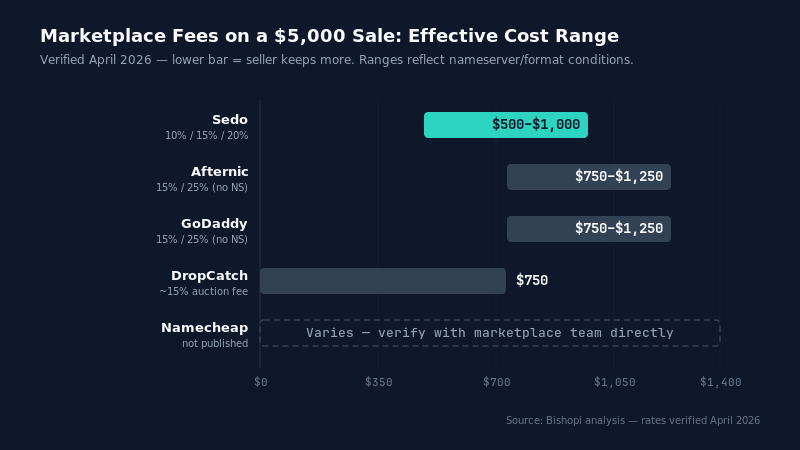
Marketplace | Commission structure | Effective rate on $5,000 sale |
Sedo | 10% Buy Now / 15% Make Offer / 20% SedoMLS | $500–$1,000 |
Afternic | 15% (with nameservers) / 25% (without) | $750–$1,250 |
GoDaddy | 15% (with Afternic NS) / 25% (without) | $750–$1,250 |
Namecheap | Not publicly published — verify directly | Varies |
DropCatch | ~15% auction fee | $750 |
Critical caveat. Commission structures shift quarterly. The rates above were verified in April 2026. Always verify current rates on each platform’s official pricing page before listing — Sedo pricing, Afternic pricing, and GoDaddy aftermarket fees.
For Namecheap specifically: as of April 2026, Namecheap doesn’t publish a standard commission rate for marketplace sales. Sellers should contact their marketplace team directly for current pricing on the specific listing format being used.
Decision Framework: Which Marketplace Fits Your Domain?
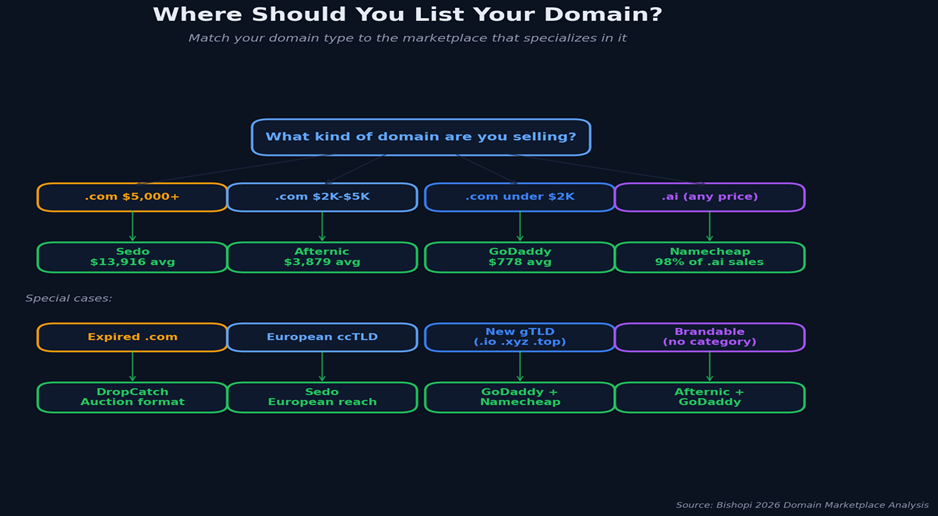
Match your domain type to the marketplace that specializes in it. Multi-listing is standard practice for premium names.
The data converges on a clean set of rules:
· .com under $2,000 → GoDaddy. Volume + speed.
· .com priced $2,000–$10,000 → Afternic + GoDaddy dual-listing.
· .com priced $10,000+ → Sedo primary, Afternic secondary.
· .ai (any price) → Namecheap. The data is unambiguous.
· Expired/aged .com → DropCatch.
· European ccTLDs (.de, .eu, .at, .ch) → Sedo. 5x the international reach of any competitor.
· New gTLDs (.io, .xyz, .top) → GoDaddy + Namecheap. Spread the listing.
· Brandable, no clear category → Afternic for distribution + GoDaddy for liquidity.
Multi-listing is standard practice for any domain priced above $5,000. The commission cost of listing in two places is small compared to the price difference between marketplaces for the same domain.
How to Spot Selling Opportunities Before They’re Priced In
Knowing where to list a domain you already own is half the battle. The other half is knowing what to acquire next — and that’s where most domain investors fly blind.
The marketplace data in this guide is descriptive — it tells you what just sold. The harder, more valuable signal is what’s gaining momentum before the resale market has caught up. A keyword that’s quietly accumulating registrations today is the keyword that resells at premium prices six months from now. By the time it shows up on aggregated sales reports, the registration window is closed.
Bishopi’s Domain Trends tool is built for exactly this gap. It surfaces:
· Trending keywords with rising registration volume across any industry niche
· Top recent sales across all major marketplaces in real time
· Customer behavior patterns showing what end-buyers are searching for
· Low-competition opportunities before the keyword saturates and prices spike
· Most popular extensions and how that ranking is shifting month over month
For domain investors, this is the practical workflow:
1.      Use Domain Trends to spot emerging keywords with momentum (the discovery layer)
2.      Use Sales History to check what comparable names have already sold for (the pricing layer)
3.      List in the marketplace this guide identifies for that domain type (the distribution layer)
Each tool answers a different question. Domain Trends answers "what should I be acquiring?" Sales History answers "what’s it worth?" The marketplace ranking in this post answers "where do I list?"
That combined workflow is what separates domain investors who scale from domain investors who just trade their existing inventory. If you’re treating domain investing as a portfolio business rather than a one-off, all three layers matter.
FAQ
Q: Where can I sell my domain for the most money?
For premium domains ($5,000+), Sedo delivers the highest average sale prices — $13,916 across all categories, with the largest concentration of six-figure deals in our 2026 dataset. For mid-market domains ($2,000–$10,000), Afternic at $3,879 average offers the best balance of price and distribution. Match marketplace tier to your domain’s price ceiling rather than chasing volume.
Q: Is GoDaddy or Sedo better for selling domains?
Different domains, different answers. GoDaddy handles 64.59% of total aftermarket transactions at $778 average — best for liquid inventory and fast sales. Sedo handles 0.43% at $13,916 average — best for premium domains where price beats speed. Most professional sellers list across both for portfolio coverage, using GoDaddy for everyday names and Sedo for the premium tier.
Q: Where should I sell a .ai domain?
Namecheap. Our 2026 data shows 97.88% of all .ai domain sales cleared on Namecheap, where they account for 16.18% of total inventory — far above the 3.6% market average across other marketplaces. The buyer pool concentration on Namecheap for .ai is the most extreme marketplace specialty in our dataset.
Q: How long does it take to sell a domain?
Premium .ai or short .com domains priced competitively: 30–90 days. Standard inventory: 6–18 months. Auction formats like DropCatch accelerate timelines when multiple buyers compete. The biggest delay factor is overpricing — domains priced realistically for their tier sell faster than discounted names that have been listed for years at unrealistic prices.
Q: What commission do domain marketplaces charge in 2026?
Sedo: 10% (Buy Now) to 20% (SedoMLS partner sales). Afternic and GoDaddy: 15% with their nameservers, 25% without. DropCatch: ~15% auction fee. Namecheap commission varies and isn’t publicly published — verify on their marketplace pricing page or with their team. Commission structures shift quarterly; always verify current rates before listing.
Q: What day of the week is best to list a domain for sale?
Thursday. The data shows Thursday averages 35,622 sales per day at $1,089 average sale price — both the volume peak and the price peak of the week. Saturday is the weakest day at 29,843 average sales and $792 average price. Listing a serious domain on Thursday rather than a weekend can affect both speed-to-sale and final price by meaningful margins.
Q: Is multi-listing across marketplaces worth it?
For domains priced above $5,000, yes. The commission cost of listing in two marketplaces is small relative to the price difference between them for the same domain. Standard pairings: Afternic + GoDaddy (mid-market .com), Sedo + Afternic (premium .com), Namecheap exclusive (.ai). Multi-listing for sub-$2,000 domains usually isn’t worth the management overhead.
What’s Next
Where you list a domain is one of the most underweighted decisions in domain investing. The data in this guide shows it shouldn’t be. A 28x price range for the same TLD across marketplaces is not a marginal optimization — it’s the difference between a profitable portfolio and one that just trades fees.
The .ai concentration finding (98% of sales on Namecheap) is the single most actionable insight in this dataset. If you have any .ai inventory and you’re listing it anywhere else, you’re listing in the wrong place. The buyer pool data is unambiguous.
Beyond the immediate marketplace decision, the bigger lever for serious domain investors is upstream — knowing what’s gaining momentum before the market prices it in. Bishopi’s Domain Trends tool tracks emerging keywords, hot domain registrations, and customer behavior patterns in real time, surfacing acquisition opportunities before they show up in retrospective sales reports. Combined with Sales History for pricing comparables and the marketplace ranking above for distribution, that’s the full investor workflow.
This analysis updates quarterly. The next edition covers the May–October 2026 window and will track which patterns held and which shifted.
Originally published at: bishopi.io
Stay up to date
Get updated with all the news, update and upcoming features.