Competitor Backlink Analysis: How to Audit Any Domain's Link Profile
Competitor backlink analysis is the practice of auditing another domain's link profile, a competitor, an acquisition target, or your own site, to find replicable wins, link gaps, and toxic liabilities. The repeatable audit takes about an hour per domain and answers one question: is this link profile an asset or a liability? |
Most backlink-audit guides assume you're auditing your own site. They miss the two reasons the audit is most valuable: studying a competitor's links to find what you should be doing, and vetting a domain's backlinks before buying it, when the audit is acquisition due diligence rather than housekeeping.
This guide covers all three lenses, but leads with the two that incumbents neglect. The method is the same; the weighting changes depending on whether you're learning, buying, or cleaning.
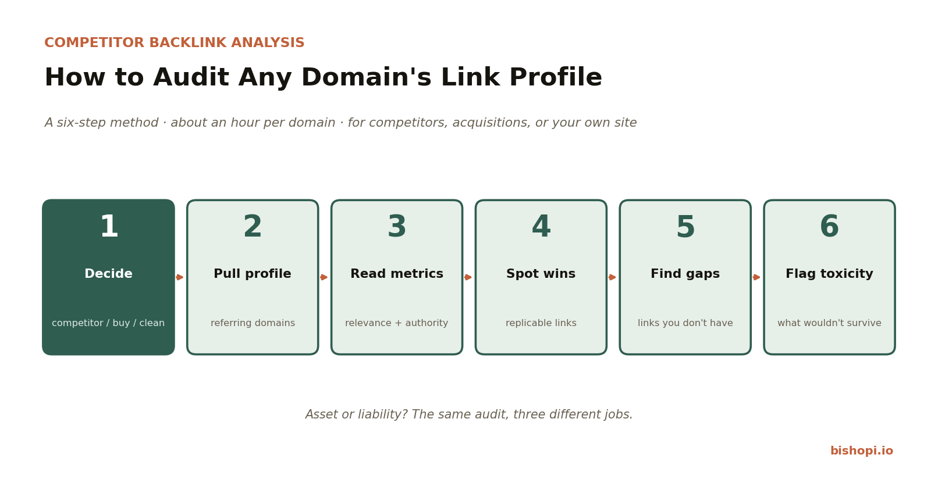
THE METHOD AT A GLANCE
|
Why audit a domain you don't own?
A backlink audit answers one question: is this link profile an asset or a liability? When the domain is yours, the answer drives cleanup. When the domain belongs to a competitor, the answer drives strategy. When the domain is an acquisition target, the answer drives a buy or walk-away decision. Most of the audits worth running are not on your own site. |
Three jobs, in order of how underserved they are by the generic "audit your backlinks" content that dominates this topic:
Competitor analysis. The job most search-result articles don't centre. You want to see where a competitor's authority comes from, which links you could realistically earn yourself, and where they're winning placements you should be pitching for. The audit doubles as a content-strategy and outreach roadmap.
Acquisition due diligence. The job almost no one writes about. Before you buy an aged domain, an expired one, or any name with existing backlinks, you need to know whether the link profile is an asset you're acquiring or a penalty you're inheriting. This is where the audit prevents real money mistakes.
Own-site cleanup. The default job most guides assume. Useful, but it's the third use case, not the first.
The underlying skill doesn't change; the objective does. Competitor audits focus on patterns worth replicating. Acquisition audits focus on link quality, relevance, and historical risk. Cleanup audits focus on identifying liabilities. The framework is the same, but the weighting changes depending on the decision you're trying to make. We'll cover all three.
What does a good backlink profile look like in 2026?
A good backlink profile in 2026 has diversity (many referring domains, not just many links), topical relevance to the site's niche, natural anchor-text distribution, low spam signals, and a steady history rather than sudden spikes. Topical relevance has overtaken raw authority as the primary criterion, following Google's 2024-2026 spam updates that progressively targeted off-niche link manipulation. |
The metrics that matter, in order of importance:
Referring domains, not total backlinks. A profile with 500 backlinks from 50 unique domains is weaker than one with 200 backlinks from 150 unique domains. Diversity beats volume.
Topical relevance of linking sites. This is the 2026 update. A clean, high-authority backlink from an unrelated niche is now suspect rather than valuable. Google's recent expired-domain-abuse targeting punishes profiles where the linking sites don't match the destination's topic.
Authority of linking domains. Real, but no longer primary. A high-authority link from an off-topic site is worth less than a moderate-authority link from a topically aligned one. Authority matters as a multiplier on relevance, not as a substitute. The specific metric your tool reports (Moz's DA, Ahrefs' DR, Bishopi's authority score) matters less than the relative gap between linkers.
Anchor-text distribution. Natural profiles have a mix of branded, generic, partial-match, and URL anchors. A profile heavy with exact-match commercial anchors signals manipulation.
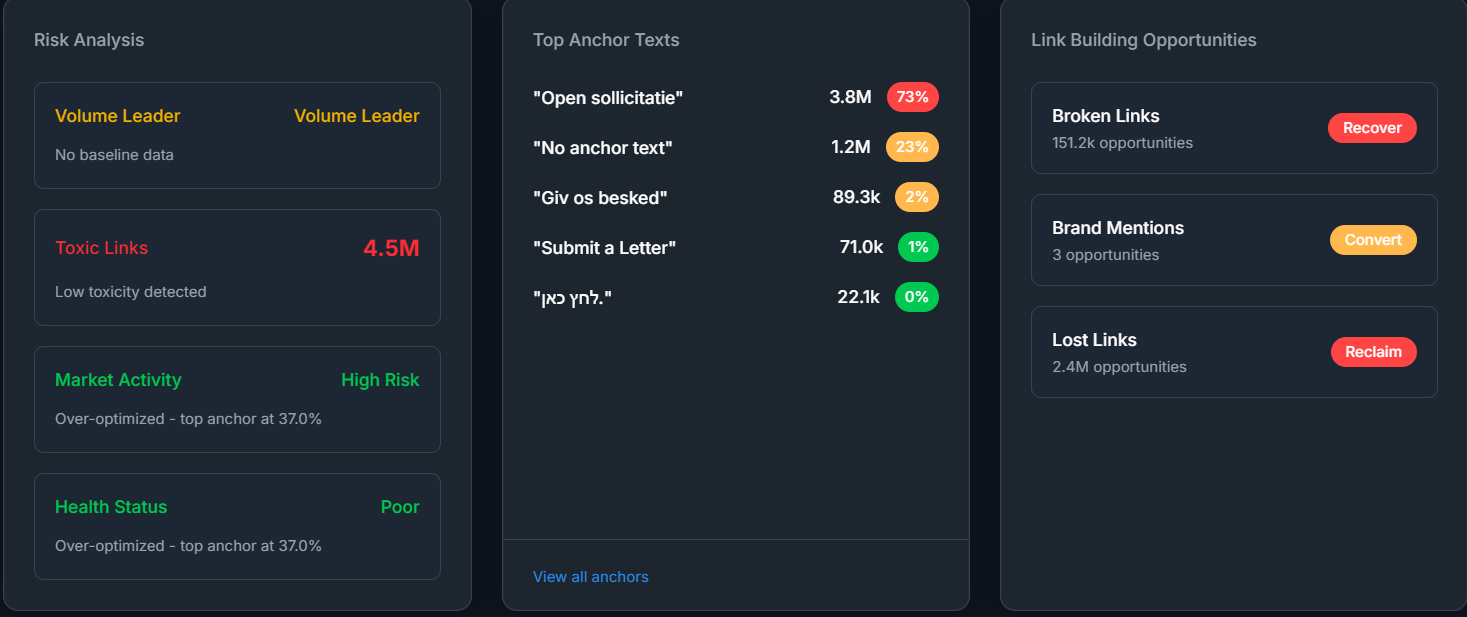
Spam and trust signals. Toxicity scores from your backlink tool catch most of this: links from known spam networks, deindexed sites, or pages with thin content.
Link velocity. Steady acquisition over time looks natural. Sudden spikes (especially with spam anchors) get scrutinised by Google.
None of these are new, but the order is. For instance, the pre-2024 guides led with authority while the 2026 reality leads with relevance, and treats authority as the second-order question.
How do I run a competitor backlink analysis?
To run a competitor backlink analysis: enter the competitor's domain into a backlink analysis tool, pull the referring domains sorted by authority, scan for content and outreach patterns you can replicate, identify their best link sources by niche relevance, and flag any toxic clusters that suggest manipulated rankings rather than earned ones. |
The repeatable process, step by step:
Enter the competitor's root domain. Run the analysis on the apex domain (example.com) unless you have a specific reason to audit a subdomain or single page. In Bishopi's Backlinks Analysis, this is the search field at the top; the same workflow applies in any comparable tool.
Sort referring domains by authority, descending. The top 50-100 referring domains tell you most of what you need to know. The long tail of low-authority links is mostly noise.
Read the top referring domains for patterns. Are they industry publications, niche blogs, resource pages, university or government sites, podcast hosts, listicle compilations? The pattern tells you what kind of content earned the links.
Identify the linkable assets. What's the competitor's "best" content, the page that earned the most diverse, highest-authority backlinks? That's usually their pillar piece, an original data study, a free tool, or a definitive guide. That's the kind of content you need to compete on.
Audit the anchor-text distribution. Are the anchors mostly branded ("CompanyName," "CompanyName.com")? That's a healthy profile. Mostly commercial keywords ("best widgets," "buy SaaS tool")? Likely manipulated.
Flag suspect clusters. A group of low-quality sites all linking with similar anchors signals a paid network or PBN. That tells you the competitor is buying rankings, which has different implications than competing with one who earns them.
WORKED EXAMPLE — TWO CONTRASTING READS
Suppose you audit a competitor and find their top 50 referring domains break down as: 22 niche blogs in the same vertical, 12 industry publications, 8 podcast show-notes pages, 5 university and government sites, and 3 listicle compilations. Anchor distribution is 60% branded, 25% generic, 15% partial-match. That profile is earned, diversified, and topically clean. The strategic read: their authority is real, you cannot replicate it cheaply, and the way to compete is content that earns similar placements rather than cheap link-building.
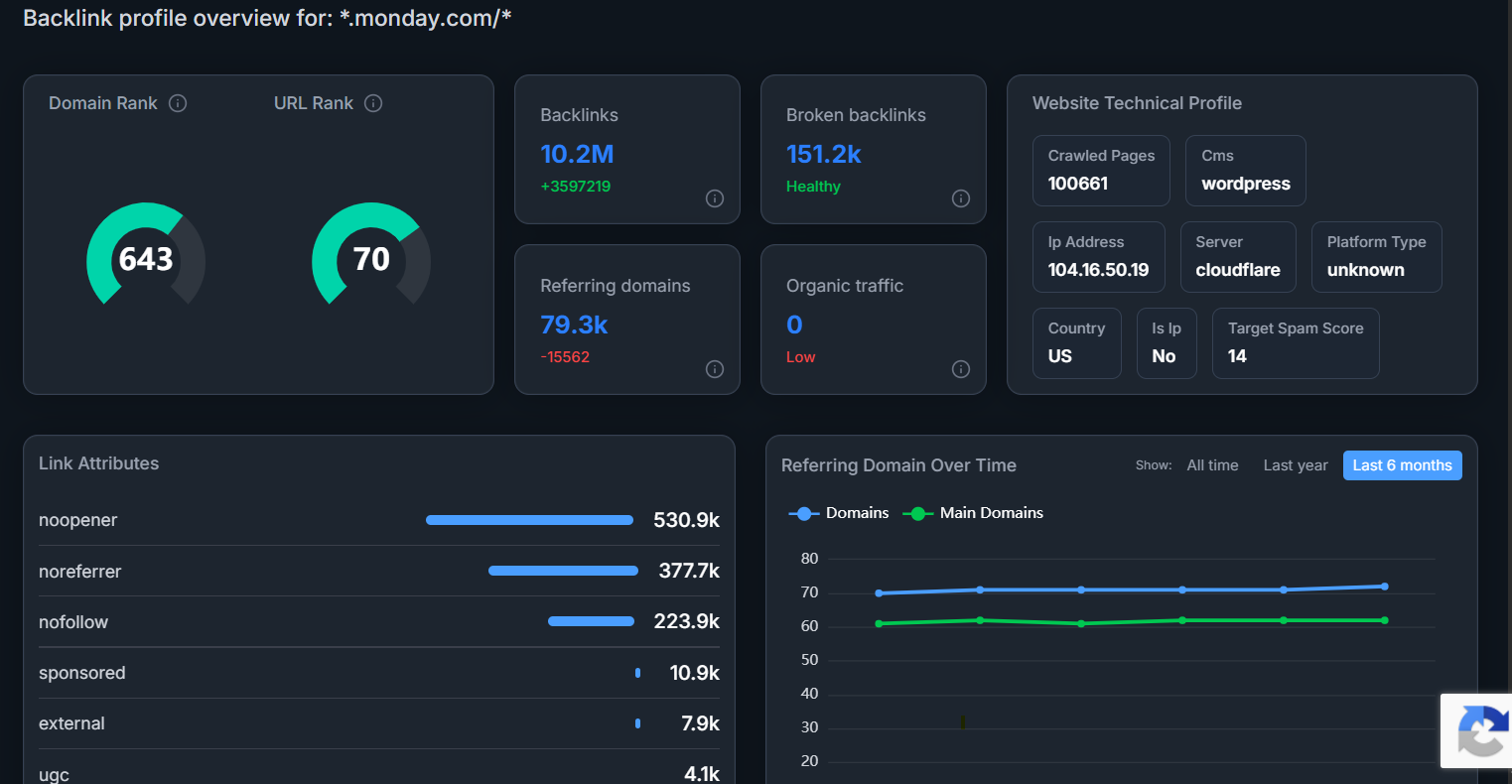
Now suppose instead the top 50 split as: 38 sites on the same shared hosting block with thin content, 8 with exact-match commercial anchors, 4 deindexed pages. The strategic read flips: they are buying or generating links, not earning them, and they are vulnerable to a Google update. You compete by being legitimate while they are exposed. The hour you spend on this produces two deliverables: a list of replicable link sources (sites that would plausibly link to comparable content from you), and a strategic read on whether the competitor is winning through content quality or through manipulation. Both shape what you do next.
How do I audit a domain before buying it?
To audit a domain before purchase: run the standard backlink audit, but weight topical relevance and historical cleanliness more heavily than competitive value. Check the Wayback Machine for prior use, verify linking sites are still live and in a niche you can use, and treat any toxic or off-topic links as deal-breakers rather than cleanup tasks. |
This is the section nobody writes about, and it's where backlink analysis is most consequential. We built Bishopi's backlink tooling alongside its domain valuation and sales-history data partly because we kept seeing investors buy domains on the basis of authority scores without checking whether the underlying links were relevant or even still live. Buying a domain with existing backlinks can be the cheapest way to acquire authority, or it can be the most expensive way to inherit a penalty.
What changes when the audit is acquisition due diligence:
Topical relevance becomes a hard filter, not a preference. If the linking sites are in a niche you can't credibly use, the "authority" is a mirage. Worse, Google's 2024-2026 spam updates explicitly target the pattern of buying off-niche aged domains and redirecting them, so a topically misaligned profile is a penalty risk.
Historical use matters. Pull the domain's history on the Wayback Machine, and cross-check ownership transitions with a domain history check. A site that was an adult network, foreign-language flip, or thin affiliate operation in its past life carries baggage. A site that was a small business or niche blog in its original use is usually cleaner.
Link decay is critical. Backlink tools surface the historical link profile, but many of those links may now be dead, lost, or pointing to 404s. Sample the top referring domains and verify the links are still live. A profile of 200 referring domains with 80% decay is a profile of 40 working links.
Toxic links are deal-breakers, not cleanup tasks. On your own site, you'd disavow them. On a domain you don't yet own, you can't. A toxic profile means you'd inherit the problem with no remediation path. Walk away.
For a deeper workflow on the discovery side, finding candidate domains worth running this audit on, see our guide to how to find expired domains with strong, relevant backlinks, which covers the filtering step that comes before the audit. Curated drops with pre-screened backlink profiles surface daily in Fresh Drops.
How do I find the gaps?
Finding link gaps means identifying referring domains that link to your competitors but not to you. The simplest method is to run a backlink gap analysis across two or three competing domains and yours, then prioritise the linking sites that link to multiple competitors, those are the most likely to also link to you with the right outreach. |
Backlink gap analysis flips the question. (Bishopi surfaces this as a dedicated Link Gap view; the workflow below applies in any tool that exposes a gap analysis.) Instead of asking "who links to my competitor," it asks "who links to my competitor but not to me." That second question is the actionable one, it generates your outreach list.
The workflow:
Pick two or three competitors who rank for the terms you want. Three is usually the sweet spot, enough to surface patterns, not so many that the gap list becomes noise.
Run the gap analysis. Output is a list of domains linking to one or more competitors but not to you.
Sort by the number of competitors linked to. A site linking to all three of your competitors is far more likely to also link to you. A site linking to only one might be a niche relationship you can't replicate.
Filter for relevance and authority. Topically aligned sites first, then by domain authority within that.
Output your outreach list. The top 20-30 sites are your highest-probability link targets. Most won't convert. The ones that do are usually worth more than dozens of low-quality placements.
WHEN THE GAP ANALYSIS FLIPS INTO SOMETHING BIGGER A gap analysis is also a signal of competitive position. If your top three competitors share 50+ common linking domains and you share none of them, you have a structural authority problem, not just an outreach problem. The gap analysis tells you whether you need a few targeted links, or whether you need to build a piece of content that earns linker attention in the first place. |
How do I spot a toxic profile?
Toxic backlink profiles show patterns: exact-match commercial anchor text dominating, large clusters of low-authority links acquired in short windows, links from deindexed or penalised sites, and concentrations from single low-quality networks. Any one signal is noise; two or three together is a real problem. |
The signals, in order of how often they actually matter:
Spam anchor over-optimisation. Commercial keywords dominating the anchor distribution, especially when the site itself doesn't rank for those terms, is the strongest signal of paid or manipulated links.
PBN footprints. Clusters of links from sites with similar hosting, identical templates, or thin content all linking with the same anchors are the classic private blog network pattern. Modern backlink tools surface this directly.
Sudden link spikes. A profile that adds hundreds of backlinks in a short window, without a corresponding press or product event to explain it, is almost always paid or automated.
Links from deindexed or penalised sites. These contribute negative trust. A handful is normal noise; a pattern is a liability.
Foreign-language link farms. Common in expired-domain manipulation. A US-targeted site with a heavy concentration of links from unrelated foreign-language thin-content sites is a flag.
Disavowing toxic links is the remedy, but only for your own site. On a competitor, you can't disavow for them; you note it for strategic purposes (they're playing a different game). On an acquisition target, you can't disavow either, which is why toxic profiles should kill the deal rather than become a project you take on. The link profile is part of the domain's value; when you're evaluating a domain to buy, a domain value analysis that incorporates link quality alongside other factors is more honest than valuing the name alone.
Frequently asked questions
What is competitor backlink analysis?
Competitor backlink analysis is the practice of auditing another domain's link profile to understand where their authority comes from, which links you could realistically replicate, and where the gaps are. It applies to direct competitors, potential acquisition targets, and reference sites in your niche.
How do I check a competitor's backlinks?
Enter the competitor's domain into a backlink analysis tool that surfaces referring domains, anchor text, authority signals, and link quality indicators. The repeatable audit takes about an hour per domain and produces a list of replicable links plus a toxicity flag.
Can I see a competitor's backlinks?
Yes. Backlink analysis tools maintain crawled indexes of the web that surface most public backlinks pointing at any domain. Coverage varies by tool, but the directionally useful picture (top referring domains, anchor patterns, authority distribution) is consistently available.
How do I audit a domain before buying it?
Run the same backlink audit you would on a competitor, but weight topical relevance and history more heavily. Check the linking domains' niche alignment, scan the Wayback Machine for prior use, and treat any toxic or off-topic links as deal-breakers rather than cleanup tasks.
Ahrefs vs Semrush for backlink analysis, which is better?
Both have large, mature indexes. Ahrefs tends to surface more historic links; Semrush integrates more deeply with broader SEO workflows. For domain investors specifically, integrated tools that combine backlink data with domain valuation and sales history offer context the pure-SEO incumbents don't.
The bottom line
A backlink audit answers one question, asset or liability, and most domains worth auditing are not yours. The competitor audit produces a strategy and an outreach list. The acquisition audit decides whether you buy or walk away. The own-site audit catches problems before Google does. Same method, different weights.
The hard part isn't the audit itself. It's combining the link data with the domain context, history, niche alignment, valuation, that tells you what the profile actually means. That combination is where domain investors and SEOs converge, and where backlink data starts answering bigger questions than "do my links look okay."
Run the audit. Whether you're studying a competitor, vetting a domain before purchase, or cleaning your own site, the same workflow applies. Backlinks Analysis surfaces referring domains, anchor distribution, relevance signals, and toxicity flags in one view. |
Originally published at: bishopi.io
Stay up to date
Get updated with all the news, update and upcoming features.