DomainTools Alternatives: Why Researchers Are Looking Beyond the Enterprise Standard
Few people looking at DomainTools alternatives need everything DomainTools offers. You often just need a specific capability - whether it’s reverse WHOIS, DNS history, or historical ownership records.
After comparing these tools and researching how different teams use them, I've found that the better comparison isn't tool versus tool.
It's capability versus capability.
Researching a domain acquisition requires a different set of tools than investigating phishing infrastructure or monitoring brand abuse.
The options below cover different parts of that workflow, along with the tradeoffs behind each one.
The Quick Answer
If you need... | Use this |
Reverse WHOIS | Whoxy |
DNS history and infrastructure tracking | SecurityTrails |
Bulk data or API access | WhoisXML API |
Ownership history and valuation | Bishopi |
Enterprise graph investigations | DomainTools |
Brand monitoring and ownership tracking | Bishopi |
What DomainTools Actually Does (And Why It's Expensive)
DomainTools is the benchmark for domain intelligence because it combines several capabilities under one roof:
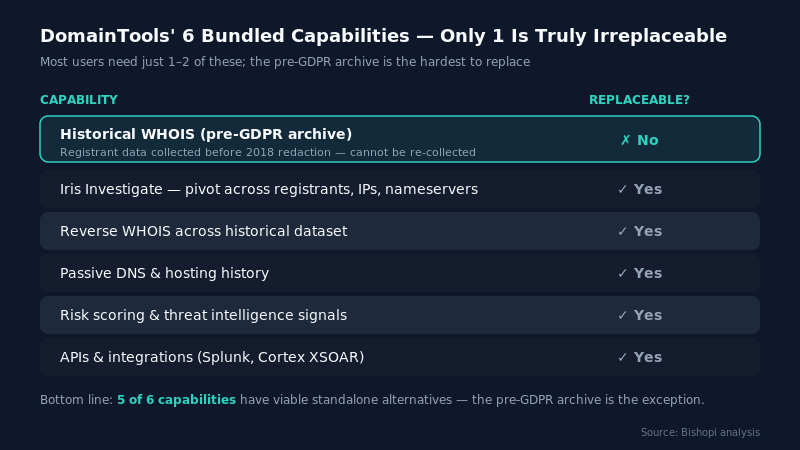
Historical WHOIS records, including pre-GDPR registrant data collected before public records were widely redacted in 2018
Iris Investigate, which lets analysts pivot from a domain to registrants, IPs, nameservers, and related infrastructure
Reverse WHOIS across a large historical dataset
Passive DNS and hosting history
Risk scoring and threat intelligence signals
APIs and integrations for security teams using tools like Splunk and Cortex XSOAR
The pre-GDPR archive is the hardest capability to replace. Once registrant details disappeared from public WHOIS records, no one could go back and collect them.
DomainTools has that data because it was already gathering it years before the rules changed.
For a brand-protection or threat-intelligence team tracking thousands of domains, that archive can justify the enterprise-grade cost.
Who Actually Needs a DomainTools Alternative?
In reviewing these tools, the pattern that kept coming up was that most users only needed one or two of DomainTools' core capabilities, not the entire platform.
That usually includes:
Security researchers investigating a specific domain or incident
Journalists and OSINT researchers tracing ownership records and domain networks
Domain investors researching acquisitions and ownership history
Startup security teams handling occasional investigations rather than continuous monitoring
Brand-protection teams operating at a smaller scale
In all these cases, the investigation is real, but the requirements don't always justify an enterprise platform.
When reverse WHOIS, DNS history, ownership records, or valuation data are the primary requirement, a specialized tool can often deliver what you need at a fraction of the cost.
The 5 DomainTools Alternative, Matched to the Investigation
If you're trying to answer a specific question rather than run enterprise-scale investigations, the tools below may be a better fit. Each one covers a different aspect of domain research.
1. Bishopi
Bishopi is built for domain investors who need thorough research before researching or buying a domain. It shows current WHOIS, ownership history, domain sales records, and live market value in one workspace.
That becomes particularly useful when a domain has a complicated history.
A prior sale, a long period of inactivity, or a series of ownership changes can all add context that a valuation alone won't capture. Looking at those signals together often provides a more complete picture than any single metric on its own.
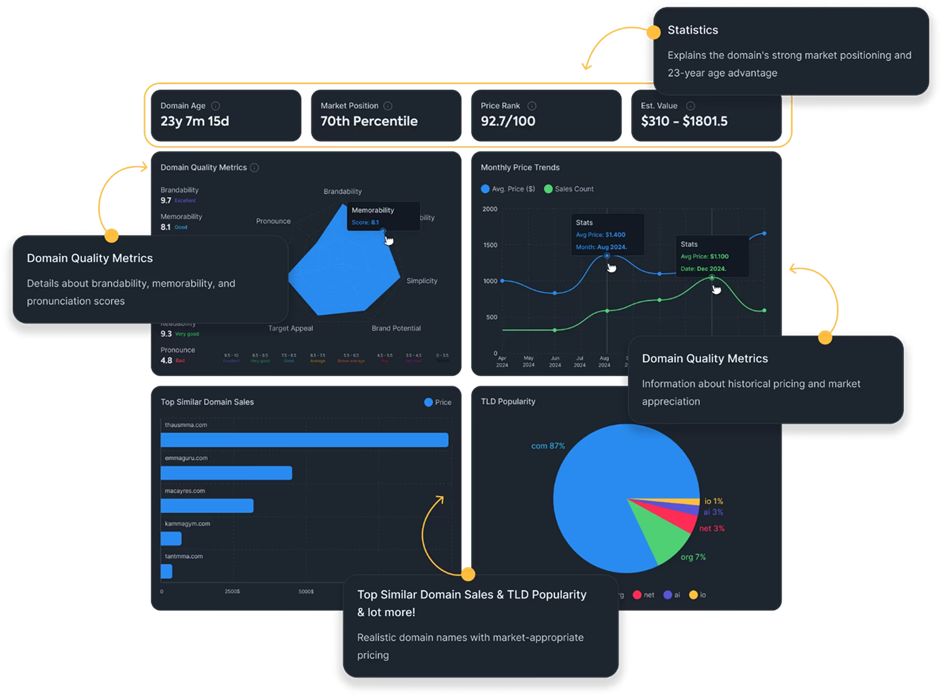
Bishopi’s sales data goes beyond individual sales records. You can use comparable sales, TLD trend data, and broader market activity to understand how a domain fits within its category, not just what it sold for in the past.
Beyond acquisition research, Bishopi is also useful for monitoring. You can track domain expiration, WHOIS changes, sales alerts, and watched-domain updates, and on higher plans you can add brand monitoring and frequent monitoring intervals. That makes it useful for catching drops, ownership shifts, and watchlist changes before they become bigger problems.
That said, it's not a passive DNS platform. It doesn't connect domains across shared infrastructure or produce the kind of graph Iris Investigate does.
Pricing (as of publication): Starter Plan for $29/month (2,500 credits), Growth Plan at $49/month (5,000 credits), Professional Plan at $129/month(15,000 credits).
Best when: Ownership history, sales data, valuation, and monitoring are part of the same acquisition or brand-protection workflow.
Want to test the workflow yourself? See how Bishopi works with a 7-day free trial.
2. WhoisXML API
WhoisXML API is the data infrastructure a lot of domain intelligence products are built on. WHOIS lookup, WHOIS history, reverse WHOIS, passive DNS via their DNS Chronicle API, reverse IP lookup, subdomain enumeration - all under one account. Outside DomainTools, no single vendor brings that combination together.
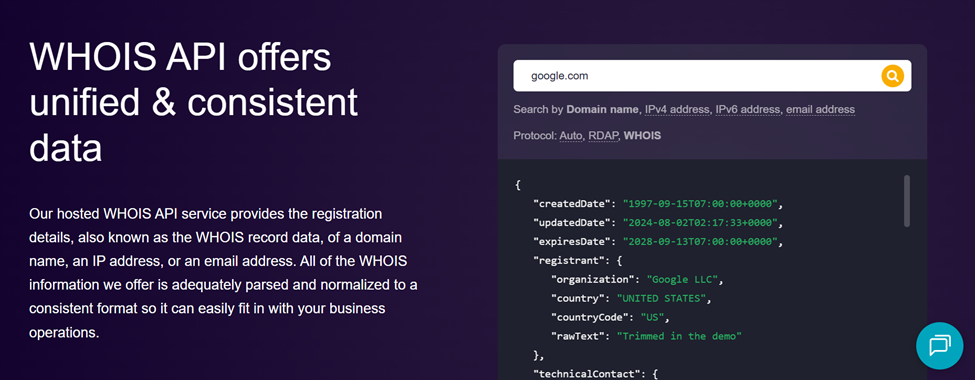
For teams building internal investigation tooling or enriching security workflows at volume, that architecture is more useful than another dashboard. You bring the workflow; it supplies the data.
What it doesn't have is an investigation interface. There's no graph visualization, no pivot workflow for non-technical analysts. If someone needs to explore without writing queries, this isn't the right fit.
Pricing (as of publication): Free WHOIS tier available. One-time paid plans start at $50/month (2,000 queries). If you opt for the monthly subscription, it gets more affordable - starting at $30/month (2,000 queries).
Best when: You have a developer, need to query at volume, or want a data layer to build internal tooling on.
3. Whoxy
The registrant behind one suspicious domain usually owns 30 more. Getting that list fast is often the whole job - for journalists covering fraud, OSINT researchers mapping disinformation networks, anyone who needs to move from one domain to the full picture of what a registrant controls.
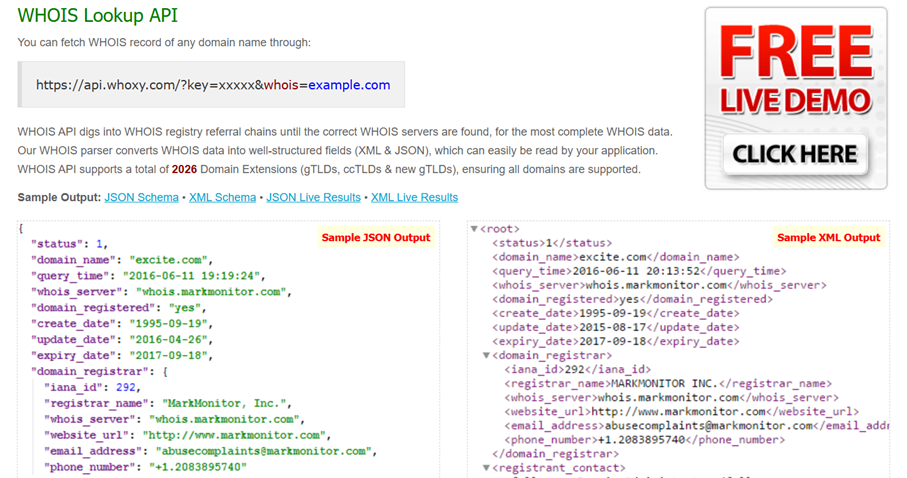
Whoxy answers that question at prices nothing else in this market approaches. Reverse WHOIS by registrant name, email, or company across 693 million domain records covering 1,596+ TLDs.
Pay-per-query: $10 per 1,000 reverse WHOIS lookups, $2 per 1,000 standard WHOIS, $5 per 1,000 WHOIS history (as of publication, confirmed at whoxy.com/pricing.php). No monthly subscription.
The tradeoff is depth and scope. Historical coverage isn't as deep as DomainTools or WhoisXML API, and features like passive DNS and threat scoring aren't part of the product. That's a reasonable tradeoff if the goal is reverse WHOIS and registrant research rather than broader infrastructure investigations.
Best when: Your investigation starts with one domain and you need to find everything else that the registrant controls.
4. SecurityTrails
For security researchers, the most common gap isn't reverse WHOIS - it's infrastructure history. Where has this domain pointed, what nameservers has it used, what IP ranges has it shared over time.
Most mid-size SOC analysts evaluating DomainTools realize they're paying for a fraud-network mapping platform they'll never open and start looking for the DNS piece separately. SecurityTrails is where most land.
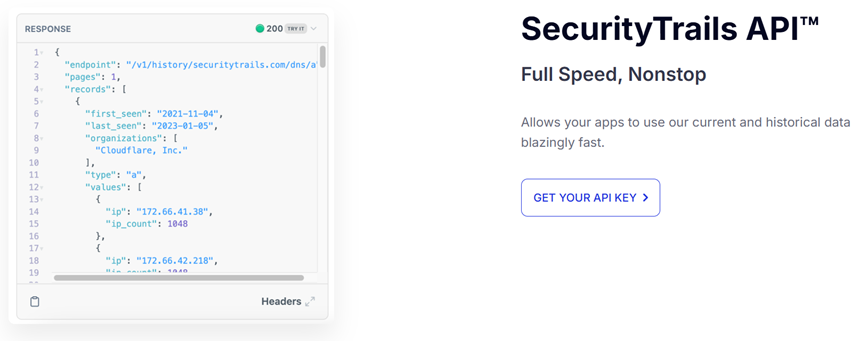
DNS record history, IP-to-domain mapping, subdomain discovery, associated domain enumeration, and an API that integrates into security workflows without significant friction. The free tier handles 50 API queries per month for occasional investigations. Paid API tier covers research at depth.
Reverse WHOIS is not a primary feature here, and there's no graph investigation interface. The focus is infrastructure history, and on that it's genuinely competitive at mid-tier pricing.
Pricing: Professional tier available at $500/month (20,000 queries); Business plan available at $1500/month (65,000 queries); contact their team for details of the enterprise plan.
Best when: You're tracing where a domain has been hosted, mapping attack surface, or investigating infrastructure changes over time.
5. ICANN Lookup
ICANN Lookup is the best free DomainTools alternative for basic WHOIS lookups.
If you only need current registration data, it provides registrar information, registration and expiry dates, nameservers, and domain status directly from registry records at no cost.
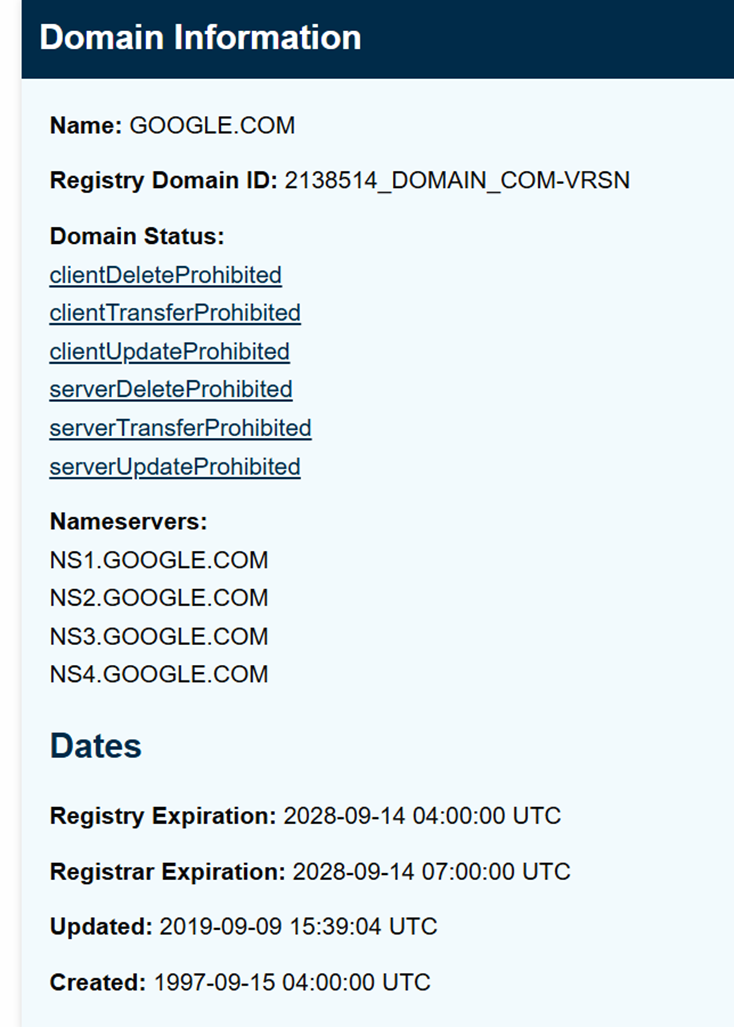
The limitation is that it only shows what's available today. There's no historical WHOIS data, reverse WHOIS, DNS history, or infrastructure intelligence.
For founders, marketers, domain buyers, and anyone doing occasional domain research, it's often enough. Paid tools only become necessary when the investigation goes beyond current registration records.
Best when: You need current registration data and run only occasional lookups.
DomainTools Alternatives Comparison: A Quick Decision Guide
This is the snapshot you need to make an informed decision. I’ve broken down the capabilities so you can see exactly where the value and the limitations lie at each tier.
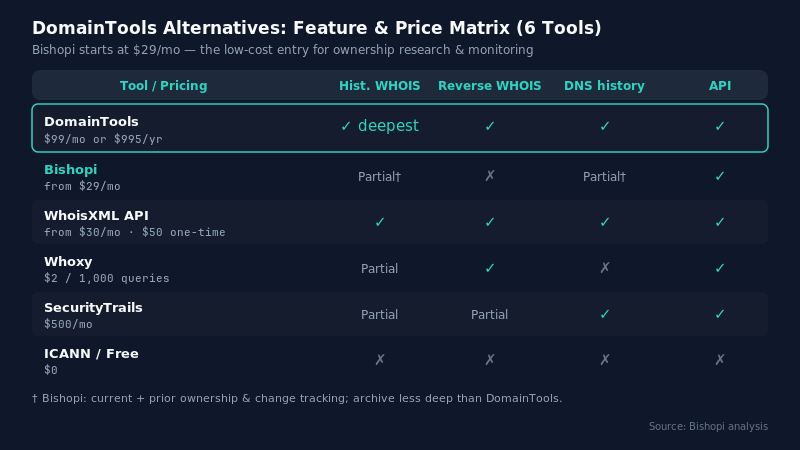
Tool | Pricing | Historical WHOIS | Reverse WHOIS | DNS history | API | Best for |
DomainTools | $99/month or $995/year | ✓ deepest archive | ✓ | ✓ | ✓ | Enterprise brand protection, SOC |
Bishopi | Starts at $29/month | Partial† | ✗ | Partial† | ✓ | Ownership research, valuation, and domain monitoring |
WhoisXML API | Subscription plan starts at $30/month; one-time plan at $50/month | ✓ | ✓ | ✓ | ✓ | Developers, bulk data |
Whoxy | $2 per 1,000 queries;pay-as-you-go | Partial | ✓ | ✗ | ✓ | One-off reverse WHOIS |
SecurityTrails | $500/month | Partial | Partial | ✓ | ✓ | Security researchers, DNS history |
ICANN/Free | $0 | ✗ | ✗ | ✗ | ✗ | Occasional single lookups |
†Bishopi covers current ownership records, prior registrant history, and domain change tracking, which handles most acquisition and domain monitoring use cases. It is not a passive DNS or infrastructure investigation platform, and its historical archive is not as extensive as DomainTools.
Which Tool Fits Your Situation?
The easiest way to narrow this market is to start with the investigation.
The Builder Path: If you're automating data pipelines, go with WhoisXML API. It’s the industry standard for programmatic access and the most predictable ROI for developers.
The Investigator Path: If you're investigating ownership, registrant history, domain changes, or potential brand abuse, Bishopi and Whoxy are good starting points.
But if the investigation requires deep infrastructure mapping, passive DNS analysis, or IP relationship discovery, SecurityTrails is the better fit.
The Acquisition Path: If you're buying or evaluating domains, Bishopi is built for that workflow. It puts ownership history, sales data, and valuation in one place, helping you see how each signal influences the opportunity. For a deeper look at the valuation side of that equation, see our guide to Estibot alternatives.
The Enterprise Path: Reach for DomainTools if you work requires historical archives, graph investigations, and large-scale security or compliance workflows.
When DomainTools is Still Worth the Price
I'd keep DomainTools in three situations:
You need historical registrant data. Records redacted after GDPR enforcement in 2018 aren't publicly available anymore, which means they can't be recreated.
If an investigation depends on who owned a domain years ago, whether for fraud research, infrastructure tracking, or legal proceedings, DomainTools' archive remains one of the few places where data still exists.
You spend enough time investigating domains that workflow matters as much as data. Iris Investigate isn't just another lookup tool.
Being able to move from a domain to a registrant, from that registrant to related domains, then to nameservers, IPs, and risk indicators in a single workflow is what makes large-scale investigations practical.
Your investigations don't stop at research. Once findings start feeding legal cases, compliance programs, or security operations, audit trails and integrations with platforms like Splunk, QRadar, and ServiceNow become part of the requirement, not a nice-to-have.
If those sound familiar, DomainTools is probably worth the price. If they don't, that's usually where the alternatives start making more sense.
Picking the Right DomainTools Alternative: The Tier-Based Workflow
The easiest way to overspend on domain intelligence is to buy for the investigation you might run someday instead of the one you're running today.
ICANN Lookup for basic registration data
Whoxy for reverse WHOIS
SecurityTrails for DNS and infrastructure history
WhoisXML API for automation and large-scale querying
Bishopi for acquisition research and valuation
DomainTools for enterprise investigations
FAQs
1. What's the best DomainTools alternative?
It depends on what sent you looking for an alternative in the first place. If the goal is reverse WHOIS, Whoxy is hard to beat. If you're investigating DNS history and infrastructure, SecurityTrails is the better fit. If you're researching a domain purchase, Bishopi brings ownership history, sales data, and valuation into the same workflow.
2. Is there a free alternative to DomainTools?
ICANN Lookup provides basic registration data for free. However, capabilities such as reverse WHOIS, historical WHOIS records, DNS history, and domain valuation typically require a paid tool.
3. Which DomainTools alternative is the best for domain investors?
Bishopi is the closest match for domain acquisition research. It combines ownership history, domain sales data, and valuation in the same workflow, making it easier to evaluate a domain before buying it.
The Bottom Line
When you’re comparing DomainTools alternatives, the right starting point is the investigation itself.
Once you know whether you're looking for reverse WHOIS, DNS history, ownership research, valuation, or infrastructure intelligence, the choice becomes much clearer.
Pick the lowest tier that answers the questions you have. Upgrade when you hit its limit.
If ownership history is part of the investigation, start the 7-day free trial and run a domain you’re already researching through Bishopi. You’ll see ownership history, sales records, valuation data, and monitoring signals side by side, making it easier to evaluate the opportunity.
Originally published at: bishopi.io
Stay up to date
Get updated with all the news, update and upcoming features.