How to Find Valuable Expired Domains (Step-by-Step Guide)
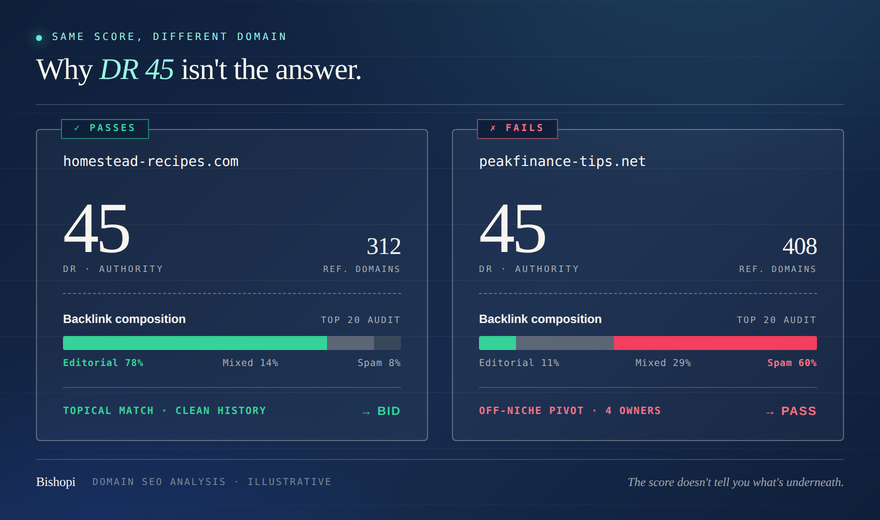
A domain with DR 45 and 380 referring domains looks like a solid acquisition. You win the auction at $180. You build the site. Ninety days later, rankings are flat and Search Console shows 87 crawl errors that were not there before.
The metrics were real. The history was not. The gap between a dropped domain with real SEO value and one that looks identical but is not is entirely visible before you bid. This guide is the evaluation process: what actually transfers, what does not, and the five checks that separate the two. The checks work whether you find the domain on Bishopi’s Fresh Drops, GoDaddy Auctions, or anywhere else in the deletion pipeline.
What Actually Transfers When a Domain Drops
A dropped domain is not a clean slate, and it is not a turnkey ranking shortcut either. Some signals carry over to the new owner. Others reset the moment Google sees that the content has changed materially. Knowing which is which is the entire game.
✓ When a domain drops, backlinks pointing to it generally remain (until disavowed or removed), brand mentions persist, and indexed pages may continue ranking briefly. What does not carry over: third-party authority scores, ranking trust accumulated under the prior owner, and any equity built on tactics Google has since devalued. Topical consistency between old and new content is the single biggest factor in whether the inherited signals are worth anything. |
Transfers | Does NOT transfer |
Backlinks (until removed or disavowed) | DR / DA / TF scores (third-party metrics, not Google signals) |
Indexed pages (until Google deindexes) | PageRank from prior owner’s content |
Brand mentions and direct traffic patterns | Manual action history (sometimes inheritable, see Section 3) |
Topical history signals | SEO equity built on tactics targeted by 2024 spam updates |
Domain age (factual, not a ranking factor) | Trust signals after material content change |
The 2026 honest position: Google’s March 2024 spam update introduced "expired domain abuse" as a named, enforceable spam policy (Google Search Central, March 2024). The June 2024 spam update reportedly deindexed sites built on abused expired domains. Clean, topically consistent dropped domains still accelerate SEO. Lazy redirects from off-topic domains do not. The distinction lives entirely in the evaluation.
How to Find Drops Before the Auction Crowd
Most expired-domain guides start at GoDaddy Auctions. By the time a domain reaches a major auction listing, every professional buyer is looking at the same data. Good drops get bid up. Mediocre ones get bought by people who did not run the checks below.
The earlier entry point is the deletion pipeline itself: monitoring domains as they enter the expiry cycle, before they reach a public auction. Bishopi’s Fresh Drops surfaces curated drops daily, with a quality and safety pre-screen on each listing. That filter handles the obvious-spam cases for you, but it does not replace the evaluation in Section 3. The point of pre-curation is to give you a smaller, higher-signal set to evaluate, not to skip the evaluation.
The same five-point evaluation works wherever you source the domain: Fresh Drops, GoDaddy Auctions, NameJet, Park.io, or a bulk deletion-list scrape. For each candidate, plan to spend 10–15 minutes on the checks below. The hour you spend evaluating four domains saves you from the one bad acquisition that costs you six months.
See what’s dropping today ✓ Bishopi Fresh Drops surfaces hand-picked dropped domains updated daily, with quality and safety pre-screening on each listing. |
The 5-Point Evaluation Checklist
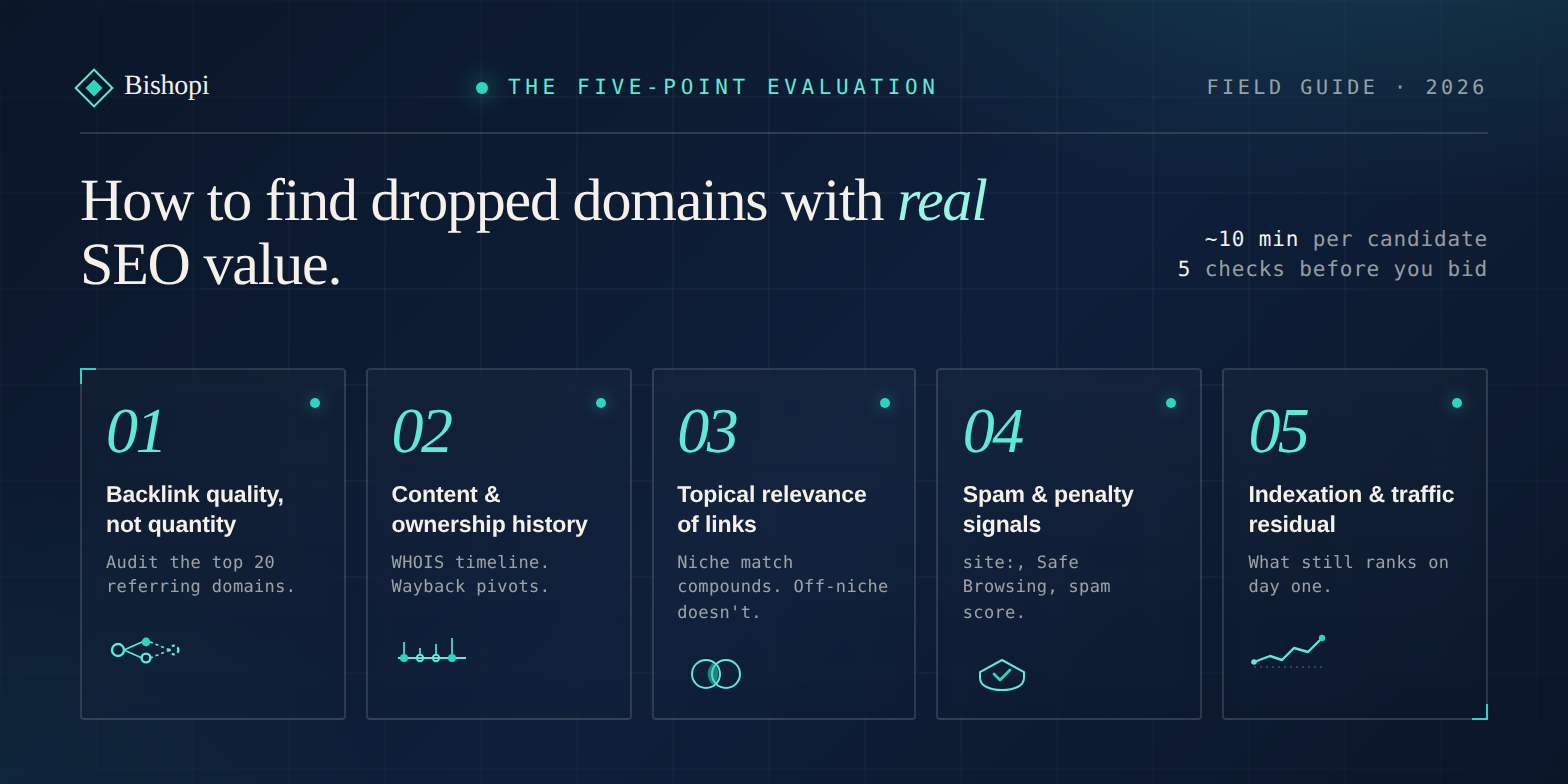
This is the section you will reference mid-evaluation. Lead with the summary table, then expand each point. Plan ~10 minutes per candidate domain. If the domain fails any of the first three checks, stop and move on. Time spent on a doomed acquisition is time you cannot get back.
# | Check | Why it matters | Where to verify |
1 | Backlink quality, not quantity | Inflated metrics from spam links are worthless | SEO metrics API + manual review of top 20 |
2 | Content and ownership history | Penalties and pivots carry over to new owner | WHOIS lookup API + Wayback Machine |
3 | Topical relevance of referring domains | Off-niche links do not compound on new content | Domain SEO Analysis (referring domain niche distribution) |
4 | Spam and penalty signals | Inherited blacklist = months of cleanup, not rankings | Domain SEO Analysis + Google Transparency Report |
5 | Current indexation and traffic residual | Deindexed domains start from zero | site: search + traffic check |
1. Backlink Quality, Not Quantity
A domain with 380 referring domains from blog comment spam is worth less than one with 28 referring domains from real editorial placements. The metric to interrogate is not total referring domain count. It is how many of those domains are real, active, topically relevant sites that linked editorially.
Pull the full backlink profile via Bishopi’s Domain SEO Analysis or your tool of choice. Manually review the top 20 referring domains. Three thresholds to reject on: more than 30% directory or web2.0 spam, more than 20% irrelevant foreign-language sites that look auto-generated, or any pattern of identical anchor text across many low-quality domains. Any one means the authority score is inflated.
2. Content and Ownership History
Two checks here, both fast. First, run a WHOIS Lookup for the ownership timeline: how many registrants, how recently it changed hands, how long it was held between transfers. A domain that has cycled through four owners in 24 months is a red flag for opportunistic flipping rather than organic development.
Second, run the domain through the Wayback Machine. Was it a real business or a parked page? Did it pivot from a cooking blog to an online casino six months before dropping? An off-niche pivot late in the domain’s life is exactly the pattern Google’s "expired domain abuse" policy targets. If you see one, the historical authority is already tainted before you even acquire the domain.
3. Topical Relevance of Referring Domains
Even a clean backlink profile from legitimate sites may not help you if those sites are topically unrelated to what you plan to build. A former personal-finance blog with backlinks from accounting firms and financial-news sites is a strong match for a new personal-finance site. It is far less valuable for a travel site, regardless of the DA score.
Google values topical consistency, and the spam updates are explicit that a domain repurposed into an unrelated niche risks losing the inherited equity. Pull the referring-domain list and check the niche distribution. If the majority of linking sites are from an unrelated vertical, the authority will not compound on your new content. The rule of thumb: build in the domain’s historical niche or one closely adjacent. Cooking to recipes works. Cooking to legal services does not.
4. Spam and Penalty Signals
Three specific checks before bidding:
Run a Google site: search (site:domain.com). If the domain had content but returns near-zero results, Google has likely deindexed it for a manual action or extended inactivity.
Check Google’s Transparency Report for Safe Browsing flags. A domain flagged for malware in the last 24 months will inherit warning interstitials in some browsers for months after acquisition.
Pull the spam score from Domain SEO Analysis. A high spam score signals a backlink profile weighted toward manipulative links: exactly the pattern the 2024 spam updates target.
Any one of these flagged is a hard pass for most use cases. Recovery from an inherited penalty is months of disavow work and reconsideration requests, not a head start.
5. Current Indexation and Traffic Residual
Some dropped domains still receive organic traffic from pages Google has not yet fully deindexed. This is a genuine short-term advantage: you inherit ranking positions instead of starting from zero on day one. Estimate residual traffic via Domain SEO Analysis or your tool of choice.
If the domain shows measurable organic traffic and is still indexed for relevant keywords, you are buying a head start, not just a backlink profile. If traffic is zero and indexation is gone, you are starting from scratch on an aged domain. That may still be worth doing if Points 1–4 are clean, but price your bid accordingly.
Pull a full domain history before you bid ✓ Bishopi’s Domain APIs expose every layer of this checklist programmatically: WHOIS history, backlink profile, referring-domain niche distribution, and SEO metrics. The Basic API plan is $39/mo for 10,000 credits, which covers full evaluation on dozens of candidates per week. |
Automating the Workflow at Scale
Investors and agencies evaluating dozens of drops per week hit a manual-review bottleneck fast. Bishopi’s Domain Name APIs expose the five-point checklist as programmatic data. The named products, all available on the same credit pool:
WHOIS lookup API: ownership timeline, registration changes, transfer history
SEO metrics API: backlink profile, referring domains, anchor distribution, authority signals
Domain valuation API: estimated value, comparable sales, market signal
Sales history API: prior auction sale prices when applicable
A typical workflow: Fresh Drops surfaces the day’s candidates. An overnight script pulls WHOIS history, top-20 referring domains, niche distribution, and indexation status on each. Filter rules eliminate the obvious failures (more than 30% spam links, more than 3 owners in 24 months, deindexed). What remains is a 10–15 candidate shortlist for human review by morning. Bishopi’s API Access pricing starts at $39/month for 10,000 credits on the yearly plan, which covers a standard agency evaluation pipeline.
After You Acquire: 30-Day Monitoring
Acquisition is not the endpoint. The first 30 days post-transfer are when inherited issues surface as crawl anomalies, unexpected redirects from old configurations, or DNS records pointing somewhere they should not. Catching them in week one is the difference between a 2-week cleanup and a 6-month recovery.
Set up Bishopi’s Domain Monitor immediately after the transfer completes. Track WHOIS changes (confirms the transfer fully cleared), DNS changes (catches inherited redirects you missed), and availability signals (confirms the domain is locked at the new registrar). If you also need to move the domain to a different registrar, see our guide on how to transfer a domain without losing SEO.
Frequently Asked Questions
Do expired domains still help SEO in 2026?
Yes, but only under specific conditions. A drop with clean history, topically consistent backlinks, and no inherited penalty can accelerate rankings, particularly by bypassing the sandbox effect new domains experience. Drops with inflated metrics, off-topic redirects, or spam history are not just useless but actively harmful: Google’s March 2024 and June 2024 spam updates specifically target manipulative expired-domain use (Google Search Central). Quality and topical alignment matter more than raw metric scores.
What’s the difference between an expired and a dropped domain?
Expired means the registration lapsed, but the domain is still in the grace or redemption period. The original owner can still reclaim it. Dropped means it completed the full expiry cycle and re-entered the open registration pool, available to anyone. The terms are often used interchangeably, but only dropped domains are fully purchasable without the prior owner’s involvement.
How do I check if a dropped domain has a Google penalty?
Run a site:domain.com search in Google. If the domain had content but returns near-zero results, it is likely deindexed for a manual action or extended inactivity. Cross-check Google’s Transparency Report for Safe Browsing flags. Also, review the backlink profile for penalty patterns: excessive exact-match anchor text, links from known spam networks, or unnatural link velocity that stopped abruptly.
How many referring domains is a "good" dropped domain?
There is no universal threshold. A drop with 15 referring domains from real, topically relevant editorial sites is more valuable than one with 400 from comment spam. Audit the top 20 manually before bidding. If more than 30% are directory spam, web2.0 properties, or irrelevant foreign-language sites, the authority score is inflated regardless of what DR or DA suggests.
Can I use a dropped domain in a different niche than its history?
Technically yes, but the SEO benefit decreases significantly and the penalty risk goes up. Google’s expired-domain-abuse policy explicitly flags off-niche pivots as a manipulative pattern. The age of the domain may still help bypass the sandbox, but expect the backlink equity to contribute less, sometimes nothing. The highest-value drops are always same-niche or closely adjacent. If the niches do not align, register a fresh domain instead.
What is domain tasting and why does it show up in WHOIS history?
Domain tasting was the practice of registering a domain during the 5-day Add Grace Period, monitoring its traffic, then deleting it for a refund if it showed no value. ICANN’s 2009 AGP Limits Policy effectively ended the practice (ICANN announcement, August 2009, a 99.7% drop in AGP deletions). It still matters for evaluation because some older domains show short-tenure registrations in their WHOIS history. Multiple short-tenure registrations are a red flag for opportunistic use rather than organic development, and worth weighing against the domain’s reported authority.
Find Drops, Verify History, Monitor After
The five-point checklist takes minutes per domain and saves months of cleanup. Run it before you bid, not after. Bishopi Fresh Drops for the discovery surface. Domain Value Analysis for the bid-versus-actual sanity check. WHOIS Lookup for the history. Free to start, no account required.
Originally published at: bishopi.io
Stay up to date
Get updated with all the news, update and upcoming features.