How to Identify Expired Domains with Powerful, Relevant Backlinks
To find expired domains with strong, relevant backlinks: filter candidates by topical relevance first, audit the link profile for spam and anchor manipulation, verify the prior use through Wayback and WHOIS history, then confirm the drop state. About thirty minutes per candidate, and most will fail at the first filter. |
Every expired-domain guide written before 2024 leads with authority: find domains with high DR, redirect, rank. That advice was already weak in 2022; in 2026 it is the fastest path to a domain that costs you money. Google's 2024 and 2025 spam updates moved topical relevance from a tiebreaker to a primary signal for expired-domain backlink value, and the off-niche-but-clean profile that older guides celebrate is now exactly the pattern the expired-domain-abuse system penalises.
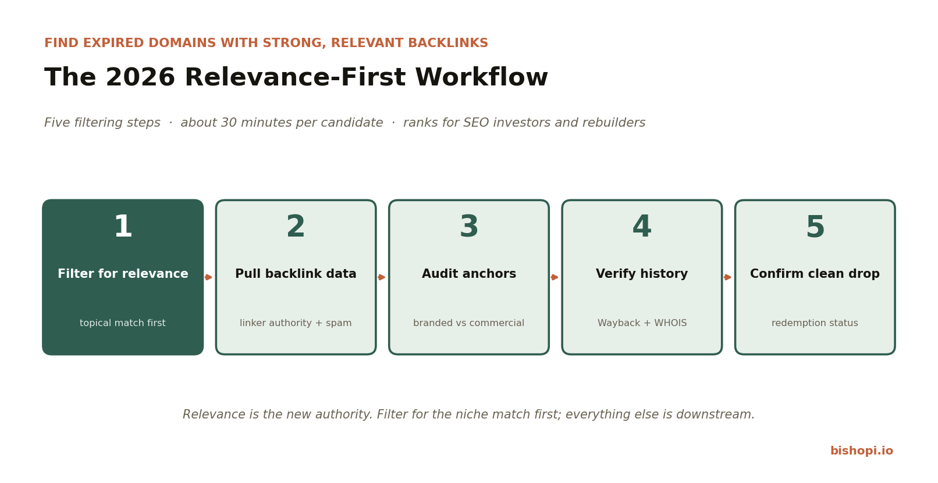
The filter order this article teaches puts relevance first, then strength, then history, then drop state. Run the filters in order and you will reject ninety percent of "available" expired domains in the first thirty seconds. The work is in finding the ten percent that are real.
Honest note before we start: expired-domain SEO is grey-hat adjacent. Google penalises it inconsistently but does penalise it, and a cheap acquisition can become a domain you cannot rank for at all if misused. The workflow below is built to keep you on the legitimate side of that line.
THE FIVE FILTERS, IN ORDER 1. Topical relevance, the niche match between linkers and your intended use. 2. Link profile strength, linker authority, spam signals, and anchor distribution. 3. Anchor-text audit, branded and natural beats commercial and exact-match. 4. History verification, Wayback Machine plus WHOIS transitions. 5. Drop-state confirmation, recoverable, pending-delete, auction, or actually available. |
What actually changed in 2026?
Google's 2024 and 2025 spam updates promoted topical relevance from a tiebreaker to a primary ranking signal for expired-domain backlinks. A clean, high-authority backlink profile in the wrong niche is now treated as suspicious rather than valuable, inverting the older "buy DR, redirect, rank" playbook completely. |
The single sentence to carry into every candidate evaluation: relevance is the new authority. Two domains with identical Domain Rating scores can have wildly different SEO value, depending on whether the sites linking to them are in a niche you can credibly inhabit.
This is the reframe most pre-2024 guides miss. The 2023 advice was "find any expired domain with DR 40+ and clean anchors." The 2026 advice is "find expired domains where the linker niche matches your intended use, then evaluate strength within that constrained set." The candidate pool shrinks dramatically. That is a feature, not a bug. The smaller pool is also where the genuinely usable domains live.
Where do strong, relevant expired domains actually surface?
Three sources, in order of yield: registrar auctions (where most topically-aligned domains end up), curated drop services that pre-screen backlinks, and the open drop pool (mostly noise). Auctions have the strongest names; the open pool rarely contains anything stronger buyers have not already filtered out. |
Registrar auctions (GoDaddy Auctions, NameJet, SnapNames). Most topically-aligned domains with meaningful backlinks are claimed here before they reach the open pool. Expect to pay; expect competition. The strongest names live here.
Curated drop services that pre-filter for clean backlinks. Bishopi's Fresh Drops is the one I use most: the daily list is hand-picked and each candidate has already been scanned for clean backlinks and malicious history. That removes most of the relevance-check work below. ExpiredDomains.net is the volume option if you prefer to do the filtering yourself.
The open drop pool (DropCatch, dynadot, registrar-scraped lists). Rarely contains topically valuable names that stronger buyers have not already filtered. Useful only with a very specific niche query and patience for noise.
Pricing tiers matter more than they look: closeout listings (under $50) almost never have usable backlink profiles, mid-tier ($100-$1,500) is where most real candidates live, and hand-curated listings above $1,500 are usually priced for specific buyers who recognise the value.
How do you actually filter for relevance first?
Pull the candidate's top 20 referring domains and ask one question per linker: would this site plausibly link to my intended use of this domain? If half or more fail the question, the candidate is off-niche - stop here. Otherwise, the relevant subset becomes the strength baseline for the next filter. |
This is the filter older guides do not lead with, and it is the one that separates a useful workflow from a wishful one. Four mechanical steps:
Pull the top 20 referring domains. Sort by authority descending; anything past 20 is signal noise for an initial filter.
For each linker, ask one question: would this site plausibly link to the project I would build on this domain? Not "is this site high-authority" - is the niche match plausible.
Count. If half or more of the top 20 fail the question, the candidate is off-niche - we stop here, regardless of how strong the aggregate profile looks.
Mark the relevant ones. These become the strength baseline for the next filter; the off-niche ones are noise that inflates the candidate's apparent authority.
The most common failure mode is wishful relevance. A candidate with twelve DR-60 linkers from generic news sites, two from a category-adjacent blog, and six from off-topic affiliate sites is not topically aligned just because two linkers happen to fit. The two are the exception, not the pattern, and Google reads the aggregate.
WORKING NOTE The test I apply when I am unsure: imagine the article on your intended site that would earn each of the candidate's top backlinks today. If for half the linkers you cannot picture what that article would even be about, the relevance match is theatre - and Google reads it the same way. |
How do you read the link profile once relevance passes?
Evaluate the relevant subset on four signals: linker authority within that subset (not the overall average), anchor-text distribution (branded beats commercial), spam and toxicity patterns, and link velocity over time. Authority matters most after relevance, never as a substitute for it. |
Linker authority within the relevant subset. Four DR-50 niche-blog linkers beat twenty DR-30 mixed linkers, even when the second profile has more aggregate authority. The overall average is misleading; the strength of the topically-relevant subset is what matters.
Anchor-text distribution. Healthy profiles lean branded and generic. Commercial-keyword anchors above thirty percent density signal paid or manipulated links, and Google's anchor-spam detection improved substantially through 2024-2025. Treat such a domain as if it had a manual action against it.
Spam and toxicity indicators. A handful of low-quality linkers is normal noise. The patterns that should kill a candidate: clusters from a single network, links from deindexed pages, sudden historical spikes without a corresponding event.
Link velocity. Steady acquisition over years looks natural. Sudden bursts that coincide with no visible event - product launch, press, viral content - usually indicate paid campaigns. The acquired authority is fragile to the next algorithm update.
The audit method itself works the same whether you are buying a domain or studying a competitor; our competitor backlink analysis guide walks through it end to end. For expired-domain acquisition the difference is weighting: topical relevance is a hard filter rather than a preference, and toxic links are deal-breakers rather than cleanup tasks (you cannot disavow on a domain you do not own).
How do you verify the history before buying?
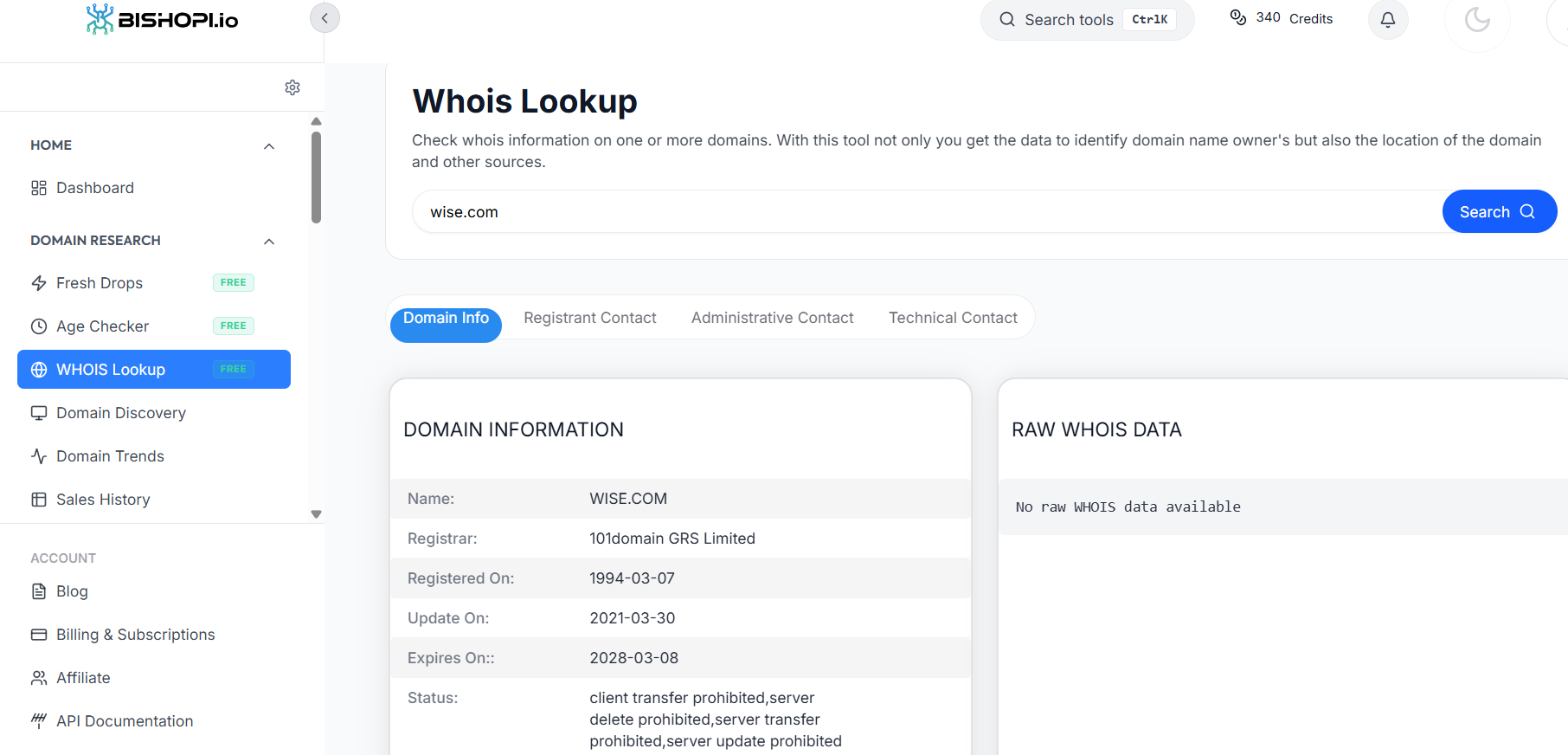
Combine three lookups: Wayback Machine for prior content and use, WHOIS history for ownership transitions, and a domain age check that combines both. Look for clean ownership lineage, on-niche prior use, and no patterns suggesting deliberate flipping. |
Wayback Machine. Pull the archive and sample five or six snapshots across the domain's life. The pattern matters more than any single snapshot - was the site a real business, a niche blog, a foreign-language flip, or a series of placeholder pages with rotating content?
WHOIS history. Multiple registrar transitions in short windows or repeated drop-and-reregister patterns almost always indicate speculative properties. Bishopi's WHOIS Lookup pulls the current record; the Domain Age Lookup combines registration data with Wayback access in one view, which is faster when you are working through a list of candidates.
Gap analysis. Long periods between active uses (no Wayback snapshots, parking pages only) suggest the domain was held for speculation rather than building, which weakens the relevance signal even when individual snapshots look clean.
The framing I use when unsure: imagine showing the full Wayback history and current backlink profile to a Google webspam reviewer. Are you comfortable with what they would see? If not, walk away.
How do you confirm the domain is actually available?
Check the current drop status: actively registered, grace period, redemption, pending-delete, or genuinely available. Most "expired" listings are still recoverable by the previous owner or already claimed by a backorder service. Only pending-delete and available domains are real opportunities. |
After expiration, a domain enters a forty-day grace period during which the previous owner can renew, then a thirty-day redemption window with higher fees. Only after both close does the domain enter pending-delete, and only then is it genuinely available. Backorder services compete for that moment; without a backorder set, the domain is effectively unavailable to you.
If the domain is in auction, set your walk-away price before bidding and stick to it. The most common loss is not buying a bad domain - it is paying double for a good one.
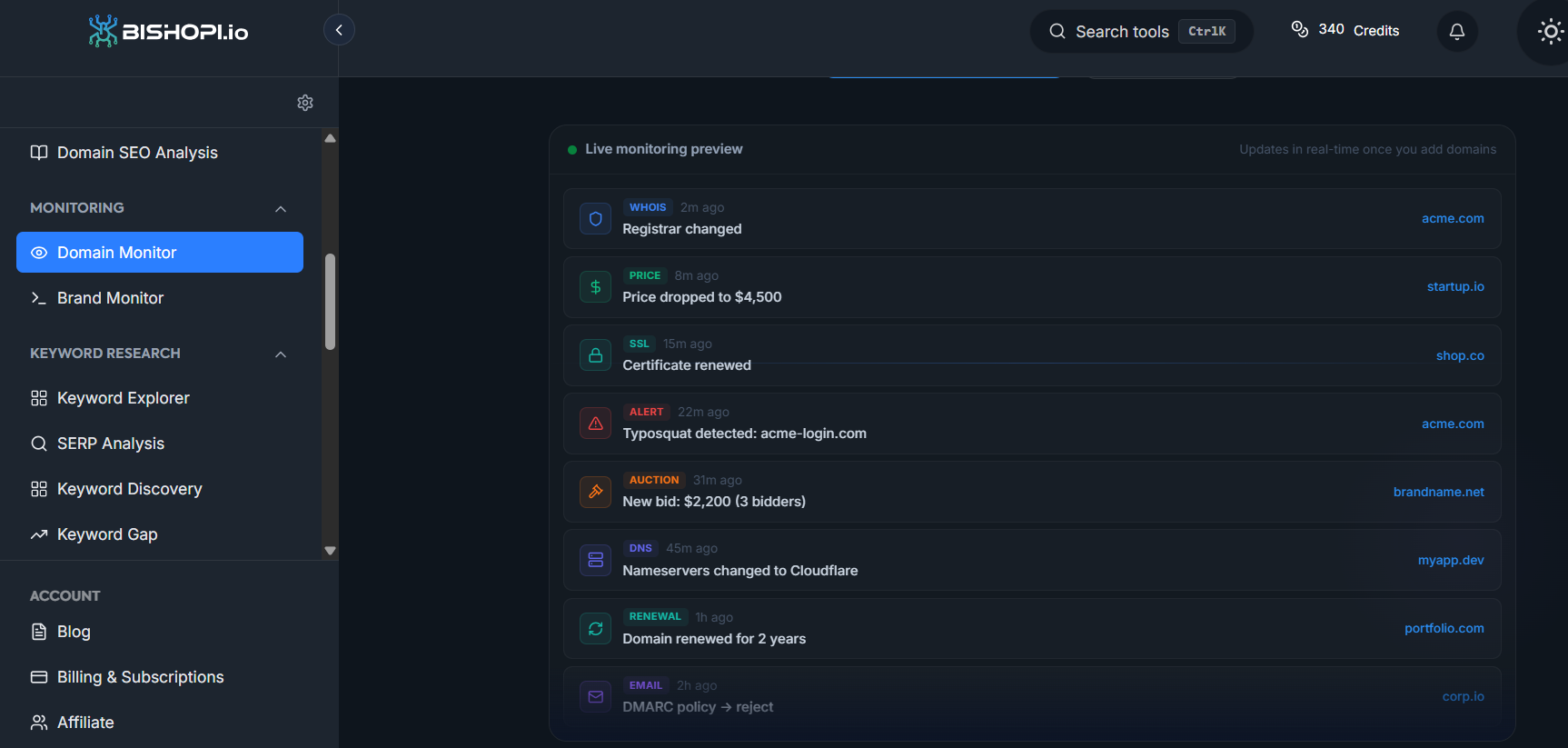
If the domain is in pending-delete, use a backorder service. For a curated workflow, Domain Monitor tracks WHOIS changes and expiration in real time, so you find out about candidates entering the recoverable window before they hit the open drop lists.
What can you legitimately do with the domain once you own it?
Four durable use cases in 2026, all sharing one rule: the niche match has to be real, not aspirational.
Niche site rebuilds. Relaunch the topic the domain was originally about. Existing backlink equity supports the new content; topical alignment is automatic. The strongest use case and the one Google rewards most consistently.
New niche sites that genuinely match. A new project in the original niche, even under a different brand. The test: would a reader landing on the new site understand why the existing backlinks point at it?
Topically-aligned 301 redirects. Redirecting to a same-niche destination is legitimate. Redirecting to anything topically unrelated, even your own established main site, is the configuration Google's expired-domain-abuse system was built to flag.
Resale within the original niche. Selling to a buyer who can use the domain credibly preserves the value. Topically-aligned domains move faster in resale than off-niche "high DR" listings.
Frequently asked questions
Are expired domains still good for SEO in 2026?
Yes, when used correctly. Topically-aligned rebuilds and niche-matched redirects still work and Google rewards them. The 2024-2025 spam updates changed which expired-domain strategies work, not whether any of them do. Off-niche profiles and link-funnel configurations are penalised; on-niche rebuilds are not.
How do I check if an expired domain has spammy backlinks?
Pull the link profile in a backlink audit tool and check three signals: anchor-text distribution heavy in commercial keywords, clusters of low-authority links from a single network, and sudden historical link spikes without a corresponding event. Any one signal is background noise; two or three together is a profile to walk away from.
Where can I find expired domains with backlinks?
Registrar auctions (GoDaddy Auctions, NameJet, SnapNames) for the strongest names. Curated drop services like Bishopi Fresh Drops or ExpiredDomains.net for daily updated lists with pre-filtering. The open drop pool rarely has topically valuable candidates that stronger buyers have not already filtered out.
Is buying expired domains legal?
Yes. The practice is fully legal in every jurisdiction that operates a registrar system. The legal question is unrelated to the SEO question: a legally-purchased domain can still be penalised by Google if used in a way that violates Google's spam policies (off-niche redirects, paid link networks, manipulation patterns).
The bottom line
Finding expired domains with strong, relevant backlinks is a discipline of rejection, not discovery. The available pool is enormous and ninety percent of it is unusable for the reasons the filters above catch. The real work is running the filters in the right order - relevance, strength, history, drop state - and walking away from candidates that fail any one of them, even when the others look promising.
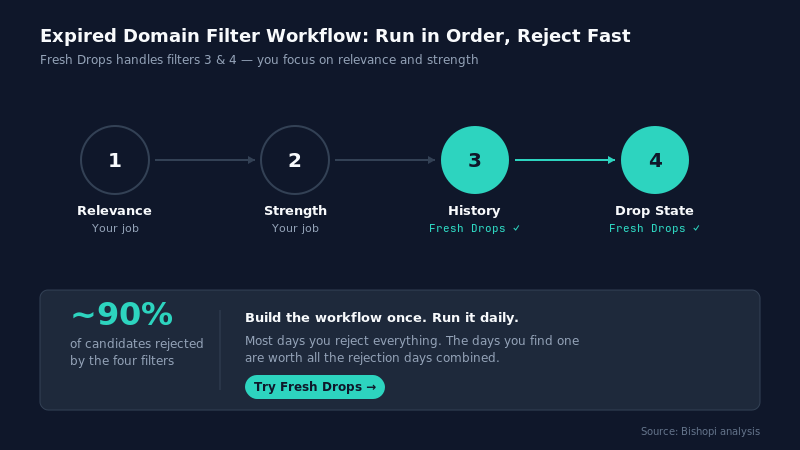
Build the workflow once and run it daily. Most days you reject everything and move on. The days you find one are worth all the rejection days combined.
Skip the first filter. Fresh Drops curates daily expired domains pre-scanned for clean backlinks and malicious history, so you start the workflow on candidates that have already passed the basic safety checks. The relevance check is still on you - but the noise is already gone. |
Originally published at: bishopi.io
Stay up to date
Get updated with all the news, update and upcoming features.