SERP Features: How to Track Featured Snippets, PAA & AI Overviews
You've probably seen this happen - your rankings haven't changed, but clicks have drastically dropped. The likely reason is a SERP feature pre-answering users.
AI Overviews, Featured Snippets, and other SERP features increasingly answer the user's question before they ever reach the organic results. According to a study across 64 publisher sites, organic clicks were 42% below pre-AI Overview baselines by 2025.
In 2026, rankings tell you where your page appears. They don't tell you how visible it is. Visibility now depends on which SERP features appear, who owns them, and whether your page is cited.
This guide explains what to track, why it matters, and how to monitor SERP features at scale, including how to check your keywords for free.
SERPs vs Rankings in 2026: Why Are You Losing Organic Clicks?
SERP monitoring tracks the search features that appear for your target keywords - Featured Snippets, People Also Ask boxes, AI Overviews, Local Packs - and whether your content appears in them. Standard rank tracking tells you where your page appears. SERP monitoring tells you what users actually see.
That distinction is easy to miss until you compare two searches with identical rankings.
Imagine your page ranks second for two keywords. In one search, you're just below the top result. In the other, users see an AI Overview, a Featured Snippet, a People Also Ask box, and a Local Pack first.
Search Console reports the same position for both but users experience two very different SERPs.
That's because ranking is only one part of visibility. The biggest change is how Google allocates attention before users ever reach them.
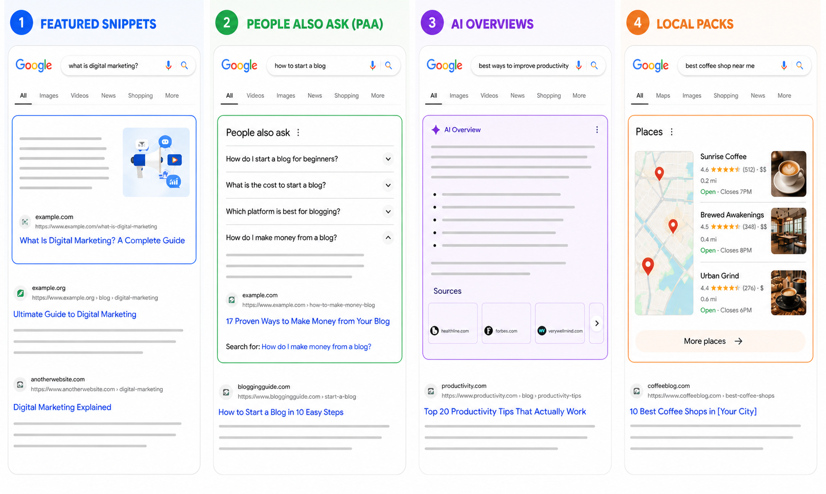
Featured Snippets: They appear right under the search box directly answering the query even before a user can see the first organic result.
People Also Ask (PAA): This section builds upon the original query by answering a series of related questions and sending clicks to posts that answer them.
AI Overviews: They synthesize information from multiple sources - several domains may receive citations while others disappear entirely, regardless of where they rank.
Local Packs: They replace traditional organic results altogether for many location-based searches.
Each SERP feature changes click behaviour in its own way, so each needs to be monitored differently. Rankings tell you where you appear. They don't tell you what users see before they reach your page.
We are moving away from thinking about "Where do you rank?" to "What competes for attention before your result?"
How Do You Track Featured Snippets in SERPs?
The latest visual change in SERPs is AI Overviews but Featured Snippets changed the rules first. They proved that Google doesn't always reward the highest-ranked page - it rewards the page that answers the query best.
That's why tracking snippet ownership separately from rankings matters. Rankings show where your page appears in organic results. Snippet ownership shows whether Google considers your page the best answer to a query.
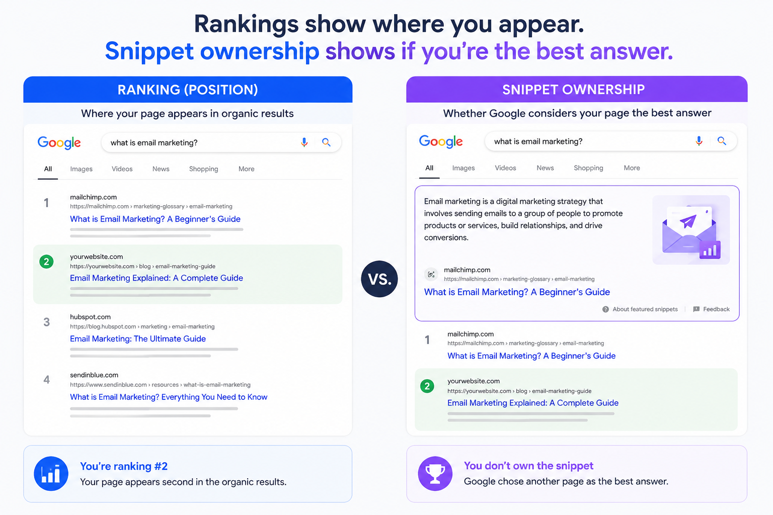
In my experience monitoring keyword sets across multiple verticals, the two signals diverge more often than most SEOs expect - and when they do, it's usually the snippet shift that explains a traffic change, not the ranking move.
A SERP API becomes useful. A ranking tells you that you're #2. It doesn't tell you whether Google has placed someone else's answer above you.
That's why I like to track snippet ownership separately. Is there a Featured Snippet? Who owns it? What format did Google choose? Where does that page rank organically? Those answers explain why two pages with similar rankings can receive very different amounts of traffic.
How Do You Get Ranked in Featured Snippets?
Featured Snippets are most likely to come from pages that answer the search query immediately, use wording that matches the user's search, and present the information in the format Google expects, such as a paragraph, list, or table. Clear, direct answers consistently outperform longer introductions.
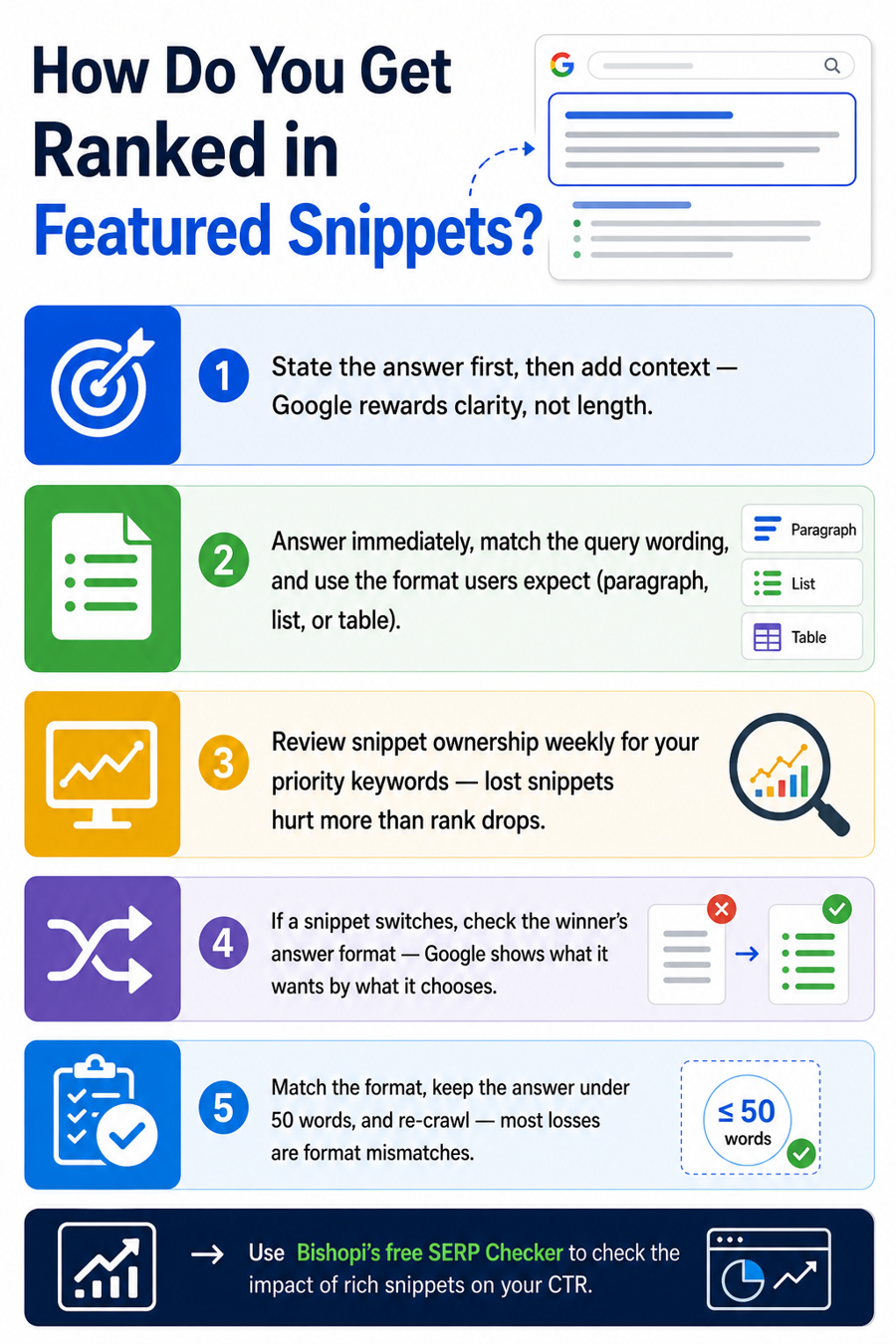
One thing I've noticed is that Google rarely rewards the longest page. It rewards the page that removes the most friction. The pages that earn snippets get to the answer immediately, then add the supporting detail. If the answer is buried halfway down the page, Google usually finds a page that surfaces it sooner.
Monitoring tip: Review snippet ownership weekly for your priority keywords. A lost snippet often has a bigger traffic impact than dropping one organic position.
When a snippet switches hands, the first thing to check isn't your content — it's the winning page's answer format. Google usually signals what it wants by what it chooses. If you had a paragraph snippet and a competitor won it with a bulleted list, the format is the fix, not the word count.
Pull the winning page, match the format, tighten your answer to under 50 words, and re-crawl. Most recoverable snippet losses are format mismatches, not authority gaps.
→ Use Bishopi's free SERP Analysis Tool to check the impact of rich snippets on your CTR.
How Do You Track the People Also Ask (PAA) Section?
Featured Snippets showed that Google could elevate a single answer above the organic results. People Also Ask expands that model across an entire topic, surfacing multiple related questions, each with its own source.
Unlike Featured Snippets, PAA changes constantly. Questions rotate, source URLs change, and every click generates new results. Your page can hold the same ranking while disappearing from the questions users are actually seeing.
PAA also surfaces competitive gaps that rankings can't. You can see which domains consistently answer related questions, where your content is missing, and which topics competitors own.
At a minimum, a SERP API should return for each PAA box: question text, answer snippet, source URL, and PAA position. Across a keyword set, those signals show who owns which questions, how often they appear, and where your biggest content gaps are.
How Can You Get Featured in PAAs?
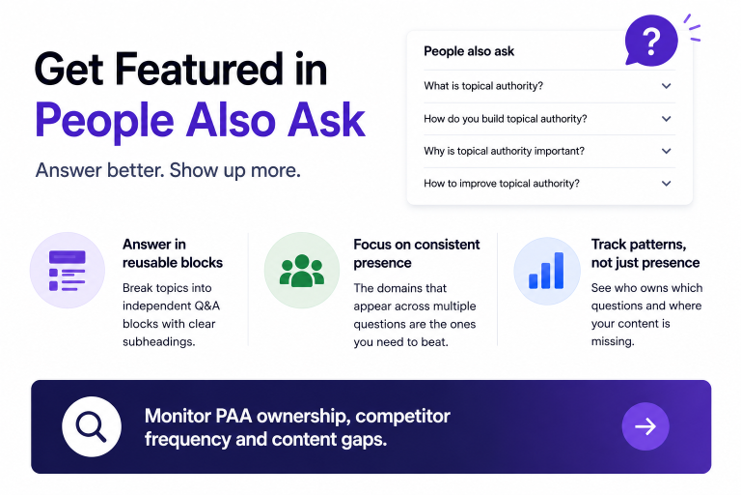
Pages that appear repeatedly in PAA break a topic into reusable answer blocks. Each question is answered independently, with clear subheadings that match how people search.
The most useful PAA metric isn't whether you appear - it's who appears consistently. If the same domains repeatedly answer questions you're missing, you've found a content gap rather than an authority gap. Google has already shown you which questions matter; your job is to answer them better.
That said, PAA source diversity. Some queries surface four different domains across four questions — distributed topic ownership. Others return the same two domains across every question — concentrated authority.
The second pattern is harder to break into but more valuable when you do. If one competitor owns the PAA cluster for your core keyword, that's not a content gap problem — it's a topical authority gap, and the fix is a content series, not a single page optimization.
→ Monitor PAA ownership, competitor frequency and content gaps with Bishopi's People Also Ask Tool.
How Do You Monitor AI Overview Citations, Rankings and Visibility?
PAA shows you which questions Google is surfacing. AI Overviews go further — they synthesise the answers, and which sources get cited has almost no relationship to where those sources rank.
AI Overviews break the link between rankings and visibility in a way no previous SERP feature did. Pages outside the top ten can be cited while higher-ranking pages are ignored. That's a fundamentally different problem than Featured Snippet tracking, and it requires different data.
Three things make AI Overviews harder to monitor than traditional rankings:
Results vary. Location, query wording and device can all change the cited sources.
Citations and rankings are separate signals. A cited page doesn't need to rank first - and often doesn't.
Rank trackers don't record citations. They tell you where a page ranks, not whether Google cited it.
It's worth being direct about the data limitations here: AI Overviews are not consistently returned. They vary by user location, query phrasing, device, and session.
Any monitoring tool - including Bishopi's - is sampling a moving target. What you're looking for are patterns over time, not a single definitive snapshot. Any AI search engine optimization tool claiming they give you a complete AI Overview picture is overselling the data.
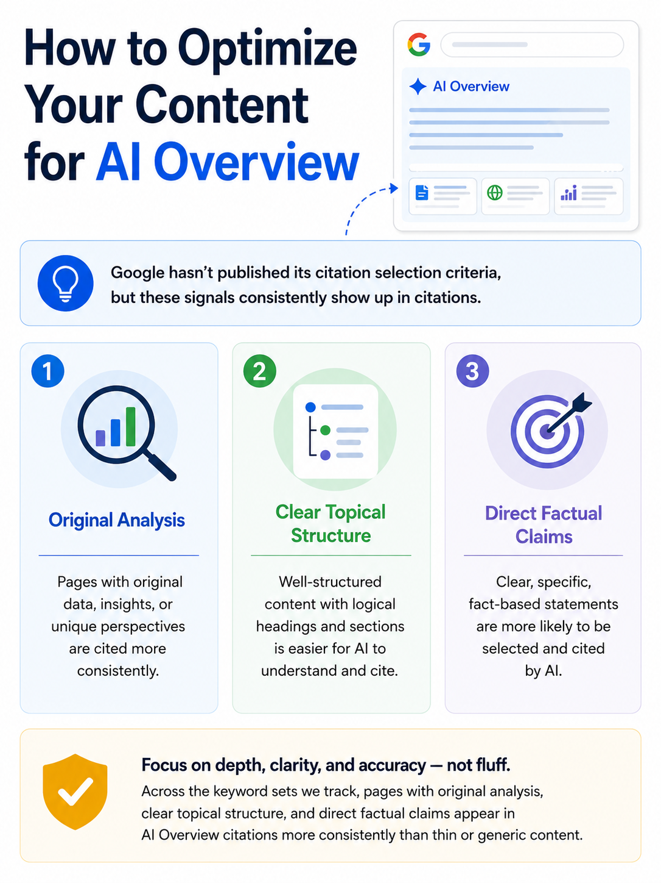
That said, patterns do emerge. Across the keyword sets I monitor, pages with original analysis, clear topical structure, and direct factual claims appear in citations more consistently than thin or generic content. Google hasn't published its citation selection criteria, but those signals have been remarkably stable.
One distinction that matters for tracking: AI Mode and AI Overviews are different search experiences.
They follow different trigger logic and produce different citation patterns - AI Overviews appear in standard Google Search results, while AI Mode is a separate conversational interface. Track them separately. Monitoring tools that conflate the two produce misleading data.
What AI Overview Tracking Data Should Look Like
Here's what structured AI Overview tracking looks like in practice. This is the kind of output Bishopi's API returns, and what you should expect from any monitoring tool you build or buy.
Note: The table below is illustrative - example output showing the data structure, not live results. Actual citations vary by location, date, and query.
Query | AI Overview Present | Is Your Brand Cited? | Competitor Domains Cited | Date Checked |
serp monitoring tools 2026 | Yes | No | semrush.com, searchengineland.com | 2026-06-10 |
how to track featured snippets | Yes | Yes | ahrefs.com, moz.com | 2026-06-10 |
ai overview rank tracking software | Yes | Yes | - | 2026-06-11 |
free serp checker api | No | - | - | 2026-06-11 |
track paa appearances | Yes | No | serpstat.com, brightedge.com | 2026-06-12 |
This is the view that standard rank trackers don't give you. The rows where Bishopi isn't cited but competitors are - those are the actionable signals. You know the query triggers an AI Overview, you know which domains are getting the citation, and you have a timestamp to detect when that changes.
Without this history, it's difficult to tell whether your visibility changed because Google introduced an AI Overview for a keyword or because the citations within an existing Overview shifted.
→ Track AI Overview appearances for your keywords with Bishopi's AI Visibility Tool.
How Do You Track SERP Features Across Hundreds of Keywords?
The ranking is the outcome but the SERP is the evidence. When traffic changes, I don't start by looking at positions.
Instead, I look at what Google added, removed, or replaced on the page. AI Overviews, Featured Snippets, and citations usually explain the shift long before rankings do.
Here’s the whole process:
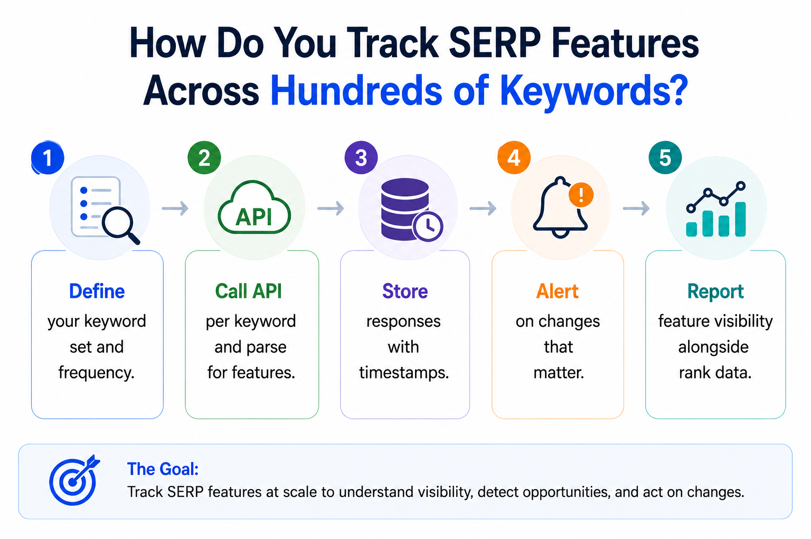
Step 1: Define your keyword set and tracking frequency. High-volatility queries, branded terms, and keywords that frequently trigger AI Overviews deserve more frequent crawls than stable informational searches.
Step 2: Make an API call per keyword and parse the response for feature presence flags. A well-structured SERP API response returns whether a Featured Snippet exists (with format and source URL), which PAA questions appear and who owns them, and whether an AI Overview is present with which domains are cited.
Step 3: Store the complete response with timestamps. Historical data explains traffic changes retrospectively. Keep Featured Snippet ownership, PAA questions, AI Overview citations, source URLs, and device/location context.
Step 4: Alert on changes. The events that matter: a Featured Snippet changing hands, an AI Overview appearing for a keyword where none existed before, or your domain dropping from citations. Those are signals; static weekly reports aren't.
Step 5: Report SERP feature visibility alongside standard rank data. Rankings explain where your page appears. SERP features explain what users actually saw above it.
→ Explore the Bishopi SERP API for structured SERP feature data at scale.
Which SERP Monitoring Tool Should You Use?
The right tool depends on what you're trying to do. Checking a handful of keywords requires a different setup than monitoring hundreds over time.
Standard rank trackers return a position number. What they don't return is whether a SERP feature is present, who owns it, or whether your domain appears in an AI Overview citation — that data requires a different kind of API.
If you want to... | Use |
Check whether a keyword has a Featured Snippet, PAA, or AI Overview - free | Bishopi SERP Analysis Tool (free), Bishopi People Also Ask Tool |
Track AI Overview citations across a keyword set | Bishopi AI Visibility Tool |
Build custom dashboards, alerts, or reporting workflows via API | Bishopi SERP API |
Monitor Local Packs across locations | Bishopi SERP Analysis Tool |
Verify SERP features before publishing or updating content | Bishopi SERP Analysis Tool (free) |
Start with the free SERP Analysis Tool if you're spot-checking individual keywords - it's also the fastest way to access free AI overview rank tracking without an API key.
It covers Featured Snippets, People Also Ask and basic AI Overview tracking. Once you're monitoring hundreds of keywords, manual checks stop scaling - that's where the SERP API becomes the better fit, giving you historical data, automated alerts and monitoring across your full keyword set.
FAQ
1. What is SERP monitoring and why does it matter?
SERP monitoring tracks search features like Featured Snippets, People Also Ask, AI Overviews and Local Packs, not just rankings. It shows what users actually see above organic results and whether your content appears in those features - which determines CTR regardless of ranking position.
2. How do I check if my content appears in a Featured Snippet?
Use a SERP checker that reports snippet ownership, format and source URL. Bishopi's free SERP Analysis Tool shows whether a Featured Snippet exists and which page owns it for any keyword you check.
3. Can I track AI Overviews with a standard rank tracker?
No. Rank trackers report positions only. AI Overview tracking requires citation data - specifically, which domains Google is citing in the Overview and whether yours is among them. You need a tool that detects AI Overviews and records citation history over time.
4. What does a SERP data API return?
A SERP API returns the full search results page, including rankings, SERP feature flags, source URLs, AI Overview citations, and device and location context. That makes it possible to monitor changes across the entire SERP, not just position numbers.
5. Is there a free SERP checker for Featured Snippets?
Yes. Bishopi's free SERP Analysis Tool lets you check Featured Snippets and basic AI Overview presence for individual keywords. For ongoing monitoring across larger keyword sets, the SERP API is the better fit.
6. How often should I monitor SERP features?
Monitor stable keywords weekly. For high-value keywords that frequently trigger AI Overviews or volatile PAA results, daily tracking is the better default - these features can change hands in hours, not weeks.
Start Tracking AI Overview Citations Now
A page can hold the same ranking while losing a Featured Snippet, disappearing from AI Overview citations, or dropping out of People Also Ask entirely. If you're only tracking positions, you're seeing less than half the picture.
The most important thing to track in 2026 isn't whether you rank - it's whether Google is citing you.
Start with Bishopi's SERP Analysis Tool to see which queries are triggering Overviews in your keyword set, which competitors are being cited, and where you're missing.
When you're ready to monitor at scale, the Bishopi SERP API gives you full historical data and automated alerts.
Originally published at: bishopi.io
Stay up to date
Get updated with all the news, update and upcoming features.