What 480,667 .com Domain Sales Reveal About the 2026 Market
The .com aftermarket is the resale market for previously registered .com domains, and across 480,667 sales recorded between January 2024 and May 2026, 99.4% of them closed below $10,000. The market's real center of gravity sits far lower than the headline transactions suggest. The largest single sale in the period was AI.com at $70 million. Almost everything else happened in a narrow band most investors rarely talk about.
That gap, between what gets reported and what actually transacts, is the story this analysis tells. We pulled every .com sale in Bishopi's sales database from the last 28 months: 480,667 transactions totaling $491,165,750 in tracked value. The numbers describe a market that is both larger and smaller than its reputation. Larger in volume than most people realize. Far smaller in price than the headlines imply.
Here is what the data shows.
Key Takeaways
99.4% of .com sales closed under $10,000. Only 0.6% crossed that line, and just 0.04% (198 sales) reached $100,000 or more.
The middle of the market is cheap. 56.5% of all sales landed between $100 and $999, with a median of $255. Another 30.7% sold for under $100.
GoDaddy moves the volume; Sedo moves the value. GoDaddy handled 67.9% of sales by count but only 37% by dollar value. Sedo was the inverse: 1.1% by count, 8.3% by value.
Length stops mattering after three characters. Three-character .com domains carried a median of $1,425. Four-character dropped to $234. From five characters on, prices flattened to roughly $180 to $195.
The headline sales are statistically invisible. The ten largest sales represent 0.002% of all transactions.
How We Measured This
This analysis covers 480,667 .com domain sales recorded in Bishopi's sales database between January 1, 2024 and May 21, 2026. It includes only .com domains. Sales are aggregated from public reporting across multiple venues, including GoDaddy, Sedo, Afternic, Dan, DropCatch, Namecheap, and Dynadot. Individual headline figures were cross-checked against public sale reporting at NameBio and DNJournal. Where a sale was reported in another currency, it was converted to USD at the time of sale. Throughout, we use the median rather than the average, because a handful of seven- and eight-figure sales (above all AI.com at $70 million) badly distort the average.
The price distribution: where the money really is
The single most useful thing the data does is correct a perception problem. Ask most people to picture the domain market and they picture six-figure sales. The reality is almost entirely sub-$1,000.
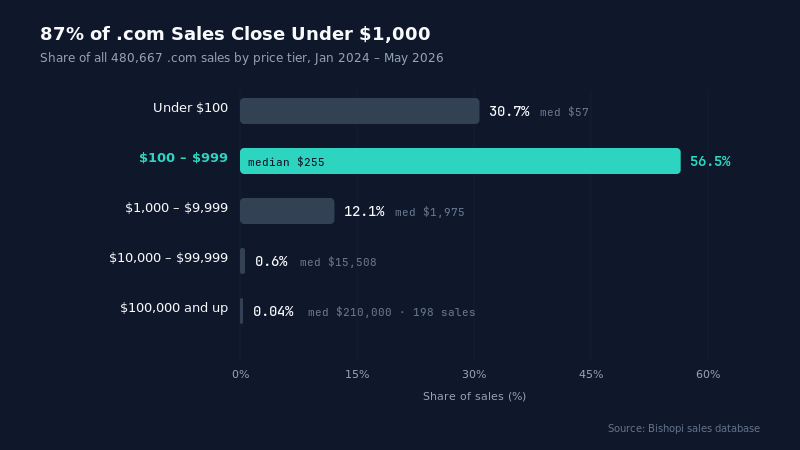
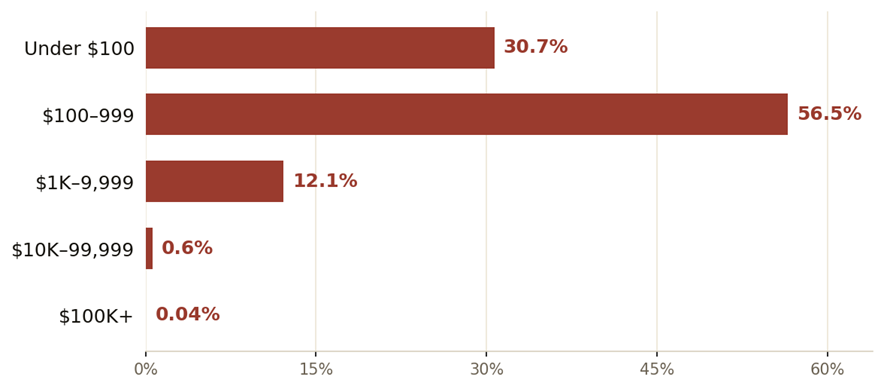
Figure 1. Share of all 480,667 .com sales by price tier, January 2024 to May 2026. The $100–$999 band alone accounts for 56.5% of the market. Source: Bishopi sales database.
Here is the full distribution across all 480,667 sales:
Price tier | Share of sales | Median in tier |
Under $100 | 30.7% | $57 |
$100 to $999 | 56.5% | $255 |
$1,000 to $9,999 | 12.1% | $1,975 |
$10,000 to $99,999 | 0.6% | $15,508 |
$100,000 and up | 0.04% | $210,000 |
Read the top two rows together. More than 87% of every .com sale in the last 28 months closed under $1,000. The largest single tier, by a wide margin, is the $100 to $999 band: 56.5% of the entire market, four out of every seven sales, with a median of $255.
The tiers most people associate with domain investing are tiny. The $10,000 to $99,999 band, the "good sale" most investors aspire to, accounts for 0.6% of transactions. The six-figure tier is 198 sales in 28 months, four hundredths of one percent. If you imagine the .com market as the stories you read about, you are imagining 0.04% of the actual market. The other 99.96% is where investors actually transact. If you want to understand what makes a name land in that top fraction, our breakdown of whether domain names are worth money walks through the signals that drive real value.
Where .coms Actually Sell
The .com aftermarket is the secondary market where registered domains are resold, and it splits cleanly into two layers: a high-volume layer led by GoDaddy, which handled 67.9% of all recorded sales by count, and a high-value layer led by Sedo, which carried just 1.1% of sales by count but 8.3% of total dollar value. Venue choice is a pricing decision, not just a distribution one.
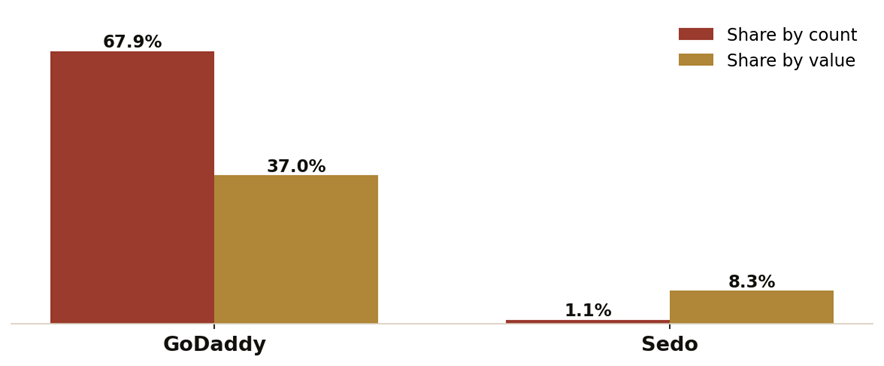
Figure 2. GoDaddy versus Sedo, share of .com sales by transaction count compared to share by dollar value. GoDaddy dominates volume; Sedo concentrates value. Source: Bishopi sales database.
By transaction count, GoDaddy dominates completely: 67.9% of all recorded .com sales ran through GoDaddy's channels. But by dollar value, GoDaddy accounted for only about 37% of the total. The volume runs through GoDaddy; the value largely does not. Sedo is the mirror image: just 1.1% of sales by count but 8.3% of total value. A sale on Sedo was, on average, worth many times a sale on GoDaddy.
The pattern points to a clean division of the market:
The volume layer (GoDaddy, DropCatch, Namecheap, Dynadot) is fast, cheap, and high-turnover. This is where expired inventory, drop-catches, and sub-$500 sales clear. Most domain investors live here.
The value layer (Sedo, Afternic, and brokered private sales) is slower, more negotiated, and carries far higher average prices. This is where end-user buyers and larger acquisitions concentrate.
The practical takeaway: the right venue depends entirely on what you are selling. If your priority is a quick exit rather than a top price, our guide to how to sell a domain name fast compares the venues built for speed.
Marketplace Fees Compared
Marketplace fees are the commission the venue deducts from your sale price, and they range from roughly 9% to 25% depending on the platform and listing type. Payout speed and escrow handling vary just as widely. The table below summarizes the headline commission structures for the six venues most .com sellers use.
Marketplace | Typical commission | Escrow / payment handling | Payout timing |
GoDaddy | ~15–20% (listing dependent) | Built-in transaction handling | Several business days after transfer |
Sedo | ~15% (min. fee applies) | Included transfer/escrow service | After buyer payment and transfer confirmation |
Afternic | ~15–25% (fast-transfer vs standard) | Escrow via partner network | After transfer completes |
Dan (GoDaddy) | ~9–15% | Built-in escrow and installments | Typically within a few business days |
Namecheap | ~10% | Marketplace-handled transaction | After transfer completes |
Dynadot | ~10% (marketplace listings) | Marketplace-handled transaction | After transfer completes |
Commission rates shift with promotions and listing type, so confirm the current schedule on each marketplace before you list. The broad shape holds
Length matters, but only up to a point
Domain investors spend a lot of energy on length. The data says length matters intensely at the very short end and almost not at all everywhere else.
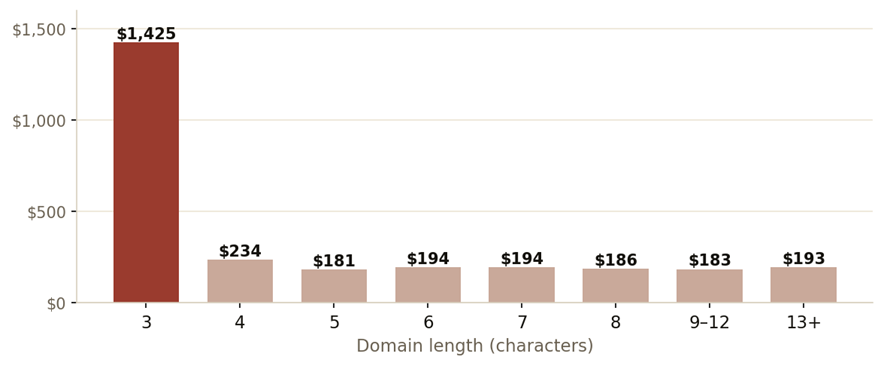
Figure 3. Median .com sale price by domain length in characters. The three-character premium is dramatic; from five characters onward, length barely moves the median. Source: Bishopi sales database.
Domain length | Median sale price |
3 characters | $1,425 |
4 characters | $234 |
5 characters | $181 |
6 characters | $194 |
7 characters | $194 |
8 characters | $186 |
9 to 12 characters | $183 |
13+ characters | $193 |
Three-character .com domains carried a median of $1,425, roughly eight times the median of any longer bucket. That premium is real and reflects genuine scarcity. Then it falls off a cliff. Four-character domains dropped to a $234 median. From five characters onward, median prices flatten into a tight band between roughly $181 and $194 and stay there, all the way out to thirteen-plus characters. A five-character domain and a twelve-character domain sold for almost exactly the same typical price.
The lesson for investors: the only length-based pricing premium worth chasing in .com is at three characters. Below that line you are paying for scarcity. Above it, the market does not reward shorter for its own sake. What it rewards is the quality of the words, not the count of the characters, which is exactly what our look at domain psychology and what makes a name memorable digs into.
The headline sales, in context
The .com market does produce spectacular sales. The ten largest in our window:
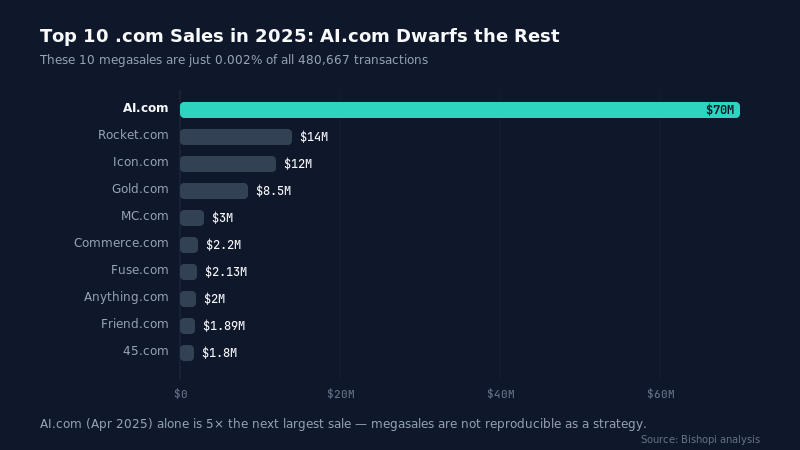
Domain | Price | Month |
$70,000,000 | Apr 2025 | |
$14,000,000 | 2025 | |
$12,000,000 | 2025 | |
$8,500,000 | 2025 | |
$3,000,000 | 2025 | |
$2,200,000 | 2025 | |
$2,130,000 | 2025 | |
$2,000,000 | Dec 2025 | |
$1,890,000 | 2025 | |
$1,800,000 | 2025 |
These are the sales that make the news. They are also ten transactions out of 480,667, which is 0.002% of the market. Every one is short, every one is a recognizable word or a premium initialism, and none is reproducible as a strategy. You cannot go acquire the next AI.com. The lesson from the top of the market is the opposite of what it looks like: the megasales are so rare that building any expectation around them is a mistake. The market that pays your bills is the one below $1,000.
What this means if you buy and sell .coms
Pulling the data together, four things follow directly for anyone trading .com domains.
If you list under $1,000, you are in the real market, so price for it. The $100 to $999 band is 56.5% of all sales. This is the most competitive, highest-velocity part of the market. Pricing precision matters more than positioning, because buyers have endless alternatives and almost no patience.
If you list at $10,000 or more, you are targeting 0.6% of buyers, so venue beats asking price. At this level the constraint is finding the rare buyer, not your number. That means Sedo, Afternic, or a broker, not a fast-turnover marketplace.
Stop overpaying for length below three characters. Unless you are buying a genuine three-character .com, length is not the value driver. A clean five-character brandable and a clean eleven-character brandable sell for roughly the same typical price.
Match the venue to the tier. The volume layer and the value layer are different markets with different buyers. Listing a premium name on a volume channel underprices it; listing a $150 brandable on a brokered channel just means it never sells.
Frequently asked questions
What is the average price of a .com domain sale?
The median .com sale between January 2024 and May 2026 was well under $1,000. In Bishopi's data, 87% of all sales closed below $1,000, and the largest single price tier ($100 to $999) had a median of $255. Averages mislead here because a few multimillion-dollar sales distort them, so the median is the more honest number.
How many .com domains sell for over $100,000?
Very few. In the 28 months from January 2024 to May 2026, only 198 .com sales reached $100,000 or more, out of 480,667 total sales. That is 0.04% of the market, roughly four hundredths of one percent.
Do shorter .com domains sell for more?
Only at the very short end. Three-character .com domains carried a median of $1,425, about eight times any longer bucket. But from five characters onward, median prices flatten to roughly $180 to $195 and stay there regardless of length.
Where do most .com domains sell?
By count, GoDaddy handles the majority: 67.9% of recorded .com sales in this dataset. But the higher-value sales concentrate elsewhere. Sedo handled only 1.1% of sales by count but 8.3% by total value, making it a higher-value venue.
What was the biggest .com sale recently?
The largest recorded .com sale between January 2024 and May 2026 was AI.com at $70 million in April 2025. Other top sales included Rocket.com at $14 million and Icon.com at $12 million.
The bottom line
The .com market is bigger than people think and smaller than they imagine. Bigger because the sheer volume of transactions, nearly half a million in 28 months, dwarfs what most observers assume. Smaller because almost all of that volume happens below $1,000, in a market that looks nothing like the seven-figure sales that define its public image.
For investors, the practical center of gravity is the $100 to $999 band, the three-character length premium, and the split between the volume and value layers. Those three facts explain most of what the data shows, and they are far more useful than any single headline sale.
Want to see where a specific domain fits? Pull real comparable sales from this same dataset, filtered by length, keyword, and date. |
Originally published at: bishopi.io
Stay up to date
Get updated with all the news, update and upcoming features.