Explore the Best Domain Registrars Ranked by What You'll Actually Pay
Here's the pricing math most domain registrars don’t want you to know: a .com domain advertised at $1.99 for year one, but $19.99 at renewal costs you $81.95 over five years.
Register that same name with a different registrar at $10.99/year flat, and you pay $54.95 over the same period. That is a $27 difference for a single domain name, and most buyers never realize they signed up for the more expensive option until renewal emails start arriving.
That pricing trap is why the best domain registrar is not the company with the lowest promo banner. It is the registrar with transparent renewals, free WHOIS privacy, clean security features, and a transfer policy that does not punish customers for leaving.
This guide covers the best domain name registrars by what you will actually pay over five years, not first-year promos. By the end, you will know which registrar fits your use case, how much your domain name costs over five years, and what to avoid.
But before that, here’s a heads up:
The domain market changed fast this year. GoDaddy changed its Terms of Service in February 2026 in ways that strip consumer protections for all 21 million+ customers. Spaceship has emerged as the new value leader with .com renewals below the Verisign wholesale price. Meanwhile, Cloudflare continues to hold at-cost pricing that no traditional registrar can match.
The 5-Year Cost Trap (And Why It Should Drive Every Decision You Make)
The domain registration industry runs on a single psychological trick: advertise a low first-year price, then quietly spike the renewal fees. A domain that costs $0.99 in year one can renew at $19.99+. For instance, a "$1 domain" from GoDaddy might end up costing over $100 after five years once renewals kick in.
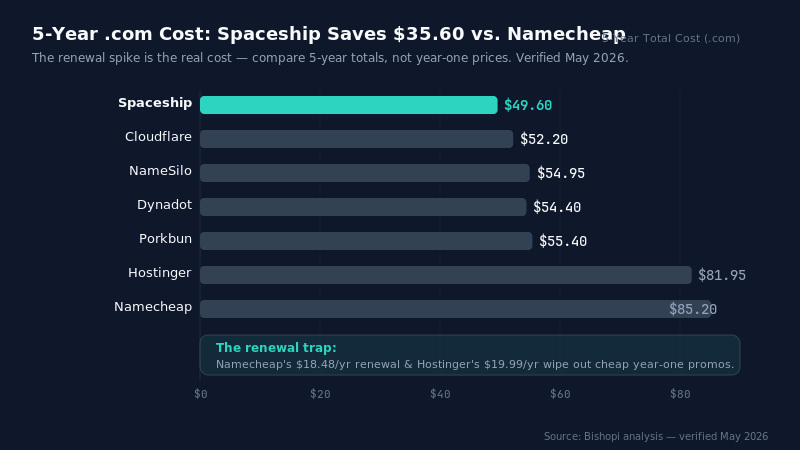
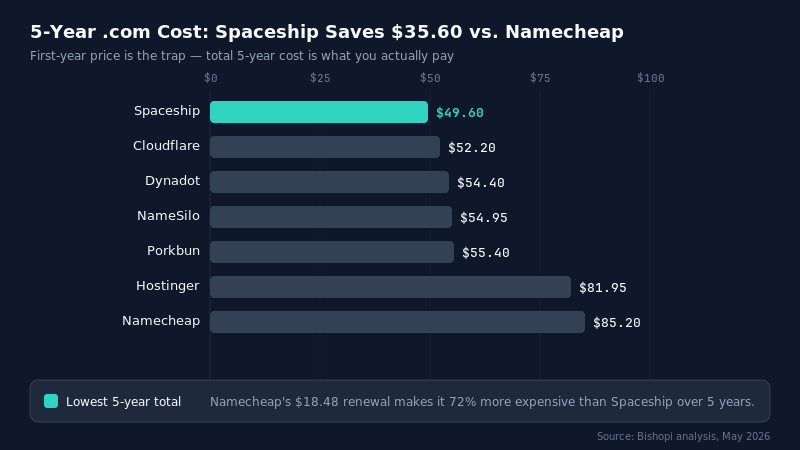
If you’re comparing domain name registrars by their first-year price, you’re comparing the wrong number. Compare by five-year total cost, because that’s what you actually pay.
Here's what you'll actually pay for a .com across the recommended domain registrars in this guide over a five-year period.
Note: The prices are verified as of May 2026. Always confirm on the registrar’s current pricing page before purchasing, as rates change.
Registrar | Year 1 .com | Renewal/year | 5-Year Total Cost |
|---|---|---|---|
Spaceship | $8.88 | $10.18 (inclusive of a standard ICANN fee of approx. $0.20/year) | $49.60 |
Cloudflare Registrar | $10.44 | $10.44 | $52.20 |
Dynadot | $10.88 | $10.88 | $54.40 |
Porkbun | $11.08 | $11.08 | $55.40 |
NameSilo | $10.99 | $10.99 | $54.95 |
Hostinger | Promo pricing varies (typically around $1.99) | $19.99 | $81.95 |
Namecheap | $11.28 | $18.48 | $85.20 |
IONOS | $1.00(requires a hosting plan purchase) | $20 to $22 | $81(assumes promo year 1 + four renewals at $20) |
Hover | $18.99 | $18.99 | $94.95 |
Squarespace | $12.00 | $20.00 | $92 |
The gap between the cheapest and most expensive options above is over $45 per domain over five years. Multiply that across 10 domains, and you’re looking at $450 in unnecessary costs, all for domains at identical registries, with identical ICANN oversight.
Beyond price, here are five things that separate a genuinely good domain registrar from a mediocre one in 2026:
Flat renewal pricing. A good domain name registrar charges the same price, or close to the same, for registration and renewal.
Free WHOIS privacy by default. WHOIS privacy should not be a paid add-on. Your contact information, including address, phone number, and email, should not be publicly exposed unless you choose otherwise. The top domain registrars now include WHOIS privacy free by default, forever. If a registrar charges extra, that's a red flag.
No upsell traps in checkout. Some registrars pre-check SSL, hosting, and email add-ons that can inflate your cart. The best domain name providers offer a clean checkout process.
DNSSEC and 2FA on by default. DNSSEC prevents DNS spoofing. Two-factor authentication protects your account from hijacking. Both should be easy to enable immediately.
A clean transfer-out policy. Reputable domain registrars make transfers simple. If a company makes leaving difficult, avoid it.
The Best Domain Registrars in 2026 — Ranked by What You'll Actually Pay
Here are the best domain name sites for 2026, ranked by overall value, pricing transparency, and real-world reliability.
1. Spaceship — The New Value King
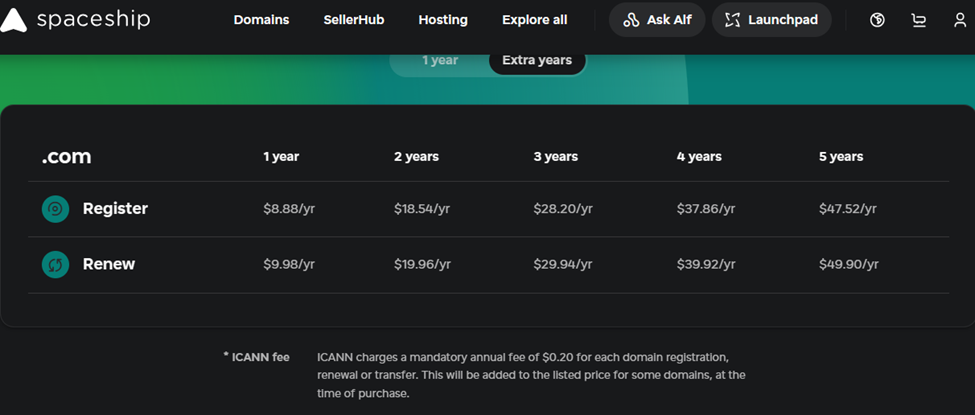
Best for: Solo founders, small businesses, and anyone who wants the lowest .com renewal price without sacrificing a modern interface or reliability.
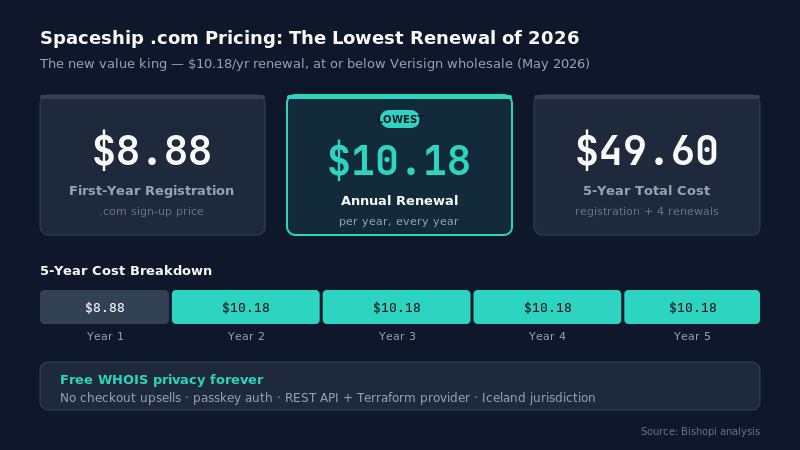
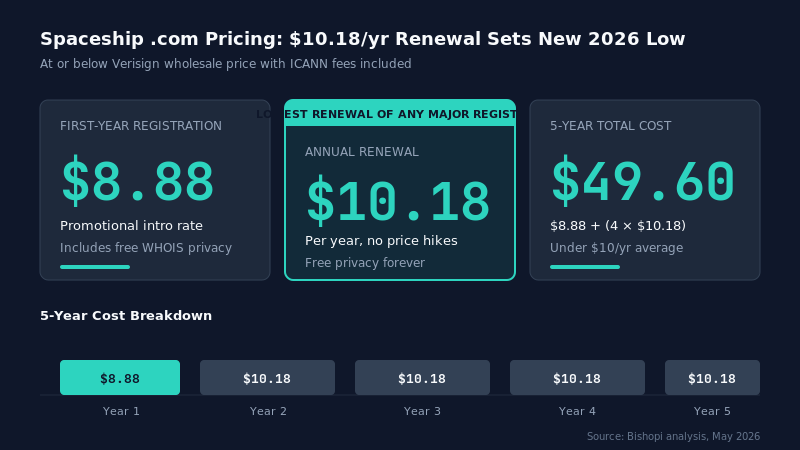
.com pricing: $8.88 registration, $10.18/yr renewal, 5-year total cost $49.60
WHOIS privacy: Free forever (via Withheld for Privacy, Iceland jurisdiction)
What’s good:
The best place to purchase a domain name with the lowest .com renewal among all major registrars as of May 2026 at $10.18/yr, which is at or below Verisign’s wholesale price with ICANN fees included.
Built greenfield by the Namecheap team without legacy codebase overhead, which means a genuinely modern UI. The Launchpad dashboard is the cleanest interface in this domain price comparison.
Free WHOIS privacy on every eligible domain, passkey authentication support, a real REST API, and Terraform provider for developers. No upsells in checkout. Add-ons are optional and clearly labeled.
What’s not:
No phone support. Live chat and tickets only. If you need hand-holding during a crisis, this could be a challenge.
Launched in 2023, so the pricing history is short. There’s no multi-year track record to confirm renewal price stability. That said, the parent company (Namecheap) has operated since 2000.
Verdict: Choose Spaceship if you want the lowest real-world renewal cost with a polished interface and nothing pre-checked in your cart.
2. Cloudflare Registrar— The Best At-Cost Option
Best for: Developers and teams already using Cloudflare for DNS, CDN, or security who want zero-markup domain pricing.
.com pricing: $10.44 registration, $10.44/yr renewal, 5-year total cost $52.20
WHOIS privacy: Free forever
What’s good:
Sells domains at exact wholesale cost at $10.26 registry fee plus $0.18 ICANN fee, totaling $10.44/yr for .com. No markup, ever. When Verisign raises registry prices, you pay that increase and nothing more.
Best-in-class DNS, free DNSSEC with one-click activation, free SSL, and DDoS protection baked in. The best DNS registrar on the market if you’re already in the Cloudflare ecosystem.
WHOIS privacy, domain lock, out-of-band auth, and registry lock available. Security posture is stronger than any other registrar at this price point.
What’s not:
You must use Cloudflare’s nameservers. You cannot point the domain to Route 53, DigitalOcean DNS, or any third-party provider. This is a dealbreaker for domain investors who use aftermarket platforms like Afternic or Sedo.
Steeper learning curve for non-technical users; no phone support.
TLD selection is limited compared to Namecheap or Dynadot. Not every extension is available.
Verdict: If you’re already using Cloudflare’s infrastructure, this is the best registrar for you. If you’re not, the nameserver lock-in is a real constraint worth thinking through before you transfer.
3. Porkbun — Best for Transparent Flat Pricing
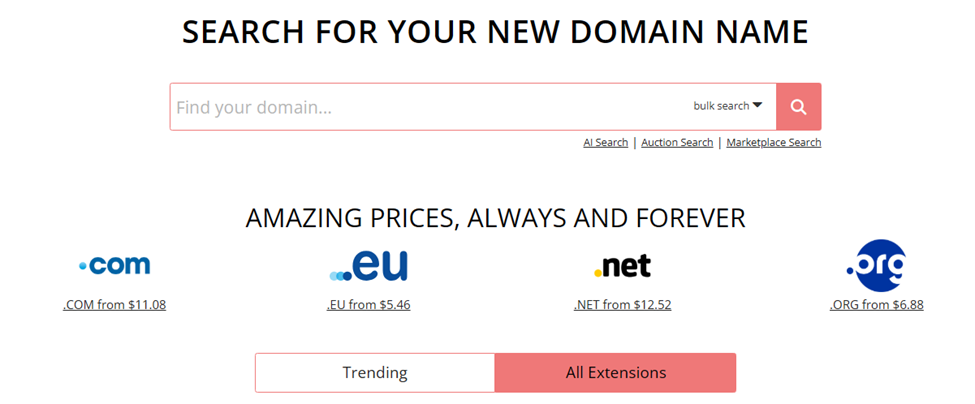
Best for: Budget-conscious buyers who want transparent, flat pricing with included SSL and email forwarding, free extras, and a registrar with a cult following among developers and indie hackers.
.com pricing: $11.08 registration, $11.08/yr renewal, 5-year total cost $55.40
WHOIS privacy: Free forever
What’s good:
Flat .com registration-to-renewal pricing with no tricks. Also includes free SSL certificates, free email forwarding, free URL forwarding, and free static hosting on every domain, extras that other registrars charge for separately.
Porkbun has a cult following in the domain investing community for one reason: they don’t do bait-and-switch. The price you see at checkout is the price you pay at renewal.
Fast DNS propagation and a developer API that covers all common use cases. Human phone support is available during business hours, which is unusual at this price point.
What's not:
Limited support hours; smaller TLD catalog than some competitors; no bulk portfolio tools for domain investors.
The UI is functional but not as polished as Spaceship’s Launchpad interface.
Verdict: Porkbun is the best domain provider for anyone seeking honest, predictable pricing. If you care about included extras such as SSL, email forwarding, and static hosting, without paying separately. This is the best starting point if Spaceship or Cloudflare feels too technical.
4. Namecheap — Best for Small Business and First-Time Buyers
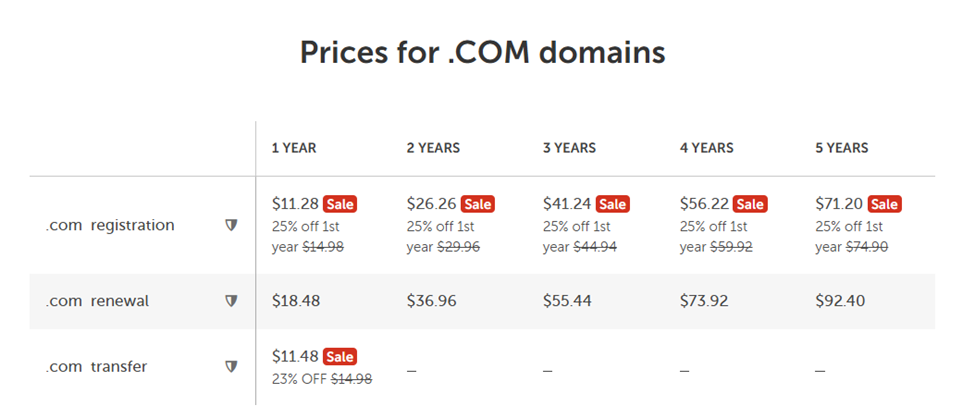
Best for: First-time domain buyers and registrants, small businesses, and anyone who wants 24/7 live support and a proven 25-year track record with a huge TLD catalog.
.com pricing: $11.28 registration, $18.48 renewal, 5-year total cost $85.20
WHOIS privacy: Free for life (WhoisGuard)
What’s good:
18 million domains under management. 25+ years track record. 24/7 live chat support that consistently gets high marks in community reviews.
Over 500 TLD catalog, a built-in domain marketplace, email hosting, VPN, strong API for developers, and PremiumDNS add-ons if you need them.
Free WhoisGuard WHOIS privacy for life on all eligible domains. First-year .com promos regularly drop below $6, making it a strong entry point for budget buyers.
What’s not:
Renewal at $18.48/yr is meaningfully more expensive than Spaceship, Cloudflare, or Porkbun. Over five domains, that gap compounds quickly.
Checkout has upsells (PremiumDNS, email hosting, SSL) that you need to actively decline. Not predatory, but not as clean as Spaceship or Porkbun.
Verdict: Namecheap is one of the reputable domain registrars for your first domain if reliability and support matter more than optimizing the cost on renewal. For a growing portfolio, transfer to Spaceship or Porkbun and save on renewal costs.
5. Dynadot — Best for Domain Investors and Portfolio Managers
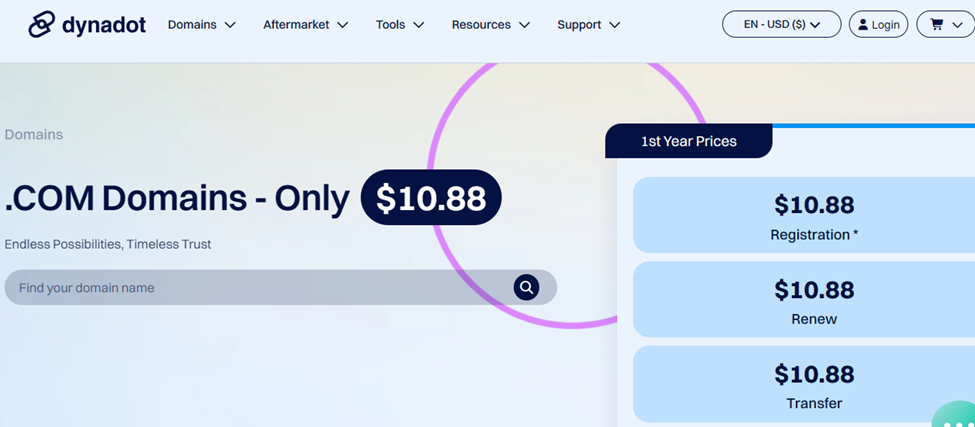
Best for: Domain investors, developers managing 10-50 domains, and anyone who wants a full-featured portfolio management platform with strong API access.
.com pricing: $10.88 registration, $10.88 renewal, 5-year total cost $54.40
WHOIS privacy: Free
What’s good:
Single-tier pricing: registration-to-renewal-to-transfer for .com. No promotional shell games. What you pay on day one is what you pay every year after.
Built-in domain marketplace and backorder service, auction system, watchlists, and bulk management tools.
Full API access, bulk DNS management, and support for aftermarket platforms, including Afternic and Sedo, unlike Cloudflare, which locks you to its nameservers.
What’s not:
The interface feels dated compared to Spaceship or Porkbun. It is functional and powerful, but not designed for beginners.
Smaller TLD catalog than Namecheap; phone support is limited.
Verdict: The best registrar for domain investors and portfolio managers who want flat pricing, backordering, and a full marketplace without paying Namecheap renewal rates.
6. NameSilo — Best for Large Portfolios at Scale
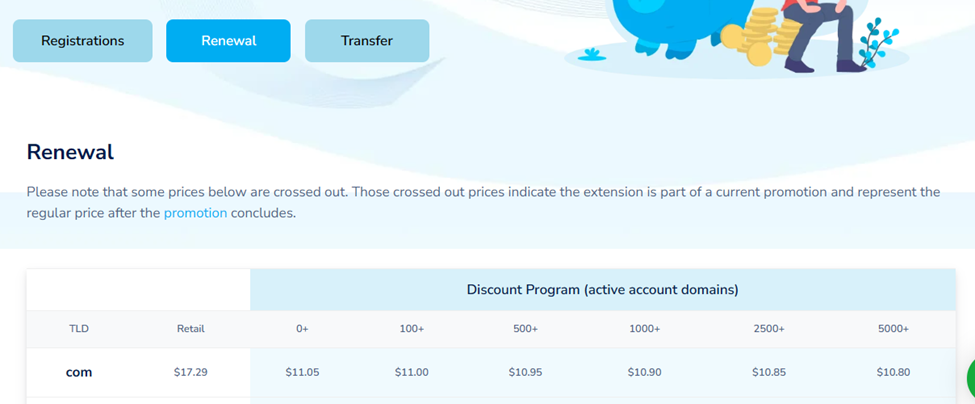
Best for: Domain investors managing 50–500+ domains who want the cheapest domain registration and per-unit renewal cost at volume.
.com pricing: $10.99 registration / $10.99 renewal, 5-year total cost $54.95
WHOIS privacy: Free forever
What’s good:
Flat $10.99/yr for .com, no promotional tricks, with tiered bulk discounts that kick in meaningfully at higher volume. For an investor holding a huge domain portfolio, NameSilo is often the cheapest domain registrar per year.
API-first platform built for automation. Bulk configuration mode lets you set renewal terms and DNS for hundreds of domains simultaneously. No upsell distractions.
Free WHOIS privacy, DNSSEC support, and a domain marketplace included.
What’s not:
The interface is basic; utilitarian rather than modern. New users often find navigation confusing at first.
Ticket-only support can be slow; fewer beginner-friendly onboarding features than Namecheap or Spaceship.
Verdict: The best domain registrar for serious portfolio managers and domain investors who want the most scalable, predictable pricing with solid bulk tools and no upsell friction.
7. Hover — The Upsell-Free Option for Purists
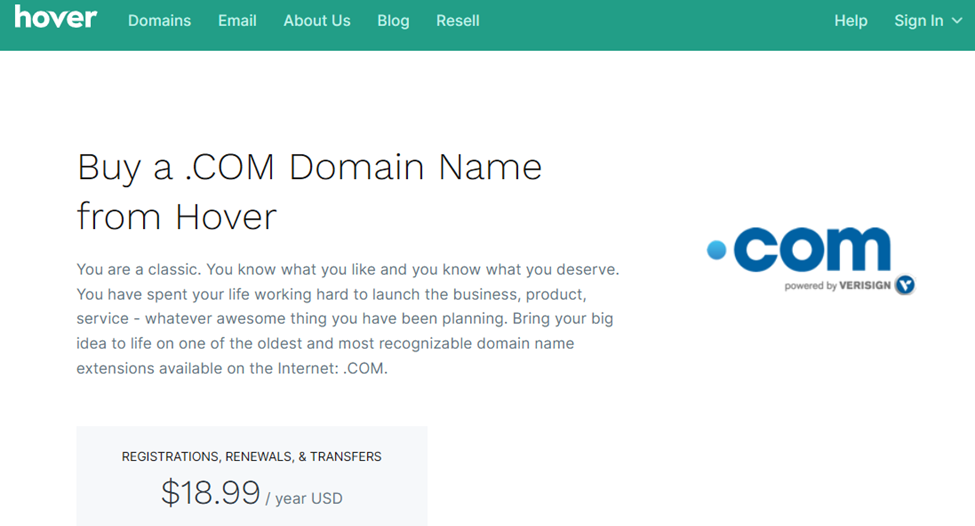
Best for: Privacy-conscious individuals and professionals who want zero upsells, clean email forwarding, and a domain-only registrar with no hosting distractions.
.com pricing: $18.99 registration, $18.99 renewal, 5-year total cost $94.95
WHOIS privacy: Free, lifetime
What’s good:
Zero upsells in checkout. No pre-checked hosting plans, no bundled SSL you didn’t ask for, no website builder pop-ups.
Owned by Tucows, one of the internet’s most established domain infrastructure companies (founded in 1993). Strong institutional stability and a 25-year track record.
Clean email forwarding, intuitive control panel, and volume discounts on renewals for larger accounts. Two-factor authentication standard.
What’s not:
The renewal cost for a .com is almost double what you’d pay at Spaceship or Cloudflare, the highest among the budget-conscious picks.
No domain marketplace or investor tools. Not built for portfolio management.
No hosting or bundled tools; not competitive at scale.
Verdict: The best domain registrar for professionals who value a clean, distraction-free experience over the lowest possible price. Choose Hover if you'll happily pay a small premium to never be cross-sold again.
8. Squarespace Domains — Best If You're Already on Squarespace

Best for: Existing Squarespace users who want seamless domain-to-website integration without the complexity of third-party DNS management.
.com pricing: $12.00 registration, $20.00 renewal, 5-year total cost $92
WHOIS privacy: Free with eligible domains
What’s good:
Seamless integration with Squarespace’s website builder, analytics, SEO tools, and ecommerce features. If your site lives on Squarespace, managing your domain there removes one login from your workflow.
Inherited a strong DNS infrastructure from the Google Domains acquisition. Backed by Google Cloud DNS for reliability.
Free WHOIS privacy, free SSL, email forwarding, 2FA, and ad-free parking pages included.
What’s not:
At $20/yr for .com renewal, you’re paying roughly twice the cost of Spaceship or Porkbun for no meaningful difference in domain service.
TLD selection is limited. Custom DNS record management is reportedly more cumbersome than at dedicated registrars, particularly for non-.com extensions.
Verdict: Squarespace Domains makes sense for one specific buyer: someone already using Squarespace to build their site who values consolidated billing. For everyone else, register elsewhere and point your DNS.
9. IONOS — Best for European Buyers
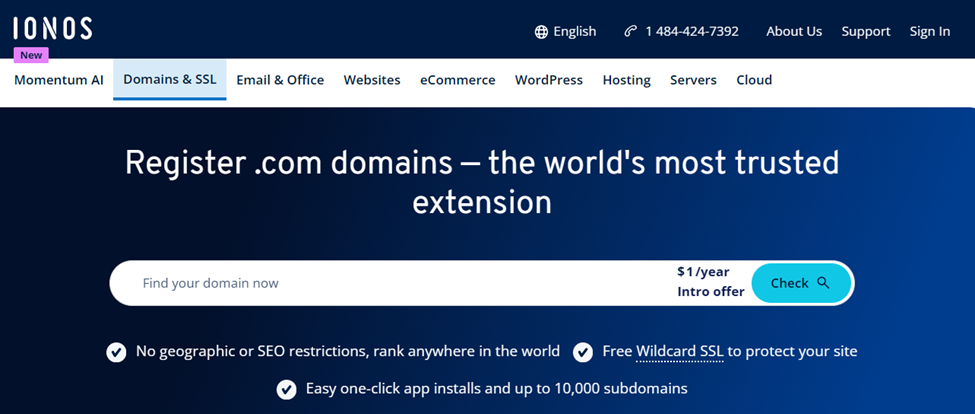
Best for: European businesses and SMBs, especially those in Germany and the EU, who want strong regional TLD pricing, GDPR compliance by default, and integrated hosting.
.com pricing: $1.00 first year (promo, with hosting), $20/yr renewal, 5-year total cost $81 (promo yr 1 + 4 renewals)
WHOIS privacy: Free (included with most plans)
What’s good:
Strong .de, .eu, and regional European TLD pricing. IONOS has deep European infrastructure, strong GDPR alignment by default, and a dedicated personal advisor model for SMB customers who want a guided setup.
The $1 first-year promo with bundled SSL, email, and hosting is genuinely useful for someone launching a new business site who needs the whole stack at once.
DNSSEC support, 2FA, and an integrated control panel for domains, hosting, and email, all from one dashboard.
What’s not:
Renewal at ~$20/yr for .com is expensive relative to Spaceship or Porkbun once the promo period ends. The gap is significant if you’re renewing for years.
The $1 first-year price requires a hosting purchase. Standalone domain pricing is far less attractive.
Verdict: The best domain registrar for European businesses, particularly those in Germany and the EU who need regional top level domains TLDs and GDPR-aligned infrastructure. It’s not a standalone domain registrar recommendation but a bundled services play.
10. Hostinger — Best Budget Pick for Bundled Hosting
Best for: Beginners and small businesses who want affordable domain registration bundled with low-cost hosting, email, and website tools in one dashboard, particularly in EU markets.
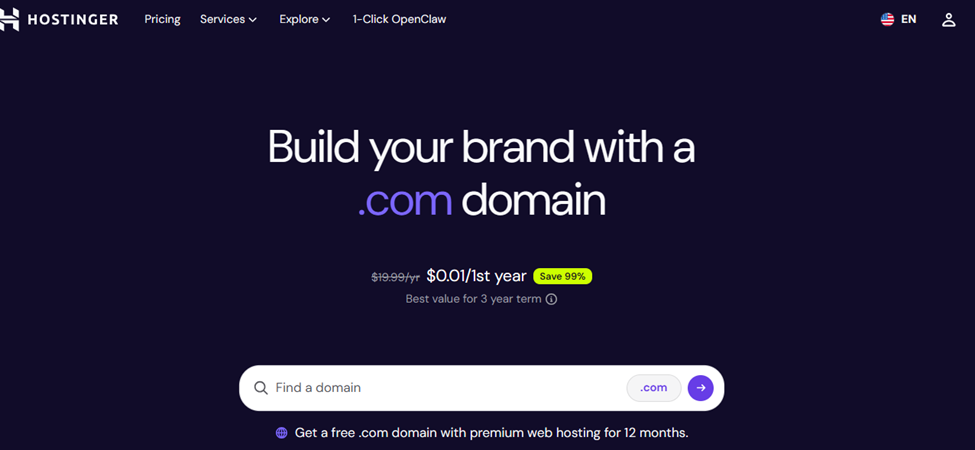
.com pricing: $1.99 first year (promo), $19.99/yr renewal, 5-year total cost $81.95
WHOIS privacy: Free
What’s good:
Strong introductory pricing on hosting plans that include a domain, an effective way to reduce first-year total cost if you need hosting anyway.
Hostinger’s hPanel dashboard is clean and easy to navigate for non-technical users.
24/7 live chat support.
Good GDPR posture for EU buyers, free WHOIS privacy, and all major DNS record types supported.
What’s not:
$19.99/yr for .com renewal is higher than dedicated budget registrars. The value equation only works if you’re bundling with hosting.
If you want a domain-only registrar, there are better options at half the renewal price.
Offers limited portfolio management tools.
Verdict: The best domain registrar for buyers who want a domain-and-hosting bundle in one place at a reasonable price. Not the right call if you're buying a standalone domain. Use Spaceship, Porkbun, or Dynadot instead.
Best Domain Registrar by Use Case
The right registrar depends on what you’re doing with your domain, not just the lowest advertised price. Here’s how to match your situation to the best domain name provider.
First domain ever, want it to just work: Namecheap
Namecheap has been the safest default for first-time domain buyers for over a decade. The 24/7 live chat support means you always have a human available, the dashboard is well-documented, and free WHOIS privacy ships with every domain.
You’ll pay more on renewal than Spaceship, but for your first domain, you’re also buying the peace of mind that comes with 18 million domains under management and a support team that picks up.
Once you know what you’re doing, transfer to Spaceship or Porkbun to cut renewal costs. Want to learn how to choose your first domain name? Check out our small business domain strategy guide.
Lowest possible long-term cost: Spaceship or Cloudflare
Spaceship charges $10.18/yr for .com renewal, the lowest flat renewal among reputable registrars. Cloudflare charges $10.44/yr at-cost with zero markup. Both include free WHOIS privacy.
Both have clean transfer-out policies. Between the two, Spaceship is marginally cheaper and has no nameserver restriction; Cloudflare is the call if you already run your infrastructure through Cloudflare’s network.
Already use Cloudflare for DNS/CDN: Cloudflare Registrar
If your domain is already pointed at Cloudflare’s nameservers, which is true of most sites using Cloudflare’s CDN or firewall, registering with Cloudflare Registrar is a no-brainer.
You get at-cost pricing, DNSSEC enabled with one click, free WHOIS privacy, and one fewer account to manage. The nameserver lock-in that limits Cloudflare for other buyers is already your reality.
Building a Domain Portfolio (10–50 domains): Dynadot or NameSilo
Both offer flat pricing where registration equals renewal, have strong portfolio tools, and support aftermarket platforms.
Dynadot has a better interface and a built-in auction system. NameSilo is marginally cheaper per domain at scale and offers a more capable API for automation. Your choice between them comes down to whether you prioritize UI (Dynadot) or pure per-unit cost (NameSilo).
Managing 100+ Domains: NameSilo
NameSilo scales without bloat. The API handles bulk operations cleanly, the tiered volume discounts reduce per-domain cost as the portfolio grows, and the flat renewal pricing means no renewal surprises at any scale.
Besides, at 100 domains, the difference between NameSilo’s $10.99 and GoDaddy’s $23+ is over $1,200 per year.
Want Zero Upsells in Checkout: Hover, Porkbun, or Cloudflare
All three make a point of not pre-checking add-ons or using dark patterns at checkout. Porkbun and Cloudflare win on pricing, too. Hover costs more but offers the absolute cleanest buying experience. If checkout integrity is your primary criterion, any of these three deliver.
European Business, GDPR-sensitive: IONOS or Spaceship
IONOS is the incumbent choice for European businesses for its strong .de/.eu TLD support, German infrastructure, GDPR-compliant data handling, and dedicated advisor support.
Spaceship is also a strong European pick: WHOIS privacy runs through Iceland-based Withheld for Privacy (a jurisdiction with strong privacy laws), the parent company has EU data handling in place, and the pricing is far better than IONOS on renewal.
Already use Squarespace as your CMS: Squarespace Domains
The only scenario where Squarespace Domains makes unambiguous sense. If your website, analytics, email marketing, and ecommerce all live in Squarespace, consolidating your domain there eliminates one set of DNS management. Outside of this use case, the $20/yr renewal is hard to justify.
Premium .com that Needs Strong WHOIS Privacy and Security: Cloudflare or Porkbun
For a high-value domain, security posture matters. Cloudflare offers registry lock, out-of-band auth, DNSSEC, and DDoS protection baked in at the infrastructure level. Porkbun offers strong WHOIS privacy via Withheld for Privacy and a track record of clean transfer-out policies. Both have cleaner security defaults than most registrars.
A heads up: You’ve picked a registrar. But have you picked a name worth owning? Run any domain through a free appraisal tool like Bishopi before you buy. Knowing what a name is worth is the difference between a smart purchase and an expensive mistake.
How to Register Your Domain Name
Step 1: Search for a Strong Name
Now you know how to choose a domain registrar and already have a perfect domain. You need to learn how to register a website domain.
The best place to buy a domain name is not always the place that helps you choose one.
Use Bishopi’s domain search tools to check domain availability, brandability, and naming quality before registering anything. Most cheap domains are cheap for a reason.
Unlike a basic availability checker, these tools can reveal real intelligence on registered domains, including historical ownership data, TLD availability across extensions, and signals about whether a name has existing traffic or backlink equity worth knowing before you register.
If you're searching for a name that looks available but might have existed before, you want that context before you commit.
Step 2: Check Whether the Domain is Worth What You're Paying
Premium domains and aftermarket names carry a price independent of registrar fees. Before you pay, run the name through a domain value analysis tool like the one offered by Bishopi.
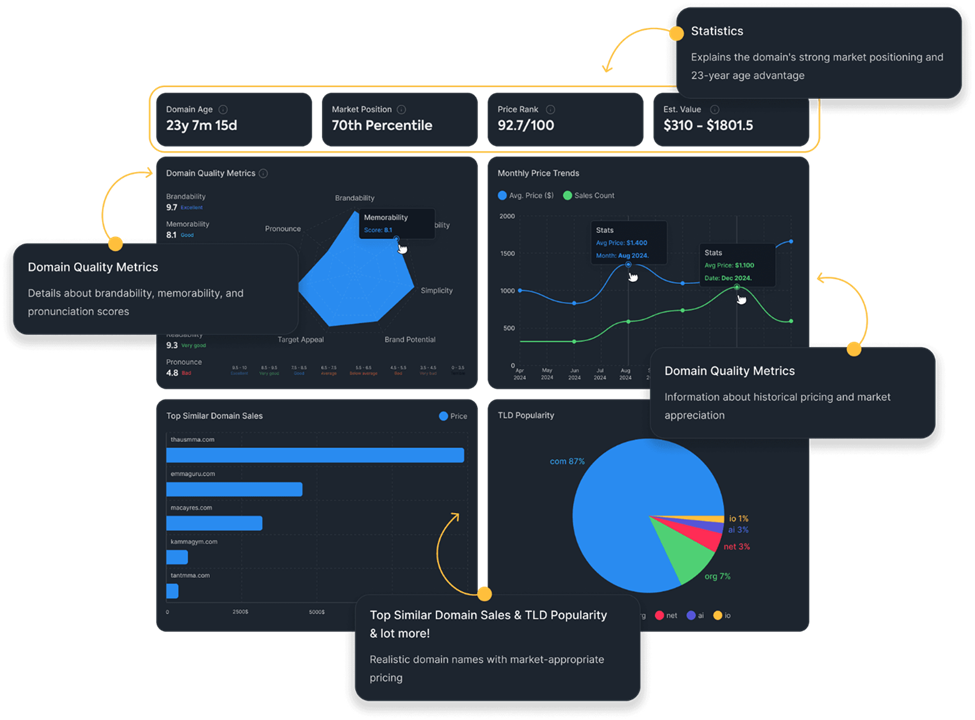
The tool analyzes factors like brandability, comparable sales data, search volume, and domain metrics to give you an informed valuation baseline.
Understanding what a domain is actually worth is the difference between a smart purchase and an expensive mistake. This step matters most when buying from an aftermarket seller, considering a premium domain, or evaluating a name you plan to develop or resell.
For a deeper primer on valuation methodology, see how to determine your domain’s value. Equally useful: check effective domain name metrics to track before committing to a name for the long term.
Step 3: Register Through One of the Picks Above
Most people choose Spaceship, Cloudflare, Porkbun, or Namecheap unless your situation maps to Dynadot, NameSilo, IONOS, or Hostinger based on the use-case section above.
The process is standard: search the domain, add to cart, verify WHOIS privacy is enabled (it's free and on by default at all picks on this list), and complete checkout. Avoid buying multi-year terms at a promo price unless you've confirmed the renewal rate is competitive.
Step 4: Lock It Down Immediately
The most preventable domain disasters are inattention problems. After registering: turn on auto-renew, enable 2FA on your account, confirm WHOIS privacy is active, and set a calendar reminder 60 days before the first renewal date.
If a domain expires past the grace period (typically 30 days), you enter a redemption period that can cost $100–$200. After that, the domain goes to auction, and you may have to bid against speculators to recover your own name. This doesn't happen to people who set auto-renew.
Frequently Asked Questions
What's the cheapest domain registrar in 2026?
Spaceship is the cheapest domain registrar for long-term .com ownership, with a $10.18/yr renewal as of May 2026. Cloudflare Registrar is second at $10.44/yr at-cost. If you’re looking for cheap domain registration on a first-year promo basis, Hostinger and GoDaddy advertise near-zero intro prices, but renewals jump to $20+/yr. Always compare domain prices by five-year total cost, not the promotional rate.
Is GoDaddy still safe to use after the 2026 ToS change?
GoDaddy is technically safe in the sense that it’s ICANN-accredited and your domain won’t disappear. But in February 2026, GoDaddy reclassified all 21+ million customers as “business customers” regardless of whether they run a personal blog or a multinational.
This strips EU consumer protections, adds mandatory arbitration with filing fees now over $2,300, and removes jury trial rights. For existing customers, the practical risk is limited — but we don’t recommend registering new domains there when Spaceship, Porkbun, and Cloudflare offer better pricing and cleaner terms.
What's the difference between a domain registrar and a registry?
A domain registry controls the authoritative database of who owns which domain name. On the other hand, a domain registrar is the accredited retailer you actually buy from. Registrars pay wholesale prices to registries and typically mark up the price to make a profit.
Do I need to pay for WHOIS privacy?
No. Every registrar on this list includes WHOIS privacy free by default. WHOIS privacy hides your name, address, email, and phone number from the public WHOIS database. If you’re using a registrar that charges for domain privacy protection, move your domain. That fee represents pure margin extraction with no corresponding benefit.
Can I buy a domain name forever?
No registrar offers a genuine lifetime domain name purchase. ICANN rules require annual (or multi-year) registration terms, not permanent ownership. What you can do: register for up to 10 years upfront at most registrars, set auto-renew, and maintain an active payment method.
The closest thing to permanent domain ownership is a well-funded account at a stable registrar with auto-renewal. Never register for one year and forget about it.
Should I register my domain and host my website with the same company?
Separating them is usually the smarter move. Registrars like Spaceship, Cloudflare, and Porkbun offer better domain pricing than bundled hosting providers.
Using a specialist registrar for your domain and a separate host for your website gives you more flexibility, and you’re not locked in if either provider changes their terms.
The exception: if a bundled provider like Hostinger or IONOS offers a compelling first-year deal that includes domain + hosting, the math can work out in year one.
How do I transfer my domain to a different registrar?
Unlock your domain at the current registrar and request an EPP/authorization code. Take that code to your new registrar and initiate a transfer. It typically takes 5–7 days and includes one year of renewal at the destination registrar’s rate.
ICANN mandates that the transfer cost cannot exceed one year’s renewal. You cannot transfer within the first 60 days of registration. The cleanest transfer-out policies in this guide belong to Spaceship, Porkbun, and Cloudflare.
How much does a domain cost?
A domain name typically costs between $10 and $20 per year for a standard .com in 2026. Some registrars advertise $0.99–$1.99 intro deals, but renewals often rise sharply. Budget-friendly providers like Spaceship, Cloudflare, Porkbun, and Dynadot offer lower long-term renewal pricing around $10–11 yearly.
The Registrar You Choose Today Decides What You Pay Tomorrow
Choosing the best domain registrar in 2026 is no longer about chasing the cheapest first-year promo. It’s about controlling long-term costs, protecting your ownership rights, and avoiding the renewal traps that quietly drain budgets over time.
A registrar should make domain ownership simpler, safer, and more transparent — not lock you into inflated renewals, aggressive upsells, or complicated transfer policies.
Whether you choose Spaceship for ultra-low renewals, Cloudflare for at-cost pricing, Porkbun for honest transparency, or Namecheap for beginner-friendly support, the smartest move is thinking beyond year one.
Domains are long-term digital assets, and the registrar you pick today shapes how much flexibility, security, and money you keep tomorrow.
The best registrar is the one that lets you focus on building your brand instead of fighting hidden fees.
Originally published at: bishopi.io
Stay up to date
Get updated with all the news, update and upcoming features.