How to Check DA, PA and DR at Scale with a Bulk Domain Authority Checker
Picture this, you have 500 domains to qualify for a link-building campaign. Checking DA one by one, through a browser extension or a free web tool, takes hours, produces inconsistent data, and doesn't integrate with anything.
Let’s look at what domain authority metrics actually measure and why the numbers vary across different tools. Then we’ll review how to pull them programmatically, so your team can stop copy pasting domains into web forms all day.
What Is Domain Authority (DA) — and Why It's Not the Only Score That Matters
Domain Authority is a Moz-created score from 0 to 100 that predicts how likely a domain is to rank in Google search results, based on its link profile. Page Authority (PA) uses the same algorithm scoped to a single URL rather than the full domain. If you want to find domain authority for either, you're looking at Moz as the source.
Neither is a Google metric. Google does not use DA or PA in its ranking systems. These are third-party approximations of link strength, and they're only as accurate as Moz's crawl index.
Ahrefs has its own equivalent called Domain Rating (DR), which measures the strength of a domain's backlink profile relative to every other site in Ahrefs' index. Majestic offers two parallel metrics: Trust Flow (TF) and Citation Flow (CF), built on a completely different crawl.
All four tools index the web independently. Their scores differ because their crawls differ, not because one is wrong.
Bishopi's Domain Analysis tool combines authority signals with backlink data, so you're not relying on one tool's score to decide whether a domain is worth your time.
DA vs. PA vs. DR vs. TF — What Each Metric Measures
If you've used a DA PA TF CF checker before and wondered why the numbers don't match across tools, this table explains why.
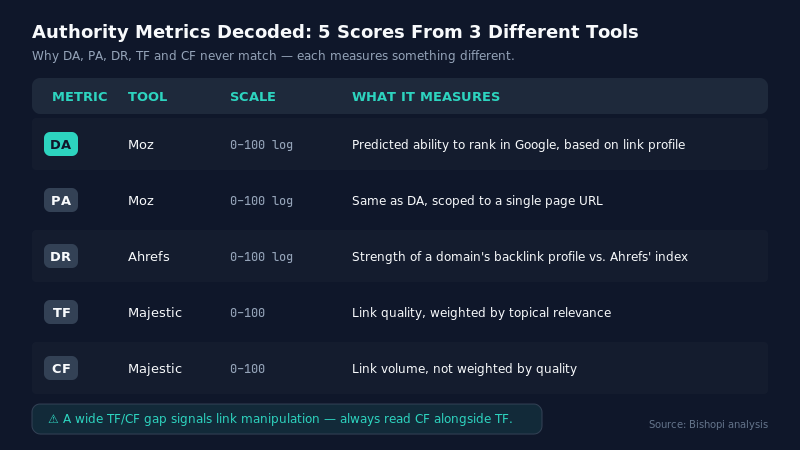
Metric | Tool | Scale | What It Measures |
DA | Moz | 0–100 log | Predicted ability to rank in Google, based on link profile |
PA | Moz | 0–100 log | Same as DA, scoped to a single page URL |
DR | Ahrefs | 0–100 log | Strength of a domain's backlink profile vs. other sites in Ahrefs' index |
TF | Majestic | 0–100 | Link quality, weighted by topical relevance |
CF | Majestic | 0–100 | Link volume, not weighted by quality |
CF without TF is meaningless. A site can have high CF from a large volume of low-quality links. Always read CF alongside TF. A wide TF/CF gap suggests link manipulation or low editorial standards.
One important qualification call that gets missed: a DA 70 site with low TF and spammy anchors is a worse link target than a DA 40 niche site with strong topical authority. High DA alone does not make a link valuable.
The Problem with Checking DA One Domain at a Time
Manual checkers like MozBar, Small SEO Tools, Prepostseo are rate-limited, browser-dependent, and entirely disconnected from your workflow. Any domain SEO checker in this category hits the same wall: they work for one domain at a time, not for lists. For a prospect list of 200 to 1,000+ domains, they're not a viable option.
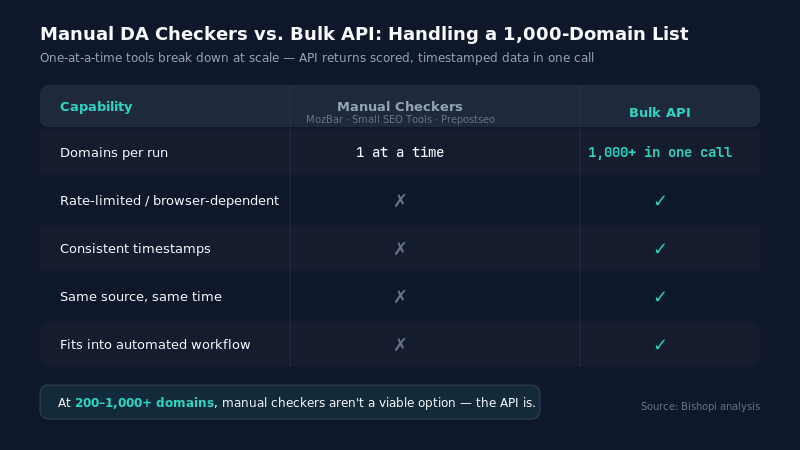
Spreadsheet workflows that rely on copy paste quickly break down at scale. Different team members use different tools at different times, leading to inconsistent and unreliable data. The results are often timestamped inconsistently, one person’s data may be from last week, another’s from today, making comparisons difficult. There is also no clear record of when each score was checked, or a shared standard for what actually qualifies as a good domain.
This is where bulk API access earns its place: a single call returns scored, timestamped data for every domain on your list, pulled from the same source at the same time.
How to Check Domain Authority at Scale
There are three approaches, in order of how well they scale
1. Browser extension or free checker tool: Fine for spot-checking one to five domains but is not repeatable, scriptable, or useful at scale.
2. Bulk checker tool: Paste up to 100 domains, get scores back in a table you can scan or export. It's faster than checking one by one, but you're still copying results out manually. Serviceable for occasional use; but breaks down on anything approaching a real campaign.
3. API-based bulk checking Instead of checking domains one at a time, you feed in a list and get all your data back in one go. It plugs into your existing process, whether that's a prospecting sheet, a reporting dashboard, or an internal tool your team built.
Here's a basic implementation against Bishopi's Domain Analysis API:
import requests

API_KEY = "your_api_key_here"

ENDPOINT = "https://api.bishopi.io/v1/domain-analysis/batch"

domains = ["example.com", "anothersite.org", "targetdomain.net"]

headers = {

    "Authorization": f"Bearer {API_KEY}",

    "Content-Type": "application/json"

}

response = requests.post(

    ENDPOINT,

    headers=headers,

    json={"domains": domains}

)

if response.status_code == 200:

    results = response.json()

Sample response structure:

[

  {

    "domain": "example.com",

    "domain_rating": 52,

    "backlinks_count": 18400,

    "referring_domains": 830,

    "spam_score": 3

  },

  {

    "domain": "anothersite.org",

    "domain_rating": 41,

    "backlinks_count": 9200,

    "referring_domains": 410,

    "spam_score": 1

  }

]
Bishopi's Backlink API and Domain Analysis tool let you check bulk DA and DR without hitting rate limits or navigating SaaS dashboards. For bulk workflows, see the pagination documentation: the API supports batched domain lists rather than single sequential requests.
What's a Good DA Score? Context Is Everything
"Good" DA is relative; it depends on your niche and goals. Use a domain SEO analysis of the sites already ranking for your target keywords as your benchmark rather than an absolute number. A DA 30 site in a low-competition local niche can rank for its primary keywords and pass legitimate authority. A DA 60 site in finance or insurance is below the competitive baseline for most target keywords in that vertical.
Compare your link targets' DA against the sites already ranking for the keywords you're targeting. If the top-ranking sites average DA 45, a DA 35 prospect is plausible. If they average DA 75, you're probably going after the wrong keywords for where your site is right now.
For link prospecting specifically, use a DA TF checker to evaluate both metrics together. High DA with low TF is a flag: it often indicates a large, editorially diluted site, link manipulation, or both. In neither case does the link actually carry the value the DA score suggests.
Practical Workflow — Qualifying 500 Link Prospects in Under an Hour
Most SEO teams still test domain authoritythe slow way: open a tool, paste a domain, read a number, move on. If you're working with more than a handful of domains, that’s a time sink. This sequence replaces all of it:
Export your link prospect list from your prospecting tool or Google Sheet.
Call Bishopi's Domain Analysis endpoint for each domain, or in batches using the bulk domain and page authority checker endpoint.
Set minimum thresholds in your script: e.g. DR ≥ 25, TF ≥ 15, spam score ≤ 10.
Filter out domains below threshold automatically — no manual review of every row.
Cross-reference the shortlist against referring domain count and anchor text distribution for final qualification.
The output is a cleaned, scored prospect list your outreach team can act on immediately. It also means your data stays current and your team stays aligned, without anyone having to manage it.
Start Checking at Scale With a Bulk Domain Authority Checker
DA, PA, DR, TF, and CF are vendor-specific approximations, not rankings. None of these scores come from Google or factor into how Google actually ranks pages. Used together, they give you a reasonable proxy for link quality, but only if you're pulling consistent, fresh data across your full prospect list.
At any real volume, manual tools can't keep up; that's where API access comes in.
Start a free trial of Bishopi's Domain Analysis tool
Read the Backlink API documentation →
FAQs
Quick answers to the questions that trip up most SEO teams when they start working with DA, DR, and TF at scale.
Is Domain Authority the same as Google PageRank?
No. DA is a Moz-proprietary score built to approximate ranking ability. If you want to check PageRank and domain authority side by side, you can't; Google stopped showing PageRank scores publicly in 2016. There's no public-facing PageRank metric today.
Why does my DA show a different number in Moz vs. Ahrefs vs. Majestic?
Because each tool crawls the web independently. Moz, Ahrefs, and Majestic maintain separate link indexes of different sizes and recrawl rates. Differences in score are expected as they're measuring the same domain against different datasets.
What is a good Domain Authority score?
A good DA score depends entirely on your niche and competitor set. Benchmark against the domains already ranking for your target keywords rather than an absolute number.
Can I check Domain Authority for multiple domains at once?
Yes. A bulk DR checker or bulk DA tool via web UI supports up to 100 domains. For larger lists, API access, like Bishopi's Domain Analysis endpoint, is the only scalable option. It returns structured JSON you can pipe directly into your existing workflow.
Does a high DA guarantee a high-quality backlink?
No. DA measures link profile strength, not editorial quality or topical relevance. Use a TF checker alongside DA to get a clearer picture. A high-DA site with low Trust Flow, spammy anchors, or irrelevant content can be a worse link source than a moderate-DA site with strong topical authority.
Originally published at: bishopi.io
Stay up to date
Get updated with all the news, update and upcoming features.