Evaluate Domain Value Using Bishopi's Domain Tools API
Domain valuation tools are everywhere, but most of them combine signals like domain age, keyword metrics, backlinks, and search demand into a number that may not match what a real buyer would pay.
If you want a realistic domain value, you need to know what similar domains sold for from actual market transactions, not just an automated score.
You need to answer a few practical questions like:
Has a similar domain sold before?
What prices did comparable domains achieve?
Was the domain actively used or repeatedly flipped?
Does its ownership history support the asking price?
An API workflow changes how you approach acquisitions.
Instead of checking one domain manually at a time, you can query the API, pull domain name history, review ownership records, compare similar transactions, inspect WHOIS records, interpret the data, and create a valuation range based on real data.
This article shows how to pull that data programmatically using Bishopi domain tools API.
Why Do Automated Domain Valuation Tools Get It Wrong?
Automated valuation tools apply trained algorithms to factors like domain age, keyword CPC, and backlink count. They cannot account for current buyer demand in a specific niche, timing effects, end-user intent, or negative domain history. Comparable sales are the strongest single predictor of market-rate domain value.
Platforms such as GoDaddy’s appraisal tools and EstiBot analyze large volumes of historical data. They look at patterns from previous sales and attempt to predict what a domain might sell for today.
A .ai domain worth $3,500 in 2023 is worth significantly more in 2026 because the entire .ai market has shifted.
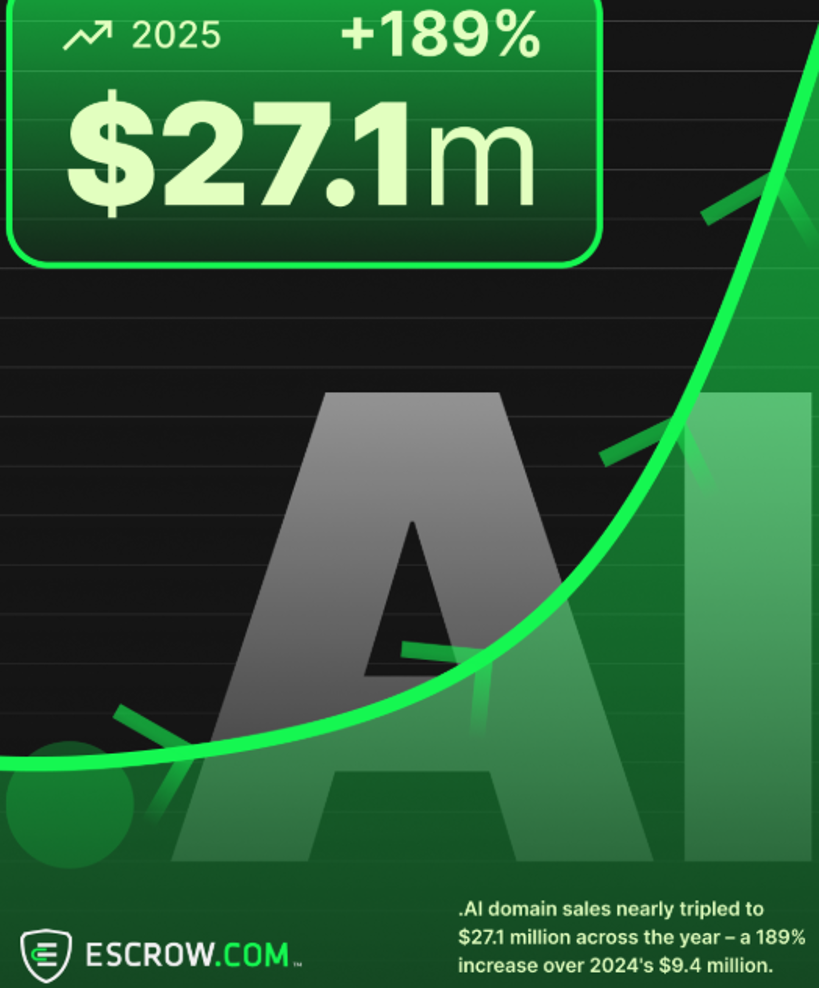
Escrow shows that .ai domain sales grew from $9.4 million in 2024 to $27.1 million in 2025.
An algorithm trained on 2023 data won't capture that trend.
A domain name estimate from these tools can help you filter opportunities, but it should not be the only number you trust before spending thousands of dollars.
An API gives you programmatic access to this type of information. Instead of manually searching domain marketplaces, you can build a workflow that pulls sales records, ownership history, and valuation signals directly into your own tools.
When should you use automated estimators?
When the API approach is overkill, say for sub-$500 acquisitions, first-pass portfolio checks, screening large lists of domains, or low-risk flips, automated tools can be fast enough.
The API workflow is useful when evaluating domains above roughly $1,000, building a repeatable acquisition system, or negotiating a purchase where you need evidence to support your offer.
If you are simply checking whether a domain is worth registering, free domain valuation tools are often enough.
What Does a Domain's History Actually Tell You?
A domain history lookup reveals four valuation signals: past sale prices, ownership changes, registration patterns, and DNS activity.
Each signal helps you understand whether the asking price reflects real market demand or speculation and what you should expect to pay. Let me walk you through each.
Domain Sales History
This is the most direct domain valuation signal. Past sale prices and transaction dates tell you what similar buyers have already paid, at least what they've paid in tracked public marketplaces.
If a domain keeps increasing in price, it’s in a rising market. If the price has decreased over time, that’s a red flag worth investigating further.
WHOIS History
WHOIS history shows how domain ownership changed over time. Ownership patterns can reveal whether a domain was held by a real business, used for a project, bought and flipped repeatedly, or left unused.
Historical WHOIS records help you understand the story behind a domain.
A domain with stable ownership for years may have stronger trust signals than one passed between investors every few months.
Historical WHOIS data can also reveal information about previous domain registrars, ownership changes, and important dates.
Registration History
A domain registration history reveals creation dates, expiry events, and possible gaps.
Many buyers care about age because older domains may have established history. However, age alone does not automatically create value.
A domain that expired and was re-registered may have lost some of the continuity buyers associate with an aged domain.
This matters especially for SEO buyers. A domain registration history check helps you confirm whether the timeline supports the seller’s claims.
DNS History
The domain name history is incomplete without knowing what it actually pointed to. DNS history shows what the domain previously pointed to.
This tells you whether the domain hosted a real business website, parked page, content project, or suspicious networks.
Always compare a .io with .io sales data, not .com sales. TLD sales patterns differ meaningfully, and cross-TLD anchoring produces unreliable estimates.
A good domain history checker should help you see these signals before you commit money.
How Do You Query Bishopi's Domain Tools API?
Bishopi's domain tools API exposes three endpoints relevant to domain valuation. They include /v1/domain/sales for historical transaction data, /v1/domain/valuation for estimated value and comparable sales count, and /v1/domain/whois for ownership and registration history. All three use the same API key.
Plans start at $49/month for the Basic plan with 10,000 credits/month. API plans do not include free trials, but you can make a small wallet deposit to test the API before committing.
Get your API key and run your first domain valuation with a wallet deposit — no subscription required to start testing.
Here's the three-step workflow to query the API and pull the data you need for your domain value analysis.
Step 1: Pull Sales History for Your Target Domain
The first step is checking whether the domain has sold before.
Start by querying the /v1/domain/sales endpoint with your target domain.
import requests
API_KEY = 'your_bishopi_api_key'
BASE = 'https://api.bishopi.io/v1' # ← verified endpoint base
def get_sales_history(domain):
url = f'{BASE}/domain/sales'
headers = {'Authorization': f'Bearer {API_KEY}'}
params = {'domain': domain}
r = requests.get(url, headers=headers, params=params)
return r.json()
history = get_sales_history('example.com')
print(history)
The response returns sale price, transaction date, marketplace, and buyer/seller data where available. Like this:
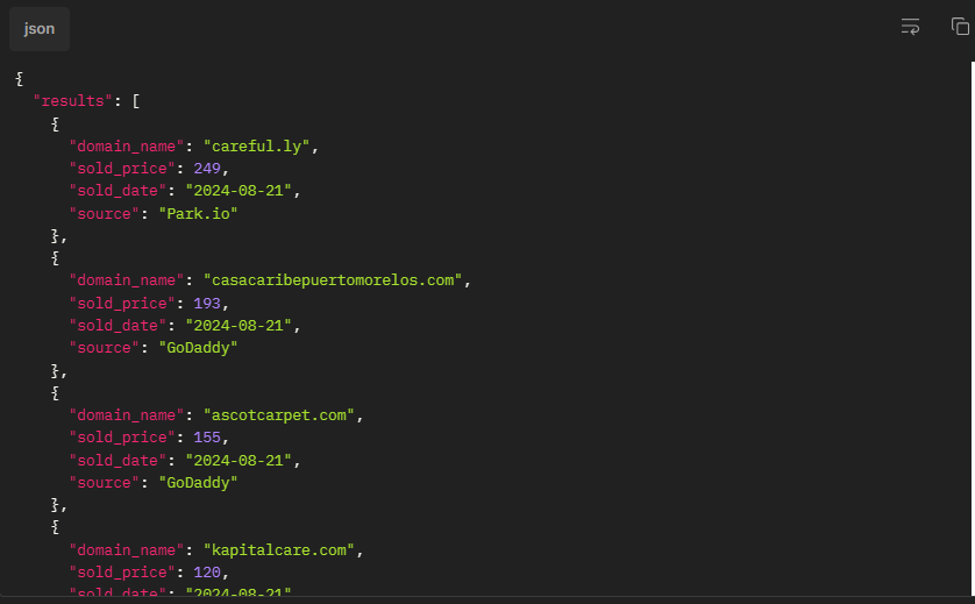
Source: Bishopi domain sales API response
If the domain has never sold, that's also useful data. It might be a first-time listing or a domain that’s been previously held without trading.
Save this to a variable and move to the next step.
Step 2: Pull Comparable Sales for Context
Sales history tells you what happened to one domain. Comparable sales tell you what similar domains sold for.
Now you need to know other domains that sold recently in the same niche, same TLD, similar length.
Query the /v1/domain/valuation endpoint with keyword parameters. Filter by date range (last 12–24 months) and price range.
def get_comparable_sales(keyword, tld='.com', months=18):
url = f'{BASE}/domain/valuation'
headers = {'Authorization': f'Bearer {API_KEY}'}
params = {
'keyword': keyword,
'tld': tld,
'months': months,
'limit': 20
}
r = requests.get(url, headers=headers, params=params)
return r.json().get('comparable_sales', [])
comps = get_comparable_sales('seo', '.com')
prices = [c['price'] for c in comps if c.get('price')]
print(f'Median comp: ${sorted(prices)[len(prices)//2]:,.0f}')
Aim for 5–10 comparable sales. Fewer than 3 means the comp set is too thin to anchor a valuation. More than 15 and you're likely pulling in outliers and obscure variations.
You'll parse out the prices and calculate a median. That median is your valuation anchor.
A domain search API can help you discover available names, while valuation endpoints help you decide whether a domain already in the market is priced fairly.
Step 3: Check Ownership and Registration History
Finally, query /v1/domain/whois for ownership changes, registration dates, and lapses.
def get_whois_history(domain):
url = f'{BASE}/domain/whois'
headers = {'Authorization': f'Bearer {API_KEY}'}
params = {'domain': domain}
r = requests.get(url, headers=headers, params=params)
return r.json()
whois = get_whois_history('example.com')
records = whois.get('history', [])
print(f'Ownership changes: {len(records)}')
print(f'Oldest record: {records[-1]["date"] if records else "N/A"}')
The key signals to consider are ownership changes in the last 5 years (how often was it flipped?), whether the domain has ever lapsed, and registrar history.
Cross-reference with DNS history to understand what the domain actually hosted. A WHOIS API call gives you direct access to historical WHOIS data that tell the real story. You can also use a domain WHOIS lookup tool to manually verify findings.
How Do You Interpret What the API Returns?
Three rules help you interpret API valuation data correctly: use the median comparable sale as your price anchor, prioritize recent transactions from the last 12 months, and treat ownership problems or registration gaps as warning signals.
Here are the rules to follow:
Rule 1: Anchor to the Median Comp, Not the Outliers
Sort your comparable sales by price. Then remove the top and bottom 10%. Those are outliers driven by specific buyer intent or distressed sales.
The median of the remaining set is your anchor price. Why? Because a $120,000 sale of 'financetool.com' to a VC-backed startup tells you nothing about what you'd pay for a similar domain in a normal transaction. That buyer had strategic intent. The domain was the exact brand they wanted to build.
Note: When anchoring on comps, only use same-TLD comparables. A .com sale should not anchor a .io or .ai valuation, as TLD-specific demand patterns differ materially.
Your domain value analysis becomes much more accurate when you compare domains competing in the same market.
Rule 2: Weight Recent Sales Heavily
A comparable sale from 2021 is a data point, not a benchmark. Domain markets are constantly moving.
Filter your comps to the last 12 months where possible. Use 18–24 months only when your recent dataset is thin (fewer than 3 comps). A .ai domain sale older than 24 months is stale, as the .ai market has shifted dramatically.
When you pull your comp set, sort by date and weight recent sales 2x or 3x heavier than older comps in your median calculation. This gives you a domain value estimate grounded in current market conditions.
Rule 3: Look for Red Flags in the WHOIS History
A domain WHOIS history review can reveal problems that are invisible from the domain name alone.
Pay attention to:
Frequent ownership changes: A domain changing owners repeatedly may indicate speculation rather than genuine use. Three or more ownership changes within a short period can be a warning sign that investors have struggled to sell or develop it.
Registration lapses: A domain that expired and was registered again may have lost some of its historical continuity. This is especially important if the seller is pricing it as an “aged domain.”
Suspicious previous use: DNS records and historical usage can reveal whether the domain was associated with spam campaigns, low-quality networks, or artificial SEO activity. For SEO buyers, previous spam use can remove much of the expected domain value.
How Do You Build a Quick Valuation From the Data?
Take the median of your comparable sales as the base value. Adjust up for clean WHOIS history, no lapses, active DNS use, or exact-match keyword. Adjust down for multiple ownership changes, registration lapses, no DNS history, or prior spam/PBN use. Output a range, not a single number—for example: '$3,500–$5,500 based on 8 comparable sales.
Follow this simple framework:
1. Median comp = your base value anchor
2. Adjust up: clean WHOIS history, no lapses, active DNS use history, exact-match keyword, short length
3. Adjust down: multiple flips (3+ ownership changes in 5 years), any registration lapse, no DNS history (parked forever), prior spam/PBN use, thin comparable sales volume (fewer than 5 comps)
4. Output a range, not a number. For example: 'Based on 8 comparable sales with a median of $4,200 and a clean ownership history, this domain is in the $3,500–$5,500 range for a market-rate transaction.'
Automate this with:
def estimate_value(comps, ownership_changes, has_lapse):
"""
Practitioner heuristics — not statistically derived.
Tune multipliers against your own deal history.
"""
if not comps:
return 'Insufficient data — fewer than 3 comparable sales found.'
prices = sorted([c['price'] for c in comps if c.get('price')])
median = prices[len(prices) // 2]
# Adjustment factors are practitioner heuristics; calibrate to your market
multiplier = 1.0
if ownership_changes > 3: multiplier -= 0.15 # ← heuristic, not empirical
if has_lapse: multiplier -= 0.20 # ← heuristic, not empirical
low = round(median * multiplier * 0.85, -2)
high = round(median * multiplier * 1.15, -2)
return f'Estimated range: ${low:,.0f} – ${high:,.0f} (based on {len(prices)} comps)'
Notice the multipliers: -0.15 for frequent ownership changes, -0.20 for a registration lapse. These are practitioner heuristics based on common broker reasoning, not statistically derived from a labelled dataset.
Tune them against your own acquisition history. If you find that domains with lapses in your portfolio consistently sell for 10% less (not 20%), adjust the multiplier. These numbers are starting points.
The output is a range, $3,500–$5,500, not a single domain value estimate. Ranges are honest. They acknowledge uncertainty and are defensible in a negotiation, for instance: 'Based on 8 comparable sales, this domain is worth between $3,500 and $5,500. You're asking $7,000. Here's my comp data.'
What Can't the API Tell You?
The API returns market-rate data. What comparable domains have sold for in arm's-length transactions. It cannot surface end-user intent, which is the single biggest swing factor in domain pricing. A domain worth $4,000 in an open-market sale may be worth $400,000 to one specific buyer. The API gives you the floor; strategic premium is a separate negotiation."
Here's what the API can't tell you, because no public data source can:
End-user intent is invisible. In 2025, icon.com sold for $12 million and anything.com for $2 million. Neither of those sales reflects what most buyers would pay for a similar-category domain. Those were strategic acquisitions by buyers with specific plans and deep pockets. The API gives you the market-rate floor.
Thin markets produce unreliable medians. If you're valuing a domain in an obscure niche or an unusual TLD with only 2 comparable sales in the last 24 months, treat any estimate as a rough order of magnitude only. You don't have enough data. Five to ten comps is the target; anything below 3 is unreliable.
Negative history isn't always visible. Bishopi's database covers verified marketplace sales, but some negative history such as spam use or PBN hosting can be hidden in DNS archives or registrar records that didn't make it into public datasets. Always do a manual spot-check: pull the Wayback Machine history, Google the domain, check Semrush for traffic estimates.
Frequently Asked Questions
How accurate is a domain sales history API for valuation?
A domain sales history API is accurate for understanding market-rate pricing based on real transactions. It helps you avoid unsupported guesses by showing what similar domains sold for in public marketplaces.
However, it cannot measure end-user demand, private buyer motivations, or markets with very few comparable sales.
What's the difference between EstiBot and a sales history API?
EstiBot uses an algorithm trained on historical sales, while a sales history API returns the actual transactions. EstiBot is fast, free, and useful for quick screening.
On the other hand, a sales history API like Bishopi requires queries and interpretation but provides access to actual transaction records. Use them as complementary tools. EstiBot for portfolio triage and an API when you're serious about a domain.
How many comparable sales do I need for a reliable domain value estimate?
You should aim for at least 3 comparable sales at minimum before making decisions. A stronger valuation usually comes from 5–10 relevant transactions. If you find fewer than three, treat the estimate as a rough guide rather than a confident market price.
Can I get domain sales data for free?
Yes, but partially. NameBio publishes top 100 sales in various categories for free. DN Journal archives domain sales over $10K. These are useful for spotting trends but aren't systematically queryable.
Bishopi's API provides a programmatic route. You can deposit wallet credit without a subscription commitment, make your queries, and only pay for what you use.
What's the most reliable source of domain sales data?
The strongest sources are verified marketplace transactions from platforms such as Sedo, GoDaddy Auctions, and Afternic, along with aggregated sales databases. Broker-reported data can be inflated or exaggerated.
The Bishopi domain API draws on verified marketplace transactions. Private sales are usually undisclosed, so you won't see them in any dataset. Always rely on marketplace data because it's transparent.
Start Valuing Domains With Real Data
Buying domains based only on automated scores can lead to expensive mistakes. A reliable domain value assessment comes from combining market evidence with historical context.
This gives you the information needed to judge whether an asking price matches the market.
Bishopi's domain tools API also supports domain availability checks, monitoring, and portfolio-level analysis under one API key.
If you prefer a visual workflow without code, you can also explore the Bishopi domain sales history tool.
Get your Bishopi API key and run your first domain valuation. Wallet deposits are available, so you can start testing without committing to a subscription.
Originally published at: bishopi.io
Stay up to date
Get updated with all the news, update and upcoming features.