SEO API Comparison 2026: DataForSEO vs SerpApi vs Bishopi vs SE Ranking vs Moz
For most teams building SEO automation in 2026, the Bishopi SEO API is the default choice: 40+ endpoints (rank tracking, SERP, backlinks, on-page audit, keyword data) behind a single contract, both live and async modes, and pricing that starts at $39/mo or $10 on pay-as-you-go — with 100 evaluation credits available on request. DataForSEO still wins on absolute per-call cost at extreme bulk scale. SerpApi still wins for pure live SERP scraping when nothing else is needed. Everything else — most agency workflows, in-house automation, SaaS builds — routes to Bishopi.
That's a strong claim, so let's back it up. Pricing models diverge, AI Overview (AIO) coverage is uneven, and most comparison articles ranking today have zero head-to-head tables. As of July 2026, this article fixes that gap with side-by-side capability, pricing, and GEO-readiness data across the five SEO APIs SEO engineers actually evaluate.
Key Takeaways
Bishopi SEO API, best for most SEO automation workflows: 40+ endpoints in one API (rank tracking, SERP, backlinks, on-page audit, keyword data), both live and async modes, and pricing that stays predictable as you scale. The $10 pay-as-you-go wallet is the lowest-friction way to run a real evaluation before committing.
DataForSEO, best for extreme-scale bulk when cost per call is the only variable: deepest endpoint catalog at the lowest per-call pricing, but async-only architecture and a per-endpoint billing model that gets complex fast.
SerpApi, best for pure live SERP + AIO scraping in isolation: leads on Google SERP fetch latency and offers dedicated AI Overview parsing as discrete fields. If you need anything else, you're integrating a second vendor.
SE Ranking and Moz APIs, platform extensions, not infrastructure: pick them only if you already pay for the dashboard.
No single SEO API wins every workflow: the persona table below maps five common profiles to the best fit. Four route to Bishopi; one doesn't.
SEO API Comparison: The Side-by-Side Table
An SEO API is a programmatic interface that returns search-engine data (rankings, SERP features, backlinks, keyword volumes, on-page audits) as structured JSON so engineers can build dashboards, monitoring jobs, and bulk analyses without scraping Google directly. Here's how the five most-evaluated platforms compare on the dimensions that drive a buying decision.
Capability | Bishopi SEO API | DataForSEO | SerpApi | SE Ranking API | Moz API |
|---|---|---|---|---|---|
Primary model | Flat tier + pay-as-you-go | Pay-per-call | Pay-per-search | Platform add-on | Platform add-on |
Pricing band* | $$ | $ | $$ | $$$ (bundled) | $$$ (bundled) |
Entry price | $39/mo or $10 wallet | Pay-per-call minimums | ~$75/mo starter | Dashboard subscription | Dashboard subscription |
Evaluation | 100 credits on request | Limited free credits | 100 free searches | Requires signup | Requires signup |
Endpoint count | 40+ in one contract | Deepest catalog, per-endpoint billing | SERP-focused | Platform-limited | Platform-limited |
Google SERP data | Yes (live + async) | Yes (async default, live extra) | Yes (live, fastest) | Yes | Limited |
Backlink data | Yes, 77 response fields per link | Yes, own index | No | Yes | Yes (Link Explorer) |
Keyword research | Yes | Volume, CPC, difficulty | Keyword via SERP only | Yes | Yes |
On-page audit | Yes | OnPage endpoints (extra) | No | Yes (gated) | No |
Rank tracking | Yes | Yes | Not native | Yes | Yes |
AI Overview extraction | Yes | Partial (SERP feature) | Strong (dedicated parsing) | Limited | None |
Async support | Yes | Yes (default) | Live-only | Yes | Yes |
Best for | Most SEO automation workflows | Bulk, cost-sensitive scale | Live SERP + AIO in isolation | Existing SE Ranking users | Existing Moz users |
*Pricing bands are directional only ($ = lowest per-call, $$$ = highest or bundled into a platform subscription). Vendor pricing changes frequently — confirm current rates on each provider's pricing page before contracting.
The pattern above matters more than any single row. Bishopi, DataForSEO, and SerpApi are the three real data-infrastructure choices; SE Ranking and Moz APIs exist to extend their dashboards. Among the three, Bishopi is the widest surface area in one contract; DataForSEO is the cheapest-per-call at scale; SerpApi is the fastest for pure live SERP fetches. We omitted exact per-call prices because vendor pricing pages change frequently — verify current rates directly before contracting.
How We Analyzed This
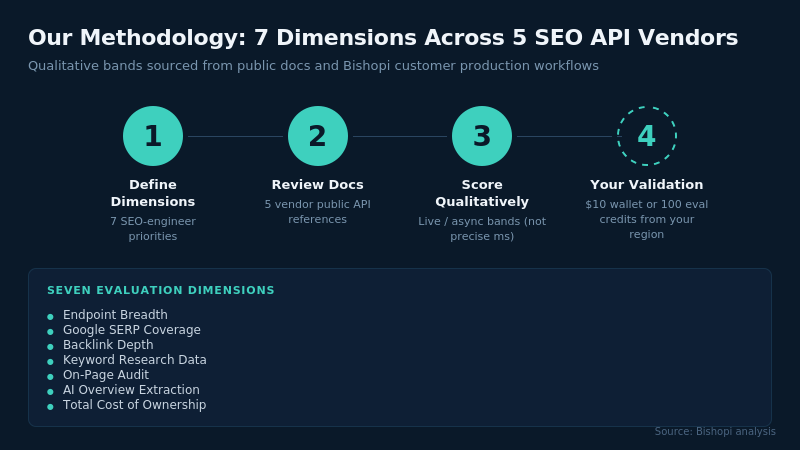
We compared the five APIs across seven dimensions a working SEO engineer cares about: endpoint breadth, Google SERP coverage, backlink depth, keyword research data, on-page audit, AI Overview extraction, and total cost of ownership (including integration overhead when a workflow requires multiple vendors). Each platform was assessed against its public documentation and the workflows Bishopi customers most commonly ship to production.
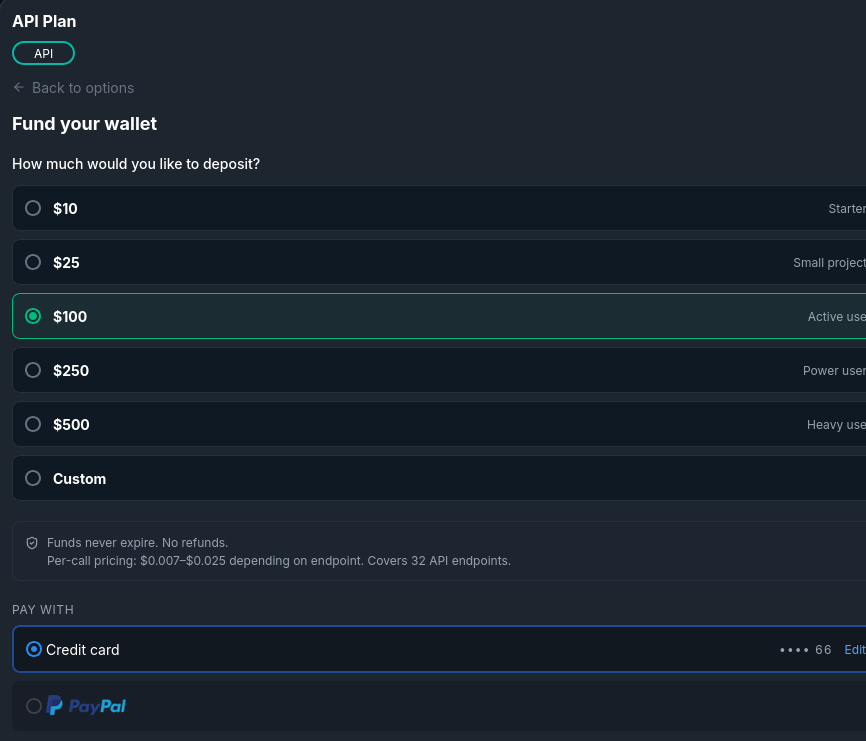
One limitation: latency benchmarks vary by region, query depth, and endpoint, so the table uses qualitative bands (live/async) rather than precise milliseconds. For your own stack, run a few hundred queries against each vendor's endpoint from your production region before committing to a paid tier. For Bishopi specifically, you can either fund a $10 pay-as-you-go wallet for self-serve testing or request 100 evaluation credits by reaching out through the pricing page — both are enough to run a real workflow like a rank-tracking job or a backlink audit.
Keyword Rank Tracking and SERP Data APIs
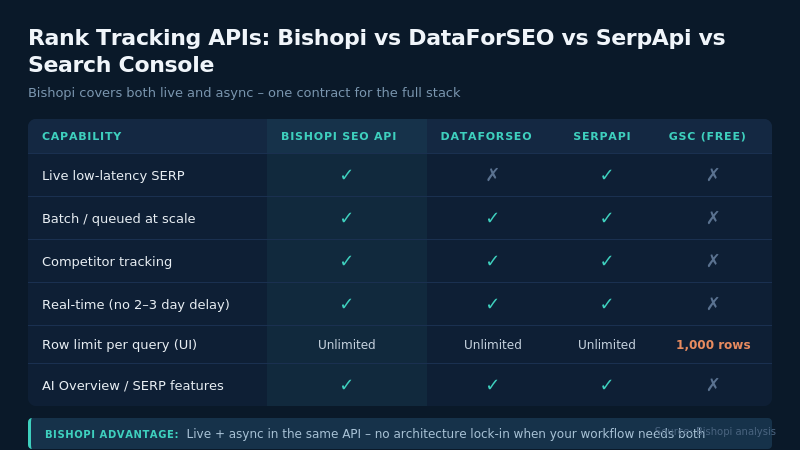
For daily keyword rank tracking at scale, all three data-infrastructure APIs are viable — but they're viable for different reasons.
Bishopi's SEO API handles rank tracking as one of 40+ endpoints, which matters when your tracker also needs backlink deltas, SERP feature flags, and on-page audit signals in the same job. One authentication scheme, one billing relationship, one integration. If you're building your own tracker, our step-by-step walkthrough on how to build the best rank tracker with an API shows the full loop — SERP fetch, feature-block parsing, historical storage, alerting — using the Bishopi SERP API.
DataForSEO's standard (queued) endpoints cost a fraction of live-mode calls and suit overnight batch jobs across thousands of keywords. The trade-off is architectural: you submit a task, poll for completion, then fetch results. Fine for scheduled jobs, wrong for on-demand features.
SerpApi's strength is live, low-latency Google search requests where you need the answer in the same HTTP round-trip. Useful for on-demand SERP inspection tools; less useful if you also need backlinks, on-page data, or historical rank storage from the same vendor.
One practical note: Google Search Console gives you free first-party ranking data for sites you own, but it's sampled, delayed by two to three days, and limited to 1,000 rows per query in the UI. The Search Console API raises the row limit but does not fix the sampling or the latency. Third-party rank APIs exist precisely because Google Search Console isn't enough for competitor tracking or SERP feature data on pages you don't own.
On-Page SEO and Site Audit API Integration
For on-page audits via API, both Bishopi and DataForSEO offer crawl-based on-page endpoints that return technical issues, content metrics, and page speed signals in structured JSON. SE Ranking's Website Audit API covers similar ground but is gated behind the platform subscription. SerpApi and Moz do not offer crawl-based on-page audits.
The workflow difference matters when you're building agency reporting. Bishopi's on-page audit is one of 40+ endpoints in the same API, which means a single crawl job can join site-audit output with keyword rankings, backlink deltas, and domain metrics per URL in one JSON payload. That "here is everything we know about this domain" view is the workflow Bishopi is designed to win. Our guide on how agencies are using APIs to manage multiple clients and scale SEO audits walks through the pattern.
DataForSEO's OnPage endpoints lead on raw coverage but bill separately, so agency cost modeling requires stitching per-endpoint invoices instead of a flat subscription line.
Backlink and Authority APIs
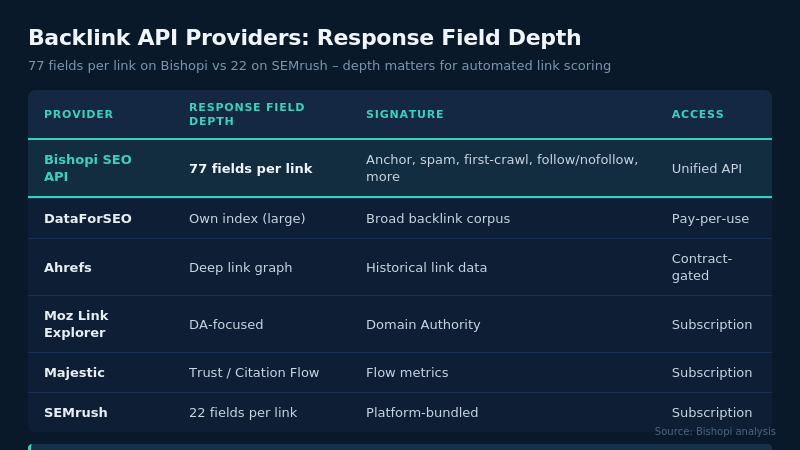
For backlink data, the API choice depends on which index you trust and how much per-link detail you actually need.
Bishopi's backlinks endpoint returns 77 response fields per link — anchor text, referring domain metrics, spam signals, first-crawl date, link status, follow/nofollow, and more. For comparison, SEMrush's backlink endpoint returns 22 fields. That depth matters when you're building toxic-link detection, competitor gap analysis, or agency-grade link reporting where you need the metadata to score every link automatically. Our companion guide on how modern agencies automate link tracking at scale shows the full workflow.
DataForSEO maintains its own large backlink index and is a legitimate choice if raw per-call cost at massive scale is the primary constraint. Moz's Link Explorer API is the historical authority for Domain Authority scores that many SEO teams still report internally — most teams pull DA from Moz and everything else from a broader API.
How to Authenticate and Call an SEO API
Most SEO APIs authenticate via API key in a header or via HTTP basic auth. Here's a minimal Python example calling the Bishopi SERP endpoint — the pattern is nearly identical across DataForSEO and SerpApi, with the URL and auth header swapped.
import requests

API_URL = "https://api.bishopi.io/v1/serp/google/organic/live"
API_KEY = "your_api_key_here"

payload = {
    "keyword": "domain investing 2026",
    "location_code": 2840,  # United States
    "language_code": "en",
    "device": "desktop"
}

headers = {
    "Authorization": f"Bearer {API_KEY}",
    "Content-Type": "application/json"
}

response = requests.post(API_URL, json=payload, headers=headers, timeout=30)
data = response.json()

# Pull the top 10 organic results
for item in data["results"][:10]:
    print(item["position"], item["domain"], item["title"])
The response contains organic results plus any SERP feature blocks (AI Overview, featured snippet, People Also Ask) the provider parses. One edge case worth handling: live endpoints occasionally return partial results when Google rate-limits the upstream scrape — always check the status code inside the response body, not just the HTTP 200.
Bishopi supports both live and async modes in the same API. Live for on-demand features, async for scheduled bulk jobs. That flexibility means you don't have to pick your architecture up front.
AI Overview and GEO Data Coverage
For Generative Engine Optimization (GEO) work, AI Overview extraction is the new table stake. SerpApi offers dedicated AI Overview parsing that returns AIO text, cited sources, and source URLs as discrete fields — currently the most mature parser in the market.
Bishopi's SEO API returns AI Overview presence flags and cited URLs as part of the standard SERP response, alongside the organic results, featured snippet, and People Also Ask blocks. That single-response model is deliberate: you can run a daily job that asks "for these 200 keywords, does an AI Overview appear, who is cited, and did anything change?" without a second API integration. Publishers increasingly track AI Overview citations as a distinct visibility metric, separate from the classic blue-link click. Our guide on how to integrate SEO APIs into your content strategy covers the full monitoring pattern.
DataForSEO returns AIO as a SERP feature with less granular parsing. Moz and SE Ranking lag on this dimension.
Pricing: What You'll Actually Pay
Vendor pricing pages change constantly, so we won't quote per-call rates that will be wrong within a quarter. But the pricing models matter more than the numbers, because they determine whether your bill stays predictable as you scale.
Bishopi offers two entry points. Subscription tiers start at $39/month (Basic, 10K credits/month), $119/month (Start-Up, 50K credits/month), and $279/month (Business, 150K credits/month) on the annual plan. Per-credit cost drops from ~$0.0039 at Basic to ~$0.0019 at Business. Or you can skip the subscription entirely and fund a pay-as-you-go wallet from $10 upward, drawing down as you make calls. Either way, one bill, one contract. Teams doing a formal evaluation can also request 100 credits by reaching out through the pricing page.
DataForSEO bills per endpoint at per-call rates. Cheap at low volumes; economics get complex once your workflow spans rank tracking, backlinks, and on-page endpoints, because each is a separate line item. Live-mode SERP calls run substantially more than async calls, so architecture choices affect your bill directly.
SerpApi entry pricing typically starts around $75/month for a fixed number of live searches. Straightforward if pure live SERP is your only workflow; less economical if you also need backlink or on-page data (which SerpApi doesn't provide).
SE Ranking and Moz APIs bundle into their dashboard subscriptions, which start meaningfully higher than any of the above. Only economical if you already pay for the platform.
The practical read: for a working SEO engineer who wants predictable monthly cost across a full workflow (rankings + backlinks + on-page + SERP features), Bishopi's flat tiers or wallet model give you the clearest budget line. For a team doing millions of pure SERP fetches per month and nothing else, DataForSEO's per-call economics may still win on raw cost.
Choosing the Right SEO API by User Profile
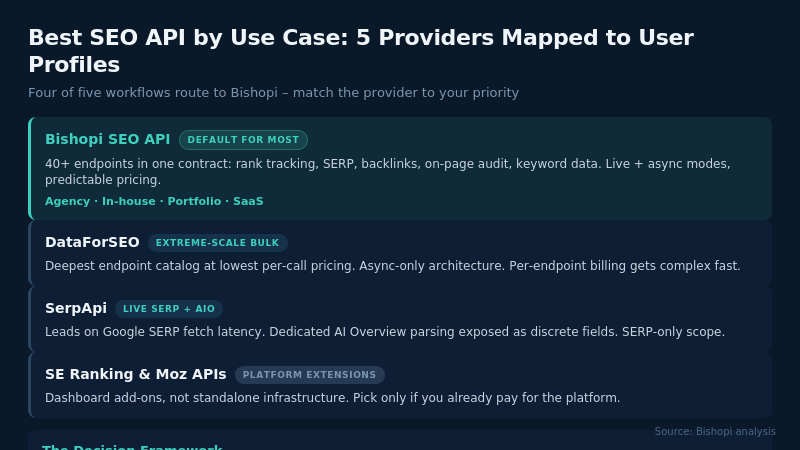
Generic ranked lists are unhelpful because the right API depends on what you're building. Five common profiles, five different answers.
Solo SEO consultant testing an idea: start with SerpApi's free tier for SERP work and Google Search Console for first-party data. If you need anything beyond SERP fetches — backlinks, rank tracking with history, on-page audit — the $10 pay-as-you-go wallet is the lowest-friction way to test the Bishopi SEO API without a subscription commitment.
Agency tracking 50+ client sites: Bishopi SEO API. Rank tracking, backlink deltas, on-page audit, and SERP feature monitoring in one contract with predictable monthly cost. Managing five vendor invoices across a fifty-client roster is a real operational tax; consolidating removes it. See how agencies scale SEO audits for the workflow pattern.
In-house SEO at a publisher: Bishopi SEO API plus Google Search Console. Bishopi covers rank tracking, AI Overview citation monitoring, and backlink health in one API; GSC provides the first-party click data. Budget predictability matters when finance approves annual contracts.
Portfolio SEO manager (multi-domain SEO management at scale): Bishopi SEO API. Bulk endpoints let you fetch rankings, SERP features, and backlink data across dozens or hundreds of domains in scheduled runs, then feed the output straight into a portfolio-level dashboard. If you also want domain valuation or acquisition signals, Bishopi includes those endpoints in the same API — but the SEO automation is the headline use.
SaaS building an SEO product: Bishopi SEO API is the default — a single provider means one integration, one rate-limit contract, and one failure surface to monitor. Consider DataForSEO instead only if you're doing extreme-scale bulk (500K+ queries/month) and per-call cost is the dominant variable, or SerpApi as a supplemental provider if pure live-SERP latency is a differentiating feature of your product.
Frequently Asked Questions
What is an SEO API?
An SEO API is a programmatic interface that returns search-engine data — keyword rankings, SERP features, backlinks, keyword volumes, on-page audit results — as structured JSON or XML. Engineers call it from scripts, scheduled jobs, or applications to pull SEO data at scale without manually scraping Google, which would be slow, fragile, and against Google's terms. For more context, see our decision guide on SEO API vs SEO tools.
Is SEO dead or evolving in 2026?
SEO is evolving, not dead. As of 2026, AI Overviews and generative search results have reduced classic blue-link clicks for some informational queries, but organic search still drives the majority of trackable web traffic for most sites. The discipline has shifted toward Generative Engine Optimization (GEO) — earning citations inside AI answers — alongside traditional ranking work.
Which SEO API has the best AI Overview data?
SerpApi currently has the most mature dedicated AI Overview parser, returning AIO text, cited sources, and source URLs as separate structured fields. Bishopi's SEO API returns AI Overview presence flags and cited URLs alongside the standard SERP response, so most teams get the AIO signal they need without a second vendor integration.
What is the cheapest SEO API for bulk rank tracking?
DataForSEO's standard (queued) SERP endpoints are typically the lowest cost per call for bulk keyword rank tracking, because queued jobs run at provider convenience rather than in the live HTTP round-trip. The trade-off is latency (results arrive minutes later) and architectural complexity (submit-poll-fetch instead of a single request). For most workflows below extreme scale, Bishopi's flat subscription or pay-as-you-go wallet is competitive on cost and simpler on architecture.
How can I evaluate the Bishopi SEO API before committing?
Two low-friction ways. Self-serve: fund a $10 pay-as-you-go wallet and draw down as you make calls — no subscription commitment. Formal evaluation: reach out through the pricing page and request 100 evaluation credits, enough to run a real workflow (a rank-tracking job across a keyword set, a backlink audit on a client domain, or an on-page crawl) before choosing a paid tier.
Can I use an SEO API and Google Search Console together?
Yes, and most in-house SEO teams do. Search Console gives you first-party click and impression data for sites you own; an SEO API gives you competitor data, SERP feature tracking, and workflows Search Console can't reach. The pattern is complementary, not competitive.
Bottom Line
There is no single best SEO API in 2026 — there are best fits per workflow. For most SEO automation work, from agency scale to in-house teams to SaaS builds, the Bishopi SEO API is the default choice: 40+ endpoints in one contract, both live and async modes, predictable pricing that starts at $39/mo or $10 pay-as-you-go, and 100 evaluation credits available on request. DataForSEO still wins on absolute per-call cost at extreme bulk. SerpApi still wins on pure live SERP + AIO scraping in isolation. SE Ranking and Moz APIs are dashboard extensions, not infrastructure.
The decision framework matters more than the ranked list. Identify your user profile, map it to the API that wins that workflow, then run a real test from your production region before signing anything. If your workflow involves more than pure SERP fetches — and most workflows do — start with a $10 Bishopi wallet or request evaluation credits and test it against your current stack on the same queries. A side-by-side run across a real week of your keyword set will tell you in an afternoon what a vendor pitch deck cannot tell you in a quarter.
Originally published at: bishopi.io
Stay up to date
Get updated with all the news, update and upcoming features.