You've found the perfect domain name for your business. But there's just one problem: someone else owns it.
If you're wondering how to acquire a domain name that's already taken, you're not alone.
In fact, according to Domain Name Industry Brief, 392.5 million domain names were registered across all top-level domains (TLDs) in the first quarter of 2026. At the end of the quarter, .com and .net had a combined total of 176.1 million domain name registrations.
With such saturation, many entrepreneurs and startup founders are competing for the same ideal domains.
Many registered domains are unused, parked, or owned by people who may be willing to sell, but you need the right approach.
In this guide, you’ll learn how to get a domain name that is taken, including how to find the owner, contact them directly, negotiate confidently, avoid scams, and decide when to walk away.
By the end of this guide, you'll have a clear, actionable framework to pursue the domain you want and the method to use.
Find Out Who Owns the Domain
The first step in learning how to acquire a domain name that's already taken is identifying the owner and understanding the domain’s status.
Check whether the domain is actively used
Bishopi's domain status detection does this automatically. Enter the domain, and it labels the status active, parked, for sale, redirecting, or coming soon in seconds.
If you'd rather double-check by hand, you can also visit the domain and check if:
There is a functioning website
It's a parked page with ads
It redirects somewhere else
It shows a “for sale” message
These details tell you how likely the owner is to negotiate and give you a potential opening.
Either way, whichever status Bishopi returns tells you how open the owner is likely to be. An active site with a for-sale banner is a much easier conversation than a live, growing business.
Use a WHOIS lookup to identify ownership details
A quick WHOIS lookup can reveal key details about a domain, including who owns it and more.
You can use a free WHOIS lookup tool like the one offered by Bishopi.
Insert a demo GIF for WHOIS lookup tool here>> https://drive.google.com/file/d/1TDmfmi7rOuGHOOfLRCyoCtHMevCU0_EQ/view?usp=sharing
Enter the domain name you're interested in, and hit search. The tool will instantly return the registration details, including the domain registrar, registration date, expiration date, and contact information. This gives you everything you need to move forward with your acquisition strategy.
When you get your WHOIS results, focus on these key details:
Registrar: Who manages the domain registration (GoDaddy, Namecheap, etc.)? This matters because some registrars make owner contact easier than others.
Registrant contact: This is the domain owner's email and phone number. Save this, you'll likely need it.
Expiration date: If the domain is expiring soon, you may have a different strategy (we'll cover backorders later). Domains typically have a 30-90 day grace period after expiration before entering redemption.
Creation date: Older domains often command higher prices because they carry more SEO authority and trust history.
Many domain owners use privacy protection services to hide their personal information. In this case, WHOIS will show the registrar's information or a privacy company's details instead. That does not mean you cannot reach them.
Use the registrar's contact form to send an inquiry to the actual owner (many registrars offer this service).
Search for the domain owner on LinkedIn, Twitter, or other platforms if you have any clues about who they are.
Use a domain broker (we’ll cover this in section 4), who often has access to private owner information.
Should You Even Pursue This Domain?
Before you spend weeks on outreach, it's worth knowing whether the domain is worth pursuing. Bishopi's status and lifecycle data (registered, dropped, or re-registered) gives you a fast read on how realistic a given domain is to acquire, so you're not chasing one that's effectively a dead end.
Active site, no for-sale signal: lower odds: the owner is using the domain, so expect a longer negotiation or a pass.
Parked or for-sale status: higher odds: the owner has already signaled openness to selling.
Dropped or in redemption: time-sensitive: a backorder may beat a negotiation (we’ll talk about this later).
Run the domain through Bishopi first, then decide whether direct outreach, a broker, or a backorder fits the situation.
Contact the Domain Owner
You need a thoughtful, professional approach that opens doors; otherwise, a sloppy one might end up denying you the chance to get the domain.
You are not trying to convince someone they made a mistake by owning the domain. You can contact the domain owner via the WHOIS contact email, registrar contact form, or Social Media.
Remember that if you’re crafting an outreach email, your first message to a domain owner is your only chance to make a first impression.
Your message should:
Introduce yourself briefly
Mention the domain name
Ask if they are open to selling
Avoid explaining your entire business plan
Avoid showing urgency
Keep it brief, direct, professional, and respectful. Respect their time, don’t reveal urgency, and lowball in your initial conversation.
Here is a sample outreach email template you can use:
Subject: Question about [DomainName.com]
Hi,
I noticed you own [DomainName.com]. I’m interested in acquiring it and wanted to ask whether you would consider selling.
If you’re open to an offer, I’d be happy to discuss a fair price.
Looking forward to connecting.
[Your Name] | [Your Phone] | [Your Email]
Negotiate the Price
You need to know what you're actually dealing with financially. How to get a domain name that is taken often hinges on negotiating a fair price. One that's realistic for the domain's value and your budget.
Value the domain
Domain valuation isn't arbitrary. Several factors determine what a domain is actually worth:
Age and history: Age matters. Domains older than 5-10 years often carry more weight in search rankings. They've accumulated backlinks and authority.
Extension type: .com domains are premium. .io, .co, and .net are secondary but still valuable. Niche extensions (.tech, .consulting) are worth less.
Keyword relevance: Domains with high-search-volume keywords command premium prices. Single-word, branded domains are valuable too.
Length: Shorter domains are more memorable and valuable. A 3-letter domain is worth more than a 10-letter one.
Brandability: Does the domain sound like a brand? Invented names are intrinsically valuable.
Get a professional valuation
You can use Bishopi’s free domain name appraisal tool to get an objective estimate of what the domain is worth in the current market. Enter the domain, and it will provide a valuation range based on comparable sales, age, keyword metrics, and more.
Unlike a black-box competitor estimate, Bishopi's appraisal runs on a tiered model built from real comparable sales: it returns a value range plus a confidence level (low, medium, or high) based on how much comparable sales data exists for that domain's category. The more comparable data, the tighter and more confident the range.
Insert Bishopi’s domain appraisal tool demo here.
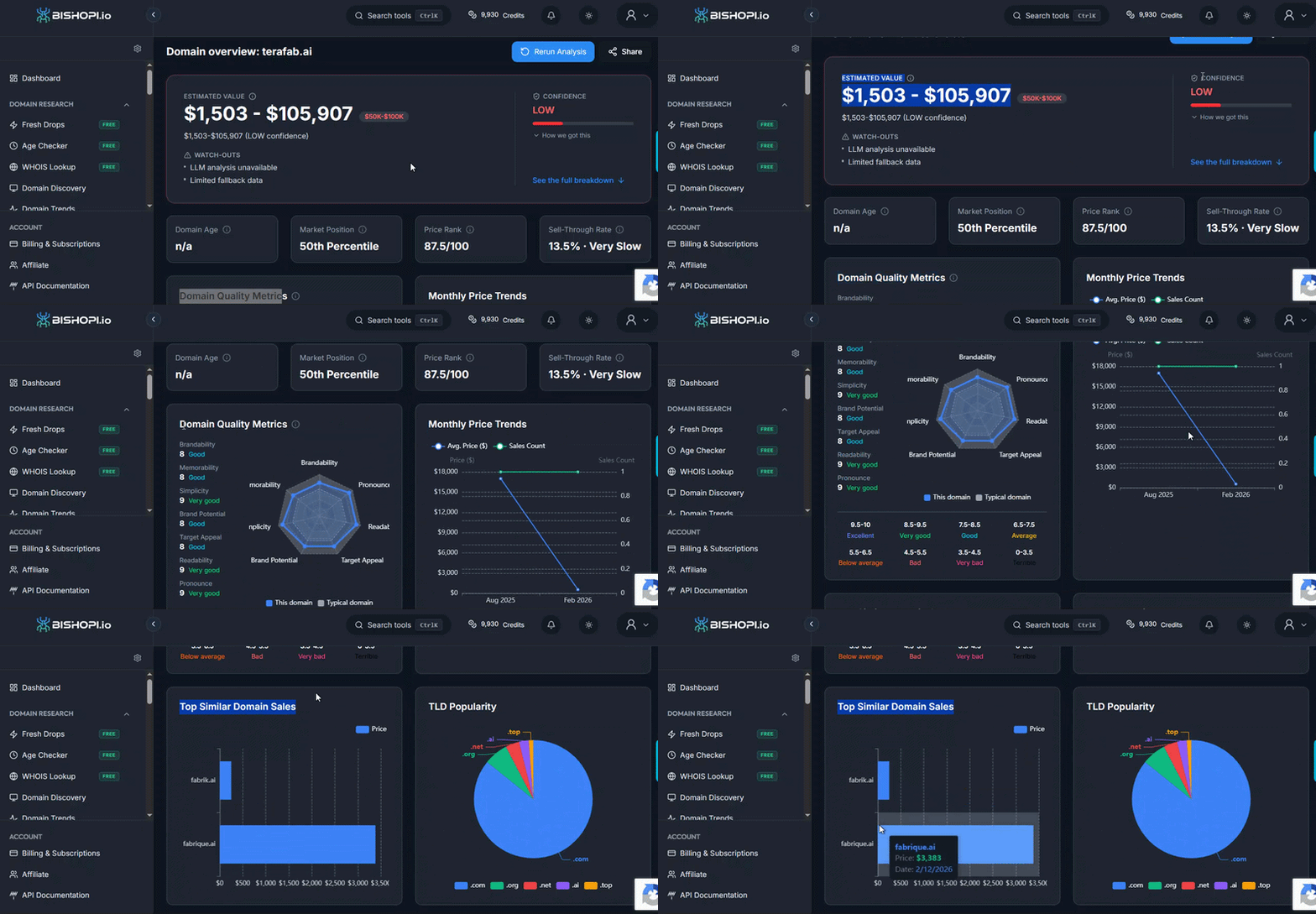
This gives you a solid negotiating position. You'll know if the owner's asking price is realistic.
How much it costs to buy a domain that is taken depends on various factors.
Here is what it costs to buy a taken .com domain based on real aftermarket sales data from Bishopi's sales database dated July 2025 – June 2026.
Domain Tier | Typical Price Range | Avg. Sale Price | Sales Volume (12 mo.) | Examples |
Generic multi-word domains (8+ chars, brandable combos) | $500 – $5,000 | $1,278 | 46,020 sales / $58.8M total | infraspect.com ($617), neuroagent.com ($4,488), communityratings.com ($4,805) |
Keyword-rich domains (4–10 chars, high search intent) | $2,000 – $15,000 | $4,355 | 6,277 sales / $27.3M total | — mid-market sweet spot for startups and SEO buyers |
Premium single-word domains (3–7 letter dictionary words) | $10,000 – $50,000 | $19,386 | 384 sales / $7.4M total | ritzy.com ($50K), aidrop.com ($49.9K), bitstar.com ($47.7K) |
Category-killer domains (ultra-premium, industry-defining) | $50,000 – $500,000+ | $196,102 | 176 sales / $34.5M total | bar.com ($500K), pub.com ($500K), delete.com ($494K), owen.com ($420K) |
Trophy / mega-premium | $500,000+ | — | Top sales in period | anything.com ($2M), sword.com ($1.5M), skins.com ($1.46M), nas.com ($1.25M) |
Negotiation tactics to keep in mind
Once you know the domain's value and the owner has shared their ask, it's time to negotiate. Here are proven tactics:
Anchor low (but not insultingly): Counter their opening offer with something 30-50% lower than their asking price. This gives you room to meet in the middle. If they ask for $10,000, offering $6,000 isn't unreasonable, but offering $1,000 will end the conversation.
Negotiate terms, not just price: If the owner won't budge on price, explore payment terms. Offer to pay in installments, or agree to a higher price if you can extend payment over 6-12 months. Sometimes, flexibility on timing is worth more to them than a lower lump sum.
Know your walk-away point: Before negotiating, set a maximum price you're willing to pay. Stick to it. Negotiations can become emotionally charged, and you might overpay if you don't have clear boundaries. Walk away if they exceed your limit. Other domains exist, and pursuing this one won't be worth the financial strain.
Consider Using a Domain Broker
Sometimes, contacting the domain owner yourself might not be the best option. A domain broker is a professional intermediary who specializes in buying and selling high-value domains. They know the market, have connections, and can often reach owners that you can't.
A heads up: Before calling in a broker, use Bishopi to do the groundwork yourself: confirm the owner via WHOIS, check the domain's status, and pull an appraisal. That way you walk into the broker relationship already knowing what the domain is worth and how gettable it is.
When should you use a domain broker?
Domain brokers aren't always necessary, but they shine in specific scenarios:
High-value domains: If the domain is premium or category-defining, a broker's connections might unlock deals you can't do alone.
Privacy-protected ownership: When the owner is hidden behind privacy services, brokers often have access to information you don't.
Owner is unresponsive: You've tried contacting them directly, but they're ghosting. A broker might have a path forward.
You want anonymity: Brokers can negotiate on your behalf, keeping your identity private until deal terms are set.
How can a broker help you?
Research: They dig into the domain's history, ownership, and comparable sales to determine a realistic asking price and negotiating strategy.
Contact: They reach out to the owner through their network or channels, often with more direct access than you'd have.
Negotiate: They handle back-and-forth negotiations, anchoring low and working toward a mutually acceptable price.
Close: Once terms are agreed, the broker facilitates the transfer, ensuring all legal and financial details are handled properly.
Follow-Up: They ensure the domain is successfully transferred to your registrar and answer any post-sale questions.
How do brokers charge you?
Brokers use different pricing models as shown below:
Commission-based (10-20%): The broker takes a percentage of the final sale price. Common for high-value acquisitions.
Flat fee: You pay a fixed fee ($500–$5,000+) regardless of the final purchase price. This works well if you have a tight budget or expect a lower acquisition cost.
Success-based: The broker only charges if they successfully acquire the domain. This is riskier for the broker, so it's less common.
Reputable domain brokers to consider
Here are three trusted brokers who specialize in domain acquisition:
Sedo: Sedo is one of the largest domain marketplaces with in-house brokers. They handle negotiations on behalf of buyers and sellers, maintaining anonymity until both parties agree. Sedo works on a commission basis and has access to a vast portfolio of premium domains.
Afternic: Afternic is VeriSign's marketplace for aftermarket domains. Many domain owners list domains for sale on Afternic, making it a searchable directory of available premium domains. You can make offers directly through the platform, and it facilitates communication. It's user-friendly and transparent, which makes it ideal if you want some broker assistance but prefer a marketplace structure.
GoDaddy Broker Service: GoDaddy's Broker Service connects buyers and sellers for premium domains. Their advantage is sheer scale. They manage a massive registrar with millions of domain clients. Their brokers are experienced and handle everything from valuation to closing. Fees are typically commission-based, and the process is straightforward.
Use Domain Backorders
Not all domains are actively held or regularly renewed. In fact, domain renewal rates for popular extensions like .com and .net were around 72% in Q3 2024, meaning approximately 28% of domains aren't renewed annually.
Using Bishopi’s domain status and lifecycle data, check whether a domain is a good backorder candidate. Look for domains flagged as dropped or heading into redemption before you commit to a backorder service.
If the owner refuses to sell, the price is unrealistic, or the domain appears abandoned, and you're willing to wait, domain backorders offer another path to acquiring a domain name that's already taken.
A domain backorder is a service that automatically attempts to register a domain the moment it becomes available. When a domain owner lets their registration lapse and doesn't renew during the grace period, the domain is released back into the registry. A backorder service catches it and registers it for you, assuming you're the only one requesting it or if you win a backorder auction.
How does the domain expiration and the grace/redemption period work?
Before you place a backorder, understand how expiration timelines work:
Expiration date: The day the domain registration ends (e.g., June 24, 2027).
Grace period: 30 days after expiration. The owner can still renew at the normal price. During this time, the domain stays active but can't be transferred.
Redemption period: 30 days after the grace period. The owner can still renew, but at a premium cost (usually 2-4x the normal renewal price).
Available for registration: After the redemption period, the domain is released and available for anyone to register. This is when backorders activate.
Popular backorder services
Several services specialize in domain backorders. Here are three trusted options:
SnapNames: SnapNames is one of the oldest backorder services. They allow you to place backorders on any domain, and if it becomes available, they attempt to register it for you. Their interface is straightforward, and they handle high volumes of orders. Pricing is competitive (typically $69 per backorder), and they win a significant percentage of attempted registrations.
NameJet: NameJet combines backorder services with an auction marketplace. If multiple people backorder the same expired domain, the backorder service holds an auction to determine who gets it. This means competition is transparent, and you can bid strategically.
GoDaddy Backorder: GoDaddy offers backorder services integrated into its registrar platform. If you already use GoDaddy, you can place backorders without switching platforms. Pricing is comparable to competitors, and their registration attempts are reliable.
Track the domain before it expires. If you've identified a domain you want to backorder, you need to know its exact expiration date.
Instead of checking manually every day, you can monitor important dates and status changes.
A domain monitoring tool like the one offered by Bishopi can help you track ownership changes, expiration events, and availability signals.
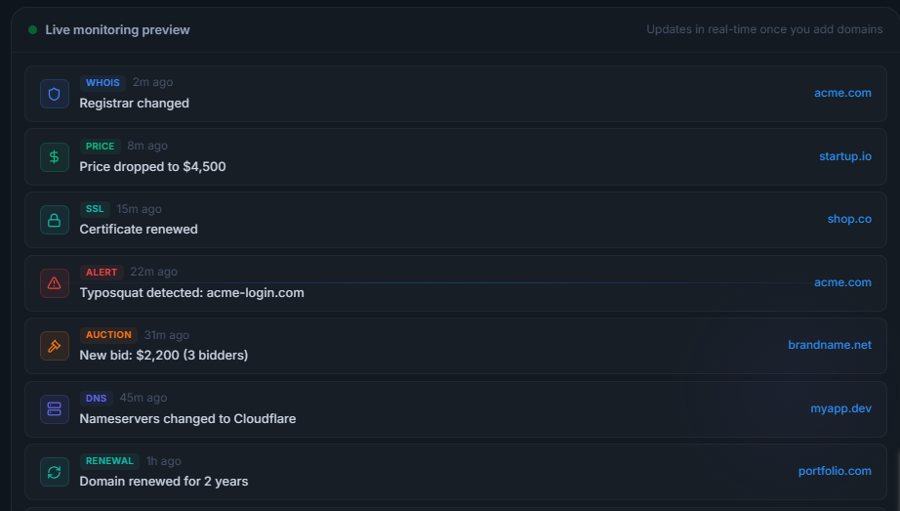
Specifically, the tool tracks the expiration date, the creation date, and DNS/ownership changes for any domain you're watching. Set an alert, and you'll know the moment the domain moves from grace into redemption, or from redemption into “available.”
Equipped with this information, you can engage a broker/backorder service for the final transaction.
DIY Outreach vs. Broker vs. Backorder
Not sure which approach to use to acquire a domain name that's already taken? Here's how they compare:
Factor | DIY Outreach | Domain Broker | Backorder Services |
Cost | Domain price only | Domain + 10-20% commission or flat fee | $69–$150 per backorder + domain price |
Speed | 1–4 weeks | 2–8 weeks | 3–6 months |
Best For | Responsive owners, lower budget, <$5k domains | Premium domains, unresponsive owners, high value | Patience available, no owner contact needed |
What to Do If You Cannot Get the Domain
Sometimes, despite your best efforts, the domain owner won't budge. The price is too high. They're not responsive. The backorder failed. At this point, you have two smart alternatives to consider.
Register an alternative TLD:
If your target domain with .com is unavailable, consider secondary extensions. .io domains have become prestigious for tech startups. .co is treated as a .com equivalent by many brands. .net has strong legacy authority.
Even .business, .company, or .pro can work if your industry is niche. Yes, .com still carries more authority, but a solid .io or .co is better than a mediocre .com alternative. Research shows that on average, startups using alternative TLDs secured their exact match brand name 88% of the time.
Register a slight name variation
If your preferred domain name is taken, you can try varying the name. These variations preserve your brand while giving you a registrable domain. The downside is they're less memorable and may dilute SEO value slightly, but it's better than no domain at all.
Frequently Asked Questions
Can I force someone to sell their domain name?
No. Unless the domain infringes on your trademark or is being used for illegal activity, a domain owner is generally free to keep or sell their domain. You can negotiate, make an offer, or wait for expiration, but you cannot force a private owner to transfer ownership unless there is a legitimate legal claim.
How long does it take to acquire a domain from a private seller?
It depends on the owner and the negotiation process. Some purchases happen within days, while others take weeks or months.
Direct negotiation typically takes 1–4 weeks from first contact to closing, assuming the owner is responsive.
If you use a broker, expect 2–8 weeks as they research, negotiate, and coordinate the transfer. Backorders take the longest: 3–6 months or more, depending on the domain's expiration timeline. Patience is critical.
The timeline depends on communication speed, price agreement, and the transfer process.
What is a domain squatter, and do I have any recourse?
A domain squatter registers domains in bad faith, typically domains matching famous trademarks or celebrity names, hoping to sell them for profit. If your registered trademark is being squatted, you can file a Uniform Domain-Name Dispute-Resolution Policy complaint to recover the domain for free. This requires proof of trademark registration and bad-faith intent. Legitimate domain owners aren't squatters, even if their asking price seems high.
Is it safe to buy a domain through a private sale?
Yes, if you use a reputable broker or escrow service. Never wire money directly to a private seller without third-party verification. To stay safe, use brokers like Sedo or Afternic, who hold funds in escrow until the domain is transferred. This protects both parties. For large transactions of around $10,000+, strictly use escrow. Always verify domain transfer eligibility before completing a sale and ensure there are no disputes, liens, or restrictions.
Conclusion
Learning how to acquire a domain name that is already registered does not have to be complicated. The process comes down to finding the owner, understanding the value, choosing the right acquisition method, and negotiating carefully.
Start by researching ownership with a WHOIS lookup tool, then decide whether direct outreach, a broker, or a backorder makes the most sense.
The biggest mistake is giving up too early. Many valuable domains change hands because someone took the time to ask.
If the domain is high-value or the owner is unresponsive, consider hiring a broker. And if you're willing to wait, place a backorder and use a domain monitor tool to track the expiration date.
Originally published at: bishopi.io
Stay up to date
Get updated with all the news, update and upcoming features.