How to Find High-Value Keyword Domains Using Real Sales Data
Every domain investor has heard the advice: buy names with search demand and commercial intent. It’s true, and it’s useless on its own, because nobody shows you the method. How do you get from a keyword to an actual buy-or-pass decision, with numbers?
We took a batch of commercial keywords, pulled their search metrics, and joined each one to what domains on that keyword actually sold for in the last two years. The result is a simple, repeatable workflow — and a finding that should change how you read a keyword: the single most-quoted metric, search volume, barely predicts whether a domain will sell at all.
The short version
Capture this | Because |
Search volume | Sizes the audience — but says nothing about whether searchers buy. The least useful number on its own. |
CPC (cost per click) | The cleanest public proxy for commercial intent. Advertisers only bid up keywords that convert to revenue. |
Keyword difficulty | How contested the space is — a rough read on how many businesses compete for the term. |
Comparable sales | What domains on the keyword actually sold for. The proof that demand converts to money — and the half no competitor publishes. |
The scoring rule, in one line: high CPC + real comparable sales = buy; high volume + near-zero CPC = trap. The rest of this piece shows the workflow and the data behind it.
Why is search volume the wrong first question in 2026?
Raw search volume tells you how many people type a phrase — not whether any of them are buyers. In 2026, with most informational searches answered without a click, volume is the least reliable signal of a keyword’s commercial value.
Search has changed in a way that matters for this decision. By SparkToro and Similarweb’s 2026 clickstream analysis, about 68% of Google searches now end without a click, up from roughly 60% just two years earlier, and AI Overviews now appear on more than 20% of all searches, cutting click-through by nearly 60% where they show. If your mental model of a keyword’s worth is “big number = valuable,” that model is now actively misleading.
But here is the part that’s good news for a domain investor, and that almost no one points out: the searches that get resolved without a click are overwhelmingly informational ones — definitions, quick facts, how-tos. AI Overviews and instant answers concentrate there. Commercial and transactional queries, the ones with buyers behind them, are far less affected; local commercial searches in particular, trigger an AI Overview only a small fraction of the time. The keywords that make a domain valuable are precisely the ones still sending real clicks to real buyers. So the job isn’t to find high-volume keywords. It’s to find high-intent ones, and then prove the intent converts.
What four numbers actually matter for a keyword?
For any keyword you’re considering as a domain, capture four things. Three are standard; the fourth is the one that turns analysis into evidence.
Search volume — monthly searches. Use it to size the opportunity, nothing more.
Keyword difficulty — a 0–100 score for how hard the term is to rank for. For an investor, it’s a proxy for how many businesses are competing in the space, which loosely tracks demand for a matching domain.
CPC — cost per click, the key column. It’s the cleanest public signal of commercial intent there is, because advertisers only bid real money on keywords that convert to revenue. A high CPC means businesses are paying to reach those searchers right now. This is the number the generic keyword guides gesture at and never operationalizes for domains. We will.
Comparable sales — how many domains containing the keyword actually sold recently, and for how much. This is the proof. A keyword can look great on the first three metrics and still have no market; comps tell you whether the demand is real money or just theory. It’s also the half only a tool with both a keyword database and a sales database can produce, which is the whole reason this study exists.
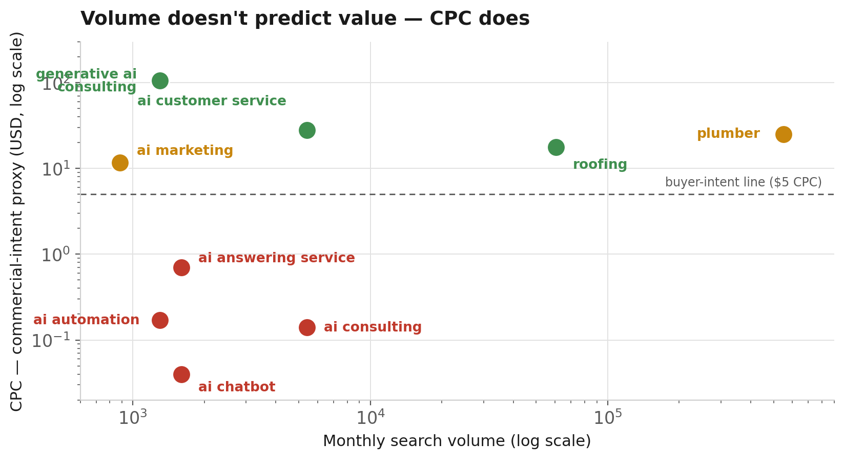
Figure 1. Volume vs. CPC across all nine keywords (log scales). The dashed line marks a $5 CPC — a rough floor for genuine commercial intent. Everything above it (green, plus the two local-service terms) has real advertiser demand; everything below (red) does not, regardless of search volume. “ai customer service” and “ai consulting” both sit at 5,400 searches but land on opposite sides of the line. Height predicts value; horizontal position doesn’t.
How does the keyword-research workflow work?
Seed keywords from categories where real businesses form, pull volume/difficulty/CPC, join each to its comparable-sales record, then apply a four-pattern scoring rule. The whole process takes minutes per keyword once the data is in front of you.
Start with commercial seeds. Pick keywords from categories where businesses actually spend — professional services, local trades, fintech, health, e-commerce. Avoid pure buzzwords; favor words a real company would build a brand on.
Pull the metrics. Run each seed through Keyword Explorer to get volume, difficulty, and CPC. Watch the CPC column hardest — it’s your intent reading.
Expand the list. Use Keyword Discovery and Keyword Gap to surface related terms and the qualifiers that change a keyword’s economics — as you’ll see, “generative ai consulting” is a very different bet from “ai consulting.”
Join to comparable sales. For each keyword, check Sales History for domains containing that term that actually sold, and over what range. This is the step that turns a keyword list into a buy list.
Apply the scoring rule. Classify each keyword by the four patterns below. That’s your buy / watch / pass decision.
The data: what we found
We ran nine commercial keywords through this process and joined each to its domain sales from January 2024 onward. A note on method, because honesty is the point: the sales match the root commercial keyword, not the exact AI phrase, a search for “ai consulting” returns names like omsconsulting.com and bergerconsulting.com, i.e. what the buyable head term (“consulting”) is worth. That’s arguably more useful than exact-phrase matching, but it’s what the numbers represent. Sample sizes are recent-window comps (2024–2026); the patterns are directional, not statistical certainties.
Keyword | Vol. | KD | CPC | Recent sales | Median | Signal |
generative ai consulting | 1,300 | 18 | $105.71 | 18 | $342 | BUY |
ai customer service | 5,400 | 72 | $28.07 | 12 | $405 | BUY |
ai marketing | 880 | 63 | $11.70 | 7 | $974 | WATCH |
ai consulting | 5,400 | 57 | $0.14 | 12 | $192 | TRAP |
ai chatbot | 1,600 | 23 | $0.04 | 12 | $103 | TRAP |
ai automation | 1,300 | 30 | $0.17 | 20 | $280 | TRAP* |
ai answering service | 1,600 | 36 | $0.70 | 5 | $110 | TRAP |
Plumber | 550,000 | 65 | $25.12 | 6 | $458 | WATCH |
Roofing | 60,500 | 100 | $17.66 | 15 | $155 | BUY |
Vol./KD/CPC: US broad-match, Keyword Magic Tool. Recent sales / median: domains containing the root keyword sold Jan 2024–Jun 2026, Bishopi Sales History. *“ai automation” has deep comps but near-zero CPC — see commentary. “roofing” carries a KD of 100 (maximally hard to rank for), but that measures SEO competition, not domain value; the CPC and comps drive the verdict.
Three things the data says
Volume lied, CPC told the truth. The cleanest result in the table: “ai consulting” and “ai customer service” both draw 5,400 monthly searches, identical volume. But “ai consulting” carries a $0.14 CPC and recent comps with a $192 median, while “ai customer service” carries a $28 CPC and a $405 median with a real end-user sale (customersupport.ai at $10,500). Same volume, opposite verdict. If you’d sorted your keyword list by search volume, these two would sit side by side; CPC pulls them apart instantly.
The qualifier flipped the bet. “ai consulting” looks like a trap, but “generative ai consulting”, a narrower term with lower volume, is the strongest buy in the set, on the back of a $105.71 CPC and 18 recent sales topping out at generateai.com for $5,100. The lesson: don’t judge a keyword by its head term. The modifier often carries the intent.
Deep comps don’t rescue dead intent. “ai automation” is the asterisk. It has the most recent sales of any keyword (20, up to letsautomate.com at $6,050), but a $0.17 CPC. Names sell, but the near-zero advertiser interest is a warning that the commercial demand is shallow relative to the activity. It’s the one keyword where the signals genuinely conflict, and the honest read is “thin buy, watch closely” rather than a confident yes. Real data has edge cases; pretending it doesn’t is how you lose money.
And it isn’t only an AI story. The two local-service terms show the framework generalizes. “roofing” (CPC $17.66, 15 recent sales) lands as a clear buy on the same logic as the strongest AI keywords, real advertiser money plus a proven resale market. “plumber” is more instructive: a huge 550,000 monthly searches and a healthy $25.12 CPC, but only 6 recent comps and the highest local median ($458). Strong intent, thin proven market — a textbook watch, not an automatic buy. (“roofing” also carries a keyword difficulty of 100, meaning it’s maximally hard to rank a site for. That’s a separate question from whether the domain holds value; the CPC and comps answer the investment question, difficulty is just context.)
What is the scoring rule for buy, watch, or pass?
Four patterns cover almost every keyword. Plot commercial intent (CPC) against proven demand (recent comparable sales), and the verdict falls out: buy, watch, or pass.
Pattern | What it means | Action |
High CPC + real comps | Advertisers pay to reach these buyers, and similar names have cleared the market | BUY — the core target profile |
High CPC + thin comps | Real buyer intent, but the resale market hasn’t proven itself yet | WATCH — a possible sleeper; confirm before paying up |
High volume + near-zero CPC | Lots of searches, no commercial value — informational or zero-click traffic | TRAP — looks attractive, won’t sell |
High volume + high CPC + no comps + buzzword | Hype stacking — speculation, not demand (the AI/Web3/metaverse pattern) | AVOID — the bubble profile |
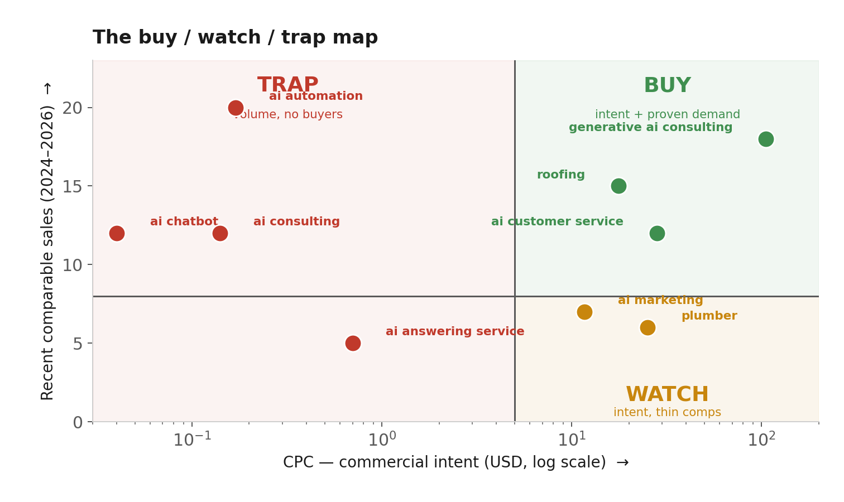
Figure 2. The same nine keywords mapped by commercial intent (CPC, horizontal) against proven demand (recent comps, vertical). The quadrant assigns the verdict: BUY top-right, WATCH bottom-right, TRAP anywhere on the low-CPC left — regardless of how many names happen to have sold there.
Keep the verdicts directional. This is a framework for reading signals, not a guarantee of profit — every acquisition still needs your own judgment on the specific name, extension, and price. None of this is financial advice.
Three keywords, worked end to end
The buy: generative ai consulting
Volume 1,300, difficulty 18, CPC $105.71. The CPC alone is a flare, advertisers paying over a hundred dollars a click means intense commercial competition for those searchers. Join to comps and it holds up: 18 recent sales, including generateai.com ($5,100), integratedai.com ($3,000), and regenerateai.com ($2,500). High intent, proven market, low ranking difficulty. This is the textbook buy.
The trap: ai consulting
Volume 5,400 — four times the previous keyword, and it’s the weaker bet. CPC is $0.14, and recent comps are modest: a $192 median, topping out at omsconsulting.com for $2,488. The huge search number is mostly people researching the concept, not businesses buying. If volume were your guide, you’d overpay here and pass on the generative-ai term. The data says do the opposite.
The sleeper: ai marketing
Volume 880 — the lowest in the set, but a $11.70 CPC and the highest median of the AI keywords ($974), with aimarketing.de and vmarketing.com both clearing $2,500. The thin recent-sales count (7) keeps it out of clear-buy territory, but the strong intent and prices make it a genuine watch, the “low volume, high intent” case the volume-chasers miss entirely.
Common mistakes this method prevents
Chasing volume. The whole point of the table: 5,400 searches at a $0.14 CPC is worth less than 1,300 searches at $105. Sort by intent, not size.
Ignoring CPC. It’s the single most predictive cheap signal you have, and most domain guides never mention it. If you take one habit from this piece, make it “check the CPC.”
Trusting asking prices instead of sales. A $50,000 listing isn’t a comp; a $5,100 completed sale is. Always join to realized sales, not listings, the same discipline behind our guide to pricing with comparable sales.
Treating zero volume as zero value. A niche service term with little search but high CPC and real comps can be a quiet winner. Volume floors don’t apply when the intent is strong.
Buzzword stacking. High volume plus high CPC plus zero comps plus a hype term is the bubble profile, speculation dressed as demand. Comps are what keep you out of it.
Frequently asked questions
Do keyword domains still sell in 2026?
Yes, but the keyword has to carry commercial intent, not just search volume. Across the keywords we studied, terms with high CPC and real comparable sales (like “generative ai consulting” and “ai customer service”) sold steadily, while high-volume low-intent terms barely moved. Commercial-intent keyword domains sell; informational ones increasingly don’t, because the searches behind them get answered without a click.
Is high search volume good for a domain?
Not by itself. Volume sizes the audience but says nothing about whether those searchers buy. In our data, two keywords with identical 5,400 search volume had opposite outcomes, one a buy, one a trap, because their commercial intent diverged enormously: a $0.14 CPC versus a $28 CPC, a roughly 200-fold gap. Always read volume next to CPC and comparable sales, never alone.
What CPC makes a keyword worth a domain?
There’s no hard threshold, but a useful rule of thumb is that a CPC above roughly $5 signals genuine commercial competition, and the keywords that performed best in our study ran far higher — $11 to $105. A CPC near zero (under about $1) is a warning that, however high the search volume, advertisers see no money in those searchers. Confirm with comparable sales before acting.
How do I check if a keyword domain has sold before?
Use a domain sales-history tool that records completed transactions, not asking prices. Search the keyword and review how many matching domains sold and in what range over the last 18–24 months. That realized-sales record is the proof that demand for the keyword converts to money, the single most important input in this whole workflow.
Why use CPC as a proxy for commercial intent?
Because advertisers only bid real money on keywords that convert to revenue, CPC is effectively the market pricing the commercial value of a search. A high cost-per-click means businesses are competing to reach those searchers right now, which is exactly the demand that makes a matching domain worth owning. It’s the cleanest public intent signal available, and it costs nothing to check.
Run the workflow on your own shortlist
The method comes down to two halves: read commercial intent, then prove it converts. Keyword Explorer gives you volume, difficulty, and the all-important CPC; Sales History gives you the realized comps that turn intent into a buy decision. Run any keyword you’re considering through both before you spend a dollar, and if you want the one-screen version, Domain Value Analysis pulls the signals together for a single name. The investors who win the next few years won’t be the ones chasing the biggest search numbers. They’ll be the ones who learned to read intent.
Related reading
→ Domain Investing in 2026: What the Data Actually Shows — the principle this workflow operationalizes
→ How to Price a Domain Using Comparable Sales — the comps discipline at the heart of the method
→ We Analyzed 113,408 Domain Sales — What's Actually Selling Right Now — the keywords quietly moving the market
→ How to Vet a Domain Portfolio Before Buying — the risk checks that pair with this demand read
→ What a Domain Analysis Tool Actually Shows You — reading the rest of a domain’s signals
Originally published at: bishopi.io
Stay up to date
Get updated with all the news, update and upcoming features.