Top Domain Sales Research Tools Beyond NameBio
For years, NameBio has been the default starting point for domain sales research. With more than 6.8 million recorded sales, it remains one of the largest publicly accessible databases of domain transactions.
But the problem for modern domain investors is that historical sales data alone is no longer enough.
If you're evaluating a domain acquisition today, you need answers to questions that NameBio doesn't solve. Is the domain currently undervalued? Who owns it? Is it listed for sale? Are similar domains gaining momentum in the market? Are buyers paying more for .ai than .com this quarter?
Those questions require live domain market intelligence, not just historical records.
In my experience researching .ai and startup-focused domains, the biggest valuation mistakes happen when investors rely exclusively on historical comps without understanding current demand trends.
NameBio tells you what happened. Modern domain research tools help explain what is happening now.
This guide compares five NameBio alternatives and shows where each tool excels, where NameBio still leads, and which platform provides the most complete domain intelligence workflow in 2026.
Why People Search for NameBio Alternatives
NameBio is a database for domain sales history, and only that. One of the challenges with NameBio is the lack of current market context. Knowing what a domain name sold for two years ago does not tell you whether that price holds today, particularly with the .ai domain boom reshuffling valuations across tech-adjacent TLDs.
In my experience tracking startup and AI-related domain acquisitions, historical sales alone frequently underestimate current buyer demand in fast-growing sectors.
Domains that appeared overpriced based on 2023 sales data often look inexpensive when compared against recent .ai transaction trends.
Besides, recent domain sales data, filtered to the last 6–12 months, are hard to extract from NameBio without significant manual filtering.
The second challenge is domain valuation. NameBio shows you what sold; it does not estimate what a domain is worth today. That requires a different kind of tool like Bishopi, one that combines sales comps with live signals like search volume, traffic, backlinks, and TLD trend data.
The rise of newer domain name extensions has also created challenges. If you’re focused on .ai, .io, and emerging TLDs, you’ll find that NameBio’s public sales data is thinner than it is for traditional .com names.
What’s more? NameBio's domain sales history skews toward publicly reported transactions. Private broker sales, which is where many of the largest deals happen, often never reach NameBio's sales database or arrive there weeks later.
If you need visibility into recent domain name sales that moved through brokerage channels, you are looking in the wrong place.
Add to this the absence of ownership data, no listing status, no live appraisals, and an interface that has changed little in years, and you realize you need additional tools to complete the picture.
How Does NameBio Work? (and Where Does it Fall Short?)
NameBio aggregates publicly reported domain sales from marketplaces, brokers, auction platforms, and others.
Data from the platform as of mid-2026 shows that it holds over 6.8 million recorded sales and more than $3.2 billion in total reported transaction value, with domain sales history going back to the early 2000s. This makes it one of the largest collections of domain transaction data available publicly.
The free tier covers most use cases. You can search for a domain name by keyword, TLD, character length, price range, date, and marketplace source. That makes it easy to identify comparable transactions and verify whether a domain name sold previously.
However, historical sales data represents only one layer of domain intelligence.
Here are five areas where NameBio falls short. These are the gaps that every alternative below maps to.
It does not provide a current domain valuation (no live appraisal engine)
It does not show who owns a domain or whether it is currently listed for sale
It does not cover private broker sales, which account for a large share of high-value transactions
It does not show comparable live listings alongside historical sales
It does not surface market trends or signal what is selling right now
NameBio Competitors: Side-by-Side Comparison Table
Tool | Free Tier? | Historical Sales Depth | Live Valuation | AI Chat | Semantic Search | Private Sales Coverage | Best For |
NameBio | ✓ | ✓ | ✗ | ✗ | ✗ | Partial | Historical price lookup |
DNJournal | ✓ | Partial | ✗ | ✗ | ✗ | Partial | Market narrative & context |
Bishopi | 7-day trial; from $29/mo | ✓ | ✓ | ✓ | ✓ | Partial | End-to-end research |
Sedo Sales Report | ✓ | Partial | ✗ | ✗ | Partial | ✓ | Premium .com investors |
Estibot | Partial | Partial | ✓ | ✗ | ✗ | ✗ | Appraisal workflows |
Atom | ✓ | Partial | Partial | ✗ | ✗ | Partial | Brandable domain trading |
Note: This information is verified as of May 2026. Check each tool's website for current rates/data.
The 5 NameBio Alternatives, by Use Case
1. DNJournal — When You Need Domain Market News for Big Sales
DNJournal remains one of the most trusted sources of domain industry news and sales reporting. While NameBio focuses on raw transaction records, DNJournal adds editorial context around those transactions.
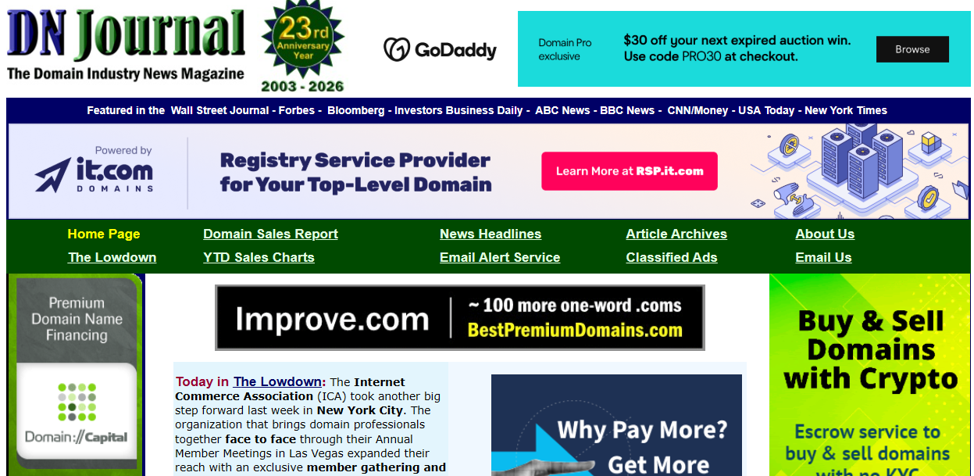
The platform publishes weekly sales charts, quarterly market recaps, and annual reports that help investors understand why particular domains sold.
That editorial layer matters. A record showing that a premium domain sold for six figures is useful. Understanding the buyer category, market conditions, and strategic significance behind the sale is often more valuable.
The platform is free, requires no account, and its archives serve as the authoritative source for the list of the most expensive domains ever sold.
2. Bishopi — When You Need Sales, Live Valuation, and Ownership Data in One View
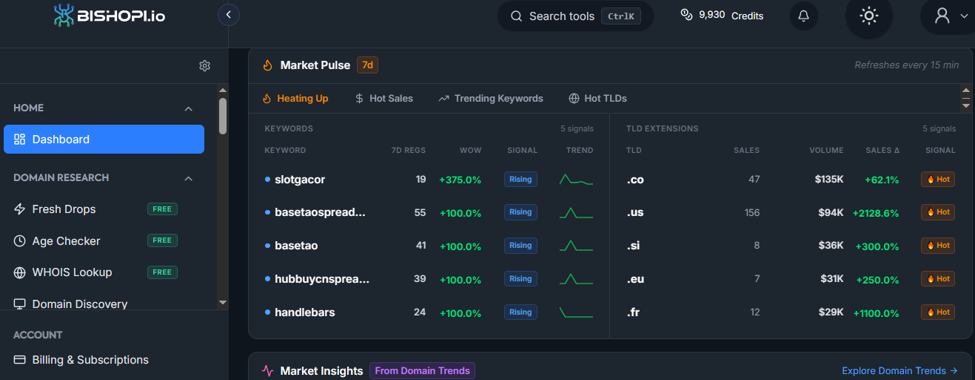
Bishopi is a full-stack domain intelligence built for investors who need more than historical data. A single search returns a live domain valuation based on real comparable sales, TLD market trends, search volume, backlinks, and domain age, alongside domain sales history.
You get all of this domain data in a single view, like this:
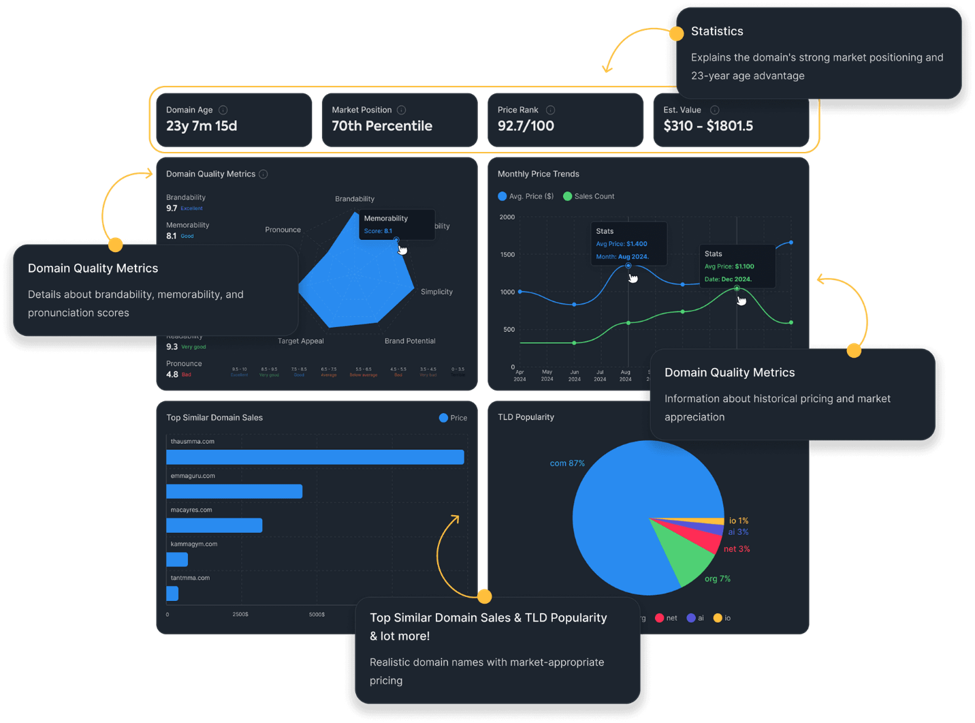
Bishopi's sales database is designed as a domain intelligence engine rather than a simple transaction archive.
What’s more? Beyond historical sales records, it supports semantic similarity search, which allows you to discover conceptually related domain sales instead of only exact keyword matches. Searches return cohort analytics such as price distribution by TLD, average sale prices, monthly transaction volume, and comparable market segments.
The tool can also evaluate each transaction through percentile rankings and repeat-sale tracking, so you can identify domains that have appreciated over time. The community-submitted sales data can expand coverage beyond publicly reported transactions.
What differentiates Bishopi from all other NameBio alternatives on this list is scope. It directly addresses four of the five gaps above. It offers live appraisal, domain ownership details, listing status, and comparable live listings.
What truly separates Bishopi from other NameBio alternatives is its AI-powered domain research assistant.
Instead of manually filtering databases and spreadsheets, you can ask natural-language questions and receive answers backed by live transaction data. For example you can ask the AI chat the following questions:
"Show me 4-letter .ai domains that sold for under $5,000 in the last 90 days."
"Which keywords are gaining momentum in .io domains?"
"Is .ai outperforming .com this quarter?"
"Find domains similar to SolarGrid.ai that were recently sold."
The assistant connects to more than 25 specialized research tools and a live sales database containing millions of records. Rather than performing static lookups, you can have an open-ended conversation with the market itself.
This changes the workflow completely. Instead of searching for data and interpreting it manually, you can ask questions and receive actionable insights in seconds.
You can try Bishopi risk-free for 7 days.
Search any domain and instantly see:
Live valuation
Comparable sales
Ownership details
Listing status
AI-powered market analysis
Start with a domain you're currently evaluating and compare the results against a standard NameBio lookup.
3. Sedo Sales Report — When You Need Broker-Grade Visibility
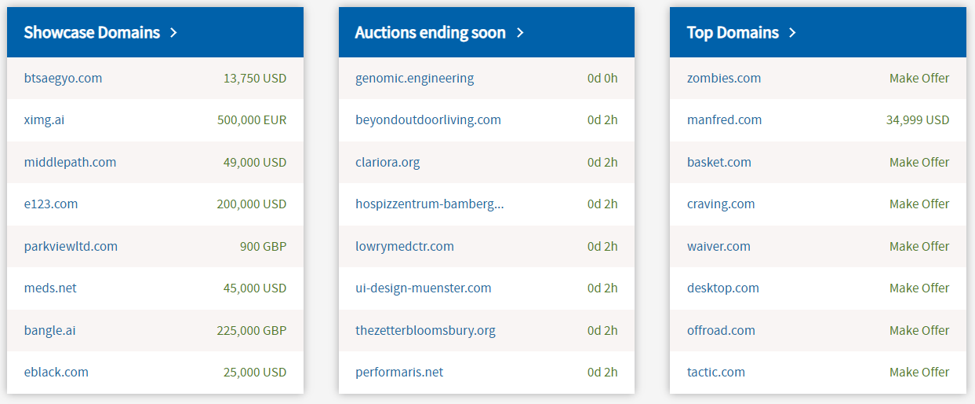
Sedo is one of the world's largest domain marketplaces, and its weekly sales reports offer something NameBio often misses: broker-handled transactions that surface before they get aggregated elsewhere.
Sedo's domain sales data matters for premium .com investors because it has operated at the center of the domain aftermarket for 25 years and handles top-tier transactions. For instance, the $1.2 million sale of Bot.ai in February 2026 happened through Sedo and Midnight.com at $1.15 million in January 2026.
Their weekly sales reports catch deals that do not always surface quickly in NameBio, especially brokered sales where the reporting lag can run weeks.
The platform itself is free to browse, although brokerage and marketplace transactions naturally involve commission structures.
4. Estibot — When You Want Appraisal Logic and Sales Together
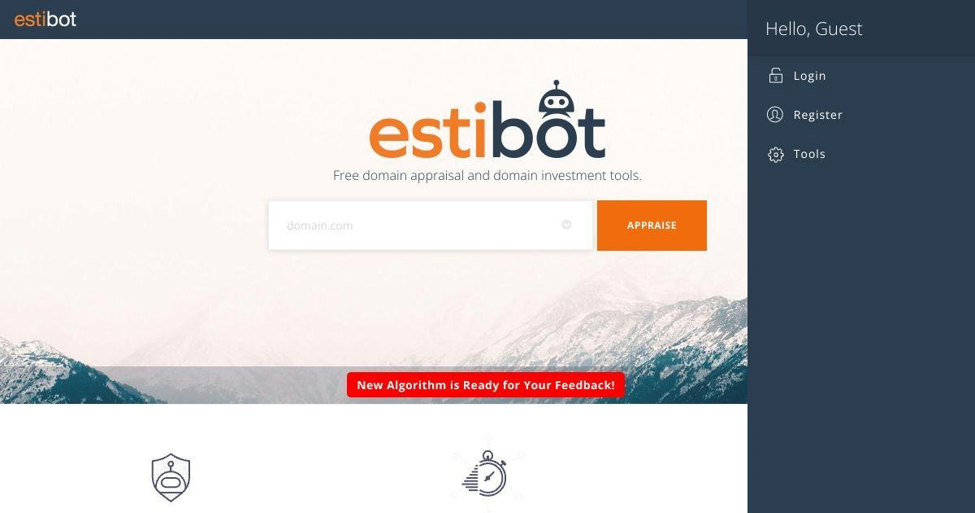
Estibot has been the domain industry's automated appraisal standard since 2007. It processes over 2 million daily valuations by combining search volume, keyword CPC data, type-in traffic, and a sales database of 500,000+ historical transactions.
Besides, the tool displays appraised value and sale price side by side, which makes it easier to spot whether a domain is priced above or below what comparable sales suggest.
Estibot supports bulk portfolio appraisal up to 100 million domains via API. It’s a practical tool for managing large domain portfolios, identifying outliers in your holdings, and quickly prioritizing which names to develop or liquidate.
The tool performs best on exact-match keyword domains with measurable search volume.
Estibot offers alimited free tier; paid plans for higher query limits, API access, and human appraisals.
5. Atom — When You Care About Brandable Domain Sales
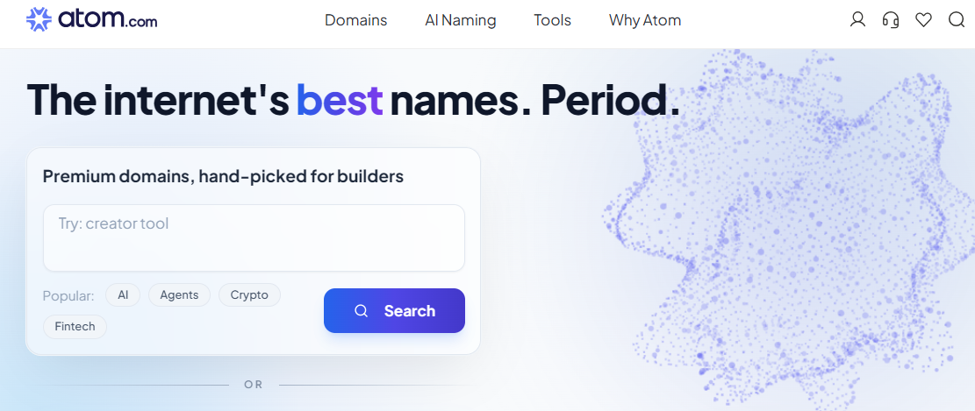
Atom operates in a different corner of the domain market than most traditional sales databases.
Formerly known as Squadhelp, Atom focuses heavily on coined and startup-oriented brandable domains. Its marketplace contains hundreds of thousands of curated listings and emphasizes invented names, modern branding, and startup positioning.
The reason NameBio misses a significant portion of brandable sales is structural. Most brandable transactions happen through marketplace-direct channels, where the sales data either is not publicly reported or arrives late.
Atom also functions as a domain registrar and offers AI-powered naming contests, audience testing, and logo generation alongside its marketplace.
Atom is free to browse; sellers list free; Atom takes 15–35% commission on sales, depending on the listing tier.
Domain Test: What Each Tool Actually Returns
Here is how the five alternatives perform on three domain types — an iconic high-value sale, a recent six-figure transaction, and an obscure 4L .io:
Domain | Bishopi | DNJournal | Sedo Sales Report | Estibot | Atom |
Cars.com ($872M iconic sale, 2014) | Price, TLD trend, domain age context | Editorial coverage; historical significance noted | Top historical sales; partial broker detail | Appraised value shown; no narrative context | Not covered. .com generics outside brandable scope |
Bot.ai ($1.2M Sedo sale, Feb 2026) | Price, .ai TLD trend, comparable recent .ai sales | Covered in the bi-weekly report with deal context | In the weekly sales report, brokered by Sedo | Appraised; algorithm struggles with .ai premiums | Not relevant. Broker .ai sale, not a brandable listing |
4L .io (e.g. XKQB.io) | Comparable .io sales filter; valuation range estimate | Not covered (editorial focuses on notable sales) | Below reporting threshold; not in weekly report | Returns a value; accuracy unreliable for acronyms | Not listed. Acronym .io outside Atom's brandable criteria |
Which NameBio Alternative Should You Actually Use?
If you're researching one domain before buying it: Use Bishopi. Search the domain once and get valuation estimates, ownership information, comparable sales, listing activity, semantic sales analysis, and AI-generated market insights in a single workflow. This replaces the need to jump between multiple domain name tools.
If you're building lists of recent domain sales for content or newsletters: Use DNJournal plus NameBio. DNJournal's bi-weekly reports give you editorial-grade domain industry news coverage of premium sales with context; NameBio fills in the volume data. Both track domain name sales history reliably and are free to access.
If you sell brandable names: Use Atom. It is the most relevant comparable sales source for coined and creative names. NameBio's database will not reflect your market accurately.
If you sell premium .coms: Use Sedo Sales Report plus NameBio. Sedo's weekly reports surface broker-handled sales that may not hit NameBio for weeks. Together, the two give you the most complete view of premium domain market news and recent sales history.
If you want a single tool that mostly replaces NameBio: Bishopi comes closest. It covers historical sales, live valuation, ownership data, and listing monitoring — the four gaps NameBio leaves open. It is not free, but for active investors, it compresses a multi-tab research workflow into one search.
When NameBio Is Still the Right Tool for You
Despite the rise of newer platforms, NameBio remains the benchmark for domain sales history.
No competitor matches its historical depth. With over 6 million recorded sales going back more than 20 years, NameBio's database is the only place to verify what obscure TLDs sold for in 2008 or to track decade-long trends for a specific keyword. That depth is not something you can replace
It is also free and fast. For a quick price check, assuming you’re asking: did a name like this sell before, and for how much? Nothing beats opening NameBio and running the search.
The Combined Workflow Most Pros Actually Use
To get enough data on a domain you want to purchase, we recommend using a combination of the domain research tools we outlined above.
Start with NameBio for historical price verification and comparable sales research. If you are evaluating a domain or entering a negotiation, NameBio tells you what similar names actually traded for, when, and on which platform. That is your baseline.
Then move to Bishopi or Estibot for current domain valuation. Historical sales anchor the range; a live appraisal tells you whether the market has moved since those sales happened. For keyword .coms, Estibot's bulk tool is efficient. For names where current TLD trends and traffic signals matter, Bishopi's valuation engine factors those in alongside the comps.
Layer in Sedo or Atom for current listings and recent broker context. If a name is listed on Sedo's marketplace right now, or if comparable brandables have sold on Atom recently, that is live pricing intelligence that neither NameBio nor an appraisal tool captures.
Finally, check DNJournal for the wider market narrative. If the sale you are researching was a newsworthy transaction, DNJournal's editorial coverage provides the context about what drove the price, who the parties were, and where the market appears to be heading.
Conclusion
The best domain investors no longer rely on a single source of information.
Historical sales data remains essential, which is why NameBio continues to be part of nearly every professional workflow. But historical data alone does not reveal current value, ownership, buyer demand, listing availability, or emerging market trends.
Search any domain you're actively considering right now and compare the results. A modern domain intelligence platform should show you the valuation, comparable sales, ownership status, listing visibility, and broader market context in one place.
Bishopi was built for exactly that purpose. Search any domain you're considering right now. The tool will show you the valuation, comparable sales, ownership status, and market trends in seconds, in a single view.
Frequently Asked Questions
What Makes a Good NameBio Alternative?
Before choosing a NameBio alternative, evaluate whether the platform provides:
Historical domain sales data
Comparable sales analysis
Domain valuation estimates
Registration trend monitoring
TLD performance insights
Portfolio tracking
Buyer and lead discovery
Market intelligence and forecasting
The best tools combine several of these functions rather than focusing on a single metric.
What is the best NameBio alternative for domain valuation?
The best alternative for NameBio depends on your specific use case. For instance, Bishopi shines in domain valuation by combining live appraisals with historical sales data in a single search.
Unlike NameBio, which only shows past sales, it generates a real-time estimated value based on comparable transactions, TLD trends, search volume, and backlinks. This gives you both the historical anchor and a current market price in one place.
Where can I find recent domain sales data?
The best sources for recent domain sales data are NameBio, Sedo's weekly sales reports, and DNJournal's bi-weekly sales charts.
For brandable name sales, Atom's marketplace tracks recent transactions that rarely appear in general databases like NameBio.
Is there a free alternative to NameBio?
Yes. DNJournal provides free domain sales reporting and market commentary. Bishopi also offers a 7-day unlimited free trial, allowing investors to access domain valuations, ownership data, comparable sales, and AI-powered market analysis without an upfront subscription.
How do I check domain sales history without NameBio?
You can use Sedo sales reports, DNJournal, Bishopi, and marketplace-specific databases. Tools like Bishopi are particularly useful because they combine historical sales records with semantic search capabilities, which makes it easier to discover relevant comparable sales even when exact keyword matches are limited.
What is the best tool for domain valuation in 2026?
For most investors, Bishopi offers one of the most complete valuation workflows in 2026 because it combines sales history, market trends, ownership data, semantic search, and AI-powered analysis. Estibot remains useful for bulk appraisal workflows, while NameBio remains the strongest source for historical transaction verification.
Originally published at: bishopi.io
Stay up to date
Get updated with all the news, update and upcoming features.