How to Identify Valuable Domain Names Early
A few years ago, most people would have laughed at the idea of a simple three-letter domain selling for life-changing money. Yet in early 2026, Bot.ai sold for $1.2 million on Sedo, making it the first publicly reported seven-figure .ai domain sale in history.
The buyer wasn't paying for a website. They were paying for scarcity, branding power, and future demand.
That's the difference between ordinary and truly high-value domains.
Experienced domain investors don't wait for everyone else to recognize value. They identify specific signals before the market catches up. Whether you're interested in buying domain names to resell, evaluating premium domain names for a startup, or searching for authority domains for sale, the goal is the same: find assets with strong future demand before the price reflects it.
This guide explores the six signals experienced investors use to identify valuable domains, how to appraise them properly, where smart investors source undervalued opportunities, and the red flags to avoid.
What Makes a Domain “High-Value”?
High-value domains are names with strong demand, limited supply, and realistic resale potential. Their value comes from market liquidity, brandability, search demand, authority, and scarcity, not simply price tag.
Plenty of domains carry high asking prices and never sell.
Real domain name value comes from evidence such as comparable sales, search demand, and a clean history.
Think of domain names the same way investors think about real estate. A house isn't valuable because the owner says it is, but because comparable properties have sold at similar prices and buyers are willing to pay.
The same principle applies to domain name value.
This is also why when evaluating any domain, you shouldn’t rely solely on the seller’s pitch but run the name through a neutral check. A good starting point is to run it through a domain appraisal tool like the one offered by Bishopi and see what the data says, independent of anyone’s asking price.
In particular, domains that consistently command premiums usually share the same characteristics:
Short and memorable
Strong TLD extension
Commercial keyword demand
Clean ownership history
Quality backlink profile
Alignment with growing industries
The more signals a domain has, the stronger its investment case.
What Are the Key Signals of High-Value Domains?
Six factors consistently separate domains that hold value from those that just look impressive. They include length and pronounceability, TLD, keyword demand, age and history, backlink authority, and market timing. Score a domain against all six, and you’ll know more about its real worth than most sellers do.
Here is a glimpse at each of these core signals:
1. Length and Pronounceability
Shorter domains usually sell for more.
For instance, in early 2026, AI.com was bought by the Crypto.com founder for $70 million.
This is because they are easier to remember, type, brand, and harder to replace.
Another reason why shorter domains consistently outperform longer names is scarcity.
As more businesses compete for memorable digital brands, the available supply continues to shrink.
The other factor is pronounceability. A domain you can say out loud in a meeting, read off a billboard, or dictate over the phone without spelling it letter-by-letter has a real advantage over one that’s just short.
2. TLD Premium
Not all domain extensions carry equal weight.
Even in 2026, .com remains the dominant extension for resale value. It remains the default extension buyers trust, and it’s the one with the deepest comparable-sales history, which makes appraisal easier and resale faster.
As of early 2026, .com TLD accounts for 163.6 million global domain name registrations.
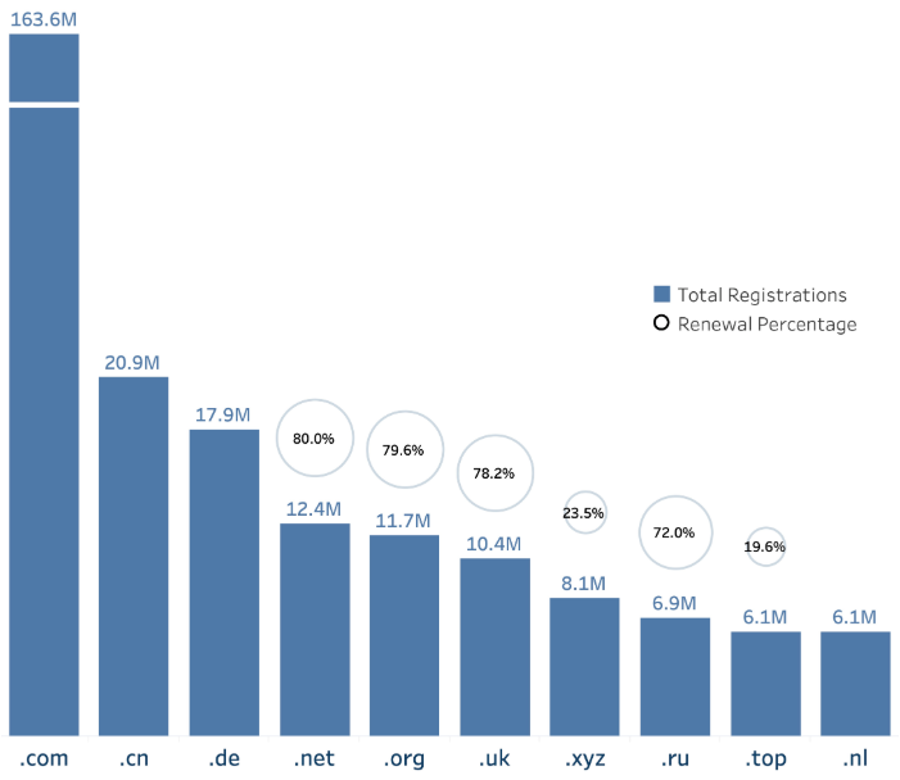
Recent market activity also highlights growing demand for AI-related extensions as artificial intelligence companies compete for memorable names. The increasing popularity of AI startups has pushed demand for strong .ai domains significantly higher.
That demand shows up directly in resale prices: the average .ai aftermarket sale now runs around $239,516, roughly ten times the average .com resale price, making it the most expensive TLD category tracked by aftermarket data as of March 2026.
Likewise, .io carries a similar, if smaller, premium among venture-backed startups and SaaS businesses, though its growth rate is far more modest than .ai’s.
Meanwhile, .net and .org domains still sell, but mostly as secondary options. Buyers pick them up when the matching .com is unavailable, which caps how much they’ll ever be worth relative to the same word in .com.
3. Keyword Demand
Keyword demand creates natural buyer demand.
Start with a keyword research tool and search for the exact term in the domain. A domain built around a word with meaningful monthly search volume has a built-in audience the moment it goes live, whether you’re building a site on it or buying domain names to resell to someone who will.
Equally, a domain built around an invented word with zero search volume has to create demand from scratch, which is a much harder, slower path to value.
The easiest way to evaluate this signal is to look at:
Monthly search volume
Commercial intent
Trend growth
Businesses already operating in that niche
Industry size
Advertising competition
A keyword that attracts thousands of monthly searches and strong advertising spend usually has more commercial value than an obscure phrase.
This doesn't mean exact-match keyword domains dominate every market. Brandable names remain highly valuable. However, keyword demand still provides an important layer of domain valuation.
4. Domain Age and History
Domain age by itself isn’t a value signal. A 20-year-old domain with a spam history can be worth less than a clean two-year-old domain. What matters is what the domain was used for during those years.
Plug the domain into the WHOIS lookup tool and look at its registrar information, registration date, ownership history, previous website quality, and whether it changed hands or sat dormant. Then check the Wayback Machine to see what was actually published on the domain over time.
The five-minute check can save you from buying someone else’s reputation problem.
A domain with a clean, consistent history, real content, no dramatic topic changes, and no signs of having been a spam farm or link network carries real equity.
Meanwhile, a domain that flipped through five owners and three completely unrelated niches in its lifetime is a much riskier bet, even if the name itself looks great.
5. Backlink Profile and Authority
This is where expired and aged domains earn their premium. A domain that’s been live for years can accumulate real backlinks. If those links are genuine and relevant, the domain inherits SEO equity that would otherwise take a new site months or years to build organically.
But here is the catch: not all backlinks are equal, and a high domain authority number can be manipulated.
Spam link networks, expired-domain link farms, and low-quality directory submissions can inflate a domain’s apparent authority without giving it any real value.
Always check its backlink profile using a backlink API like the one offered by Bishopi.
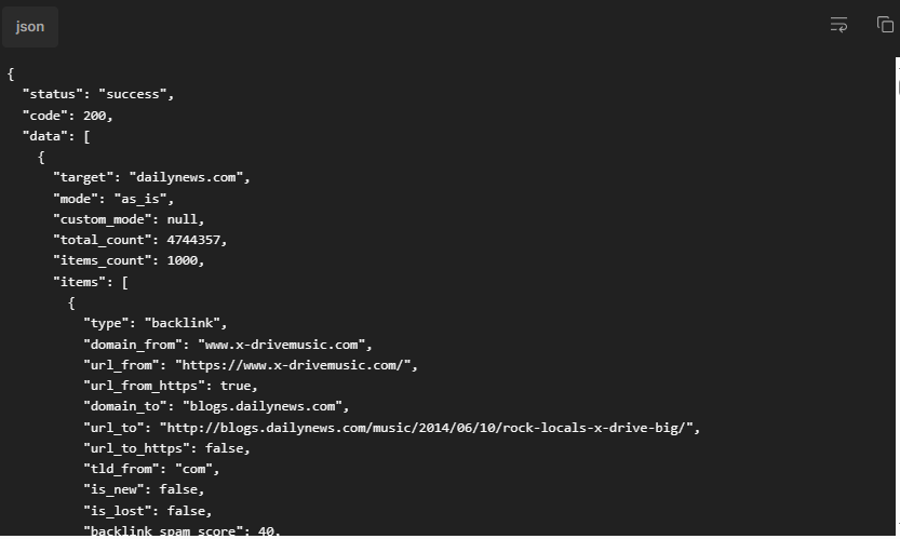
The domain SEO analysis can reveal domain authority, search rankings, traffic sources, and overall SEO strength.
Insert GIF for Bishopi domain SEO analysis here>> https://drive.google.com/file/d/1hd4t1JH8zxhi4hKC4-j0X5EB1GtKtDmX/view?usp=sharing
When reviewing authority, look specifically at referring domains, link quality and relevance, anchor text diversity, and historical growth.
6. Market Timing
The same domain can be worth ten times more depending on when you’re evaluating it. Categories go through phases: a wave of attention pushes prices up fast, early movers capture the cheap inventory, and by the time a trend is obvious to everyone, the good names are already gone or priced accordingly.
Consider what happened with:
AI domains after ChatGPT's rise
Crypto domains during blockchain adoption
Telehealth domains during remote healthcare expansion
Fintech domains, such as digital banking, accelerated
In each case, early investors identified a growing trend before mainstream demand arrived.
AI domains in 2025 and 2026 are the clearest current example. Six-figure and seven-figure AI-related sales were rare before the recent boom and are now a recurring feature of weekly sales reports.
Crypto, health tech, and fintech have all gone through similar cycles in the past decade. You should track which categories are heating up before the headline sales make it obvious, by paying attention to domain name auction sites like NamePros and trade publications like DomainNameWire to discover emerging niches well before mainstream coverage catches on.
Now, you’ve got a domain, what’s next? Score it against the six signals before buying it.
Signal | Question to Ask | Pass / Fail |
|---|---|---|
Length & Pronounceability | Is it short and easy to say out loud? | ✅ / ❌ |
TLD | Is it .com, or a TLD with real premium (.ai, .io)? | ✅ / ❌ |
Keyword Demand | Does it contain a term with real search volume? | ✅ / ❌ |
Domain Age & History | Is the WHOIS and content history clean? | ✅ / ❌ |
Backlink Authority | Are the backlinks genuine, not spam-built? | ✅ / ❌ |
Market Timing | Is the category trending up right now? | ✅ / ❌ |
If a domain scores 5/6 or 6/6, you can proceed to negotiate its price. A domain in the 3/6–4/6 range can still be worth buying, but only at a price that reflects the gaps. Don’t pay premium-domain prices for a domain with premium-domain weaknesses.
Anything 2/6 or below should be treated with real skepticism, regardless of how good the name sounds when you say it out loud.
Where Do Smart Investors Find Undervalued Domains?
Smart investors source undervalued domains where competition is lower, and pricing inefficiencies still exist. The most reliable sources include expired domain auctions, backorder services, domain marketplaces, and niche investor communities where motivated sellers often list assets below market value.
Expired Domain Auctions
When you don’t renew a domain, it doesn’t disappear instantly. Instead, it moves through a multi-week expiration process, and during part of that window, it’s listed for public bidding on platforms like GoDaddy Auctions, NameJet, and Sedo.
This is where some of the best value hides, because plenty of domain owners simply forget to renew, or let a domain lapse without realizing what it’s actually worth.
The mechanics differ slightly by platform.
GoDaddy Auctions lists domains roughly 26 days after expiration for a 10-day bidding window; if nothing sells, the name drops into a five-day closeout where the price falls daily until someone buys it outright.
NameJet works through a private backorder system. You place a backorder before a domain expires, and if multiple people backordered the same name, an auction opens between just those bidders, which tends to keep prices more rational than open public bidding.
Backorder Services
With backorder services, you tell a service like NameJet, DropCatch, or SnapNames that you want a specific domain the moment it becomes available, and they handle the technical race to capture it the instant it drops.
Set alerts before a domain you’re watching even gets close to expiring. You can track this on Bishopi’s domain monitor tool by setting an expiry alert on any domain you’re watching, and you’ll know the moment it enters its renewal grace period, giving you time to research it properly and line up a backorder instead of scrambling at the last minute.
Domain Marketplaces
Atom, Afternic, and Sedo are the renowned domain marketplaces where most active (non-expired) domain sales happen. These are domains current owners have deliberately listed for sale, not names that lapsed. The advantage here is volume and filtering: you can search by price range, length, TLD, and keyword, and narrow tens of thousands of listings down to a shortlist in minutes.
The tradeoff is that everyone else can filter the same way, so genuinely underpriced listings on these platforms get noticed and bought quickly.
Set saved searches with tight filters and check them daily rather than browsing broadly.
Reddit and NamePros
You can also find motivated individual sellers who haven’t listed anywhere formal yet, or who are open to offers well below what a marketplace listing might suggest on Reddit communities like r/Domains and the NamePros forum.
The competition here is lower simply because it takes more effort to participate — you have to read threads, build a small reputation, and negotiate directly instead of clicking “buy now.” That friction is exactly why prices tend to run lower than equivalent marketplace listings.
How Do You Appraise a Domain Before You Buy?
To appraise a domain, combine automated estimates with manual verification against real sales data. Never rely on either one alone, since automated tools can miss context, and manual research alone is slow and easy to bias toward what you want to believe.
Here is how to do it:
Run an Automated Appraisal
Start with an objective baseline.
Before making an offer, run it through Bishopi's domain appraisal tool:
The tool will pull together the underlying data points that drive value, including comparable historical sales, current search volume for any keyword in the name, TLD, length, and basic authority signals, then return an estimated value range.
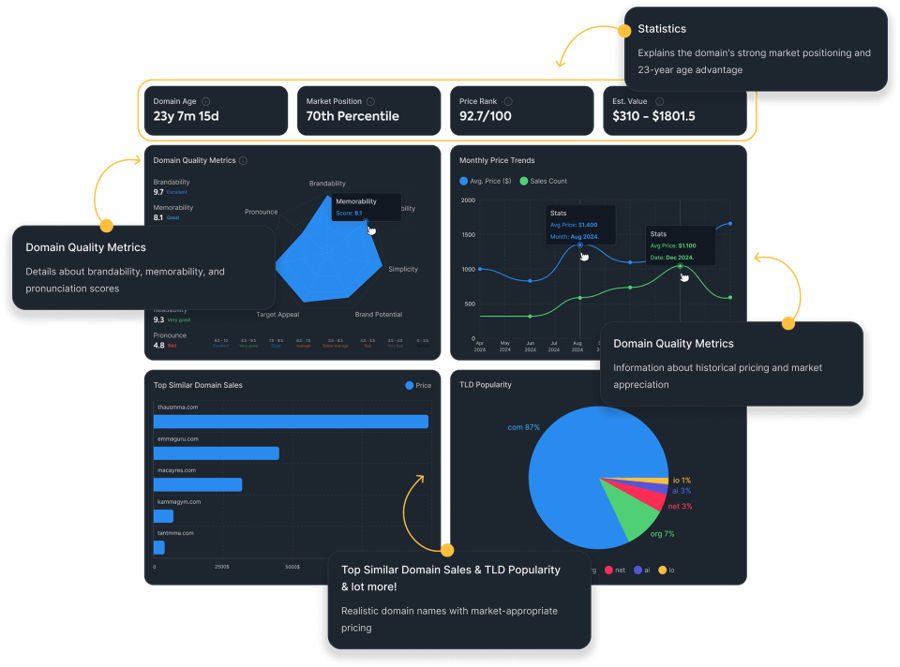
Treat that number as a starting point for negotiation, not a guarantee because it’s built on patterns across thousands of past sales, but every domain has a unique context that a model can’t fully capture.
Review Comparable Sales
From there, cross-reference manually. Search NameBio or its alternatives for the closest comparable sales you can find with the same or similar keyword, same TLD, similar length, and look at what actually closed, not what’s listed.
Recent NameBio data shows daily sales volumes running into the hundreds of thousands of dollars across thousands of individual transactions, so for almost any common keyword pattern, there’s real comparable data available if you look.
DomainNameWire’s recent transaction reports are useful for the same reason. They cover notable sales as they happen, which gives you a sense of where current pricing actually sits, not where it sat two years ago.
Perform a Manual Valuation Check
Finally, validate everything manually.
Review:
WHOIS history
Backlink quality
Search demand
Brandability
Trademark risks
Potential buyer pool
Wayback Machine for content history
If the appraisal tool’s estimate, the NameBio comparables, and your manual history check all roughly agree, you have a domain you can buy with confidence. If not, say, a strong appraised value sitting on top of a spammy backlink history, that’s your signal to dig deeper before paying anything.
What Are the Red Flags to Check?
Some domains appear valuable at first glance but fail under real scrutiny. Know the common red flags to avoid buying a liability. The four patterns below show up constantly in seller listings, and each one is checkable before you pay.
Common warning signs to check include:
A high asking price with no comparable sales data.
Blacklisted or deindexed domains.
Hyphens, numbers, and non-.com TLDs sold at .com-equivalent prices.
Inflated domain authority from spam backlinks.
Is Domain Flipping Still Worth It in 2026?
Yes, but selectively. The era when almost any short, dictionary-word .com could be hand-registered for $10 and resold for thousands is over; that low-hanging fruit got picked clean years ago. What’s left requires real research instead of luck.
The best current opportunities sit at the intersection of emerging categories and genuine authority. AI-related domains are the obvious example right now.
Based on my research, domain flipping remains profitable for investors who focus on:
Emerging industries
Expired domains with real authority
Strong brandable names
Undervalued marketplace listings
The biggest mistake newcomers make is expecting quick profits. To be successful in flipping domains, evaluate hundreds of opportunities before acquiring a single domain.
FAQ
What makes a domain name valuable?
A domain becomes valuable when it combines strong buyer demand, scarcity, brandability, keyword relevance, quality history, and a desirable extension. High-value domains are typically easy to remember, easy to spell, commercially relevant, and attractive to multiple potential buyers rather than a single niche audience.
How do I know if a domain is worth buying?
Evaluate the domain against the six signals outlined above, run it through an appraisal tool to get a baseline estimate, then cross-check that number against comparable sales on NameBio and DNJournal. Pull the WHOIS history and check the backlink profile manually before paying. If the automated estimate and the manual checks agree, you’re likely looking at a fair price.
What is the most valuable type of domain?
Short, pronounceable .com domains built around high-demand keywords remain the most consistently valuable category. Premium one-word domains, two-word commercial domains, strong AI-related domains, and highly brandable names with broad business appeal consistently attract the highest buyer demand and resale values.
How do I find undervalued domains?
Look beyond standard marketplace listings. Monitor expired domain auctions, place backorders, participate in investor communities, track emerging industries, and use monitoring tools to identify domains approaching expiration. Many of the best opportunities appear before they become obvious to the wider market.
Apply the Framework
The biggest misconception in domain investing is that high-value domains are obvious.
They're not.
The highest-performing investors consistently identify opportunities before demand becomes visible to everyone else. They evaluate every acquisition using the same framework: length, TLD quality, keyword demand, age, authority, and market timing.
Before purchasing your next domain, score it against all six signals.
Then run it through Bishopi's appraisal tool, validate the results with comparable sales, and track promising opportunities with the domain monitor.
The earlier you identify value, the less you'll have to pay for it.
Originally published at: bishopi.io
Stay up to date
Get updated with all the news, update and upcoming features.